
STCrushers Is A Professional Minging Equipment Manufacturer since 2004, Providing High Quality Crushers, Sand Making Machines, Drying Equipment and more.
STCrushers Is A Professional Minging Equipment Manufacturer since 2004, Providing High Quality Crushers, Sand Making Machines, Drying Equipment and more.
A truck arrives carrying broken concrete, bricks, asphalt, exposed rebar, wood, plastic, soil, and interior finishing debris. From a distance it looks like one pile of construction waste. To a crusher, it is several different materials mixed together.
Construction waste recycling begins here. The first useful decision is not the crusher model, but which part of the load belongs in an aggregate process at all.
Concrete, masonry, brick, asphalt, and natural stone can form a mineral fraction that may be processed for reuse. Wood, plastic, insulation, gypsum board, soil, and other contaminants may need a different route. Materials suspected of containing asbestos, lead, or other regulated contamination should be assessed and handled under local requirements before they are mixed into crusher feed.
The excavator operator can often see the difference before the crusher does. Large timber, plastic sheets, cable, insulation, loose soil, and obvious metal can be removed while the material is still spread out and easy to inspect.
Early sorting matters because crushing everything smaller only makes unwanted material harder to separate later. Wood can become many light fragments, while soil can become mixed into fine recycled aggregate.
Feed cleanliness is therefore part of recycling performance. A crusher may accept a mixed load mechanically, while the final product still loses value if non-mineral material follows the concrete through the circuit.
Concrete with reinforcing steel is common in demolition work. The concrete itself can often be crushed, but the steel should not be treated as ordinary aggregate.
Where practical, long exposed rebar should be cut or removed before feeding. After primary crushing releases steel that was embedded inside the concrete, a magnetic separation step can remove ferrous metal from the material stream before it reaches later crushing, screening, or conveying stages.
Recovered steel has its own recycling value, while cleaner mineral material is easier to grade consistently. Primary crushing can expose embedded metal, but another operation is usually needed to separate it.
A demolition load can contain many materials that are physically crushable but commercially undesirable in the recycled mineral product.
Wood and plastic can become light contamination in stockpiles. Soil and wet fines can affect screening and increase the amount of dirty fine material. Gypsum and interior finishing debris can change the chemical and physical character of the recycled material. Glass and other fragments may require their own evaluation depending on the intended product.
The recycling route should therefore protect the mineral fraction rather than trying to force every material into one product. Cleaner input gives the crusher and screen a much easier job later.
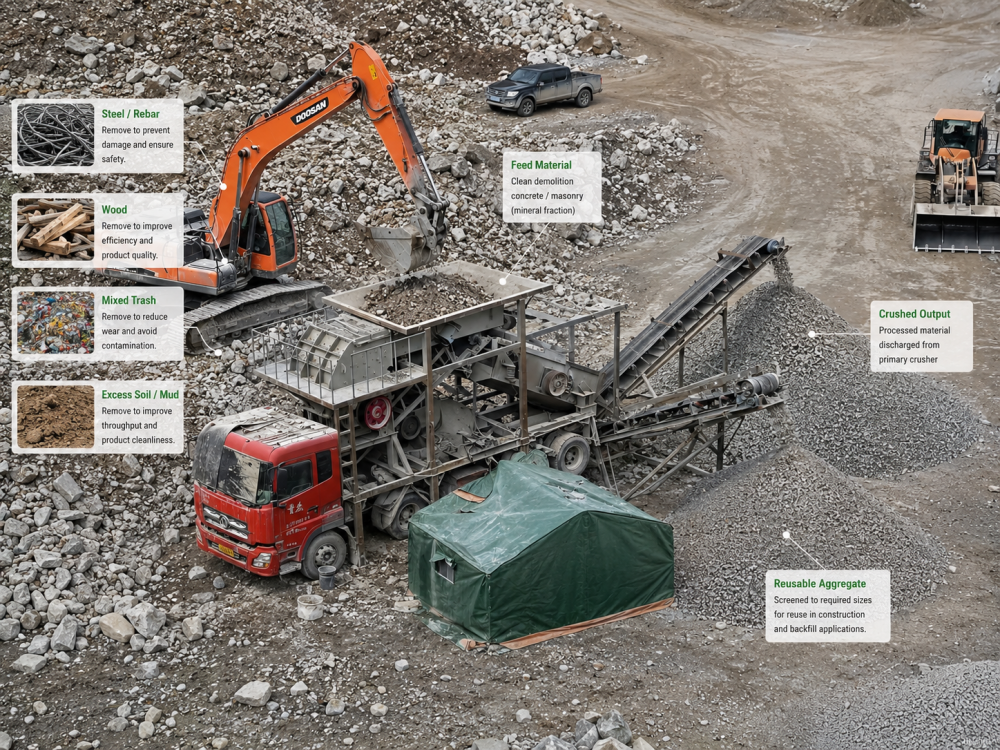
Once the incoming material is mainly concrete, masonry, brick, asphalt, or stone, the process begins to look more like an aggregate plant.
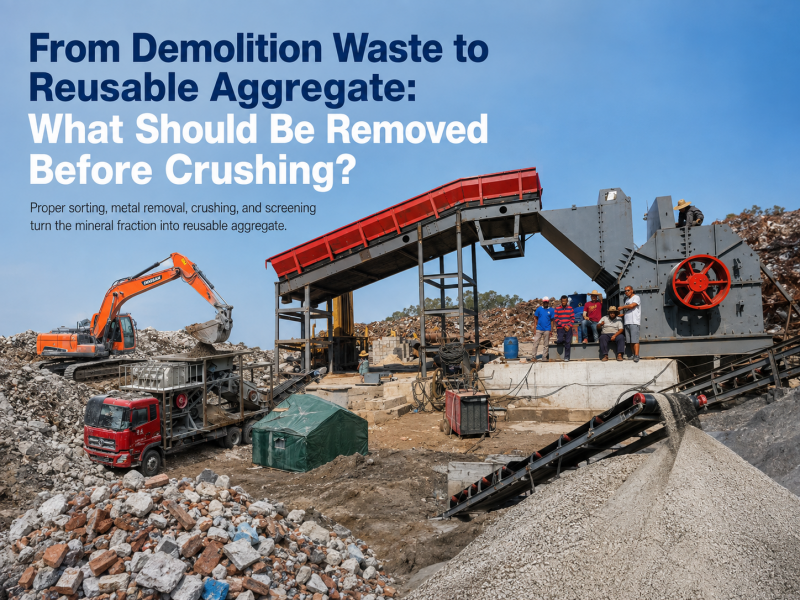
Large concrete pieces may first need a jaw crusher to reduce size and open embedded reinforcement. An impact crusher can be considered for further reduction of concrete and other brittle demolition material when product size and shape require a second stage. The exact route still depends on maximum feed size, concrete strength, contamination, required capacity, and the final use of the recycled product.
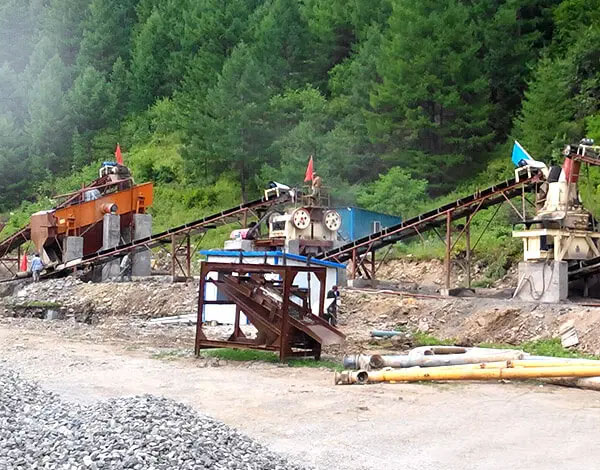
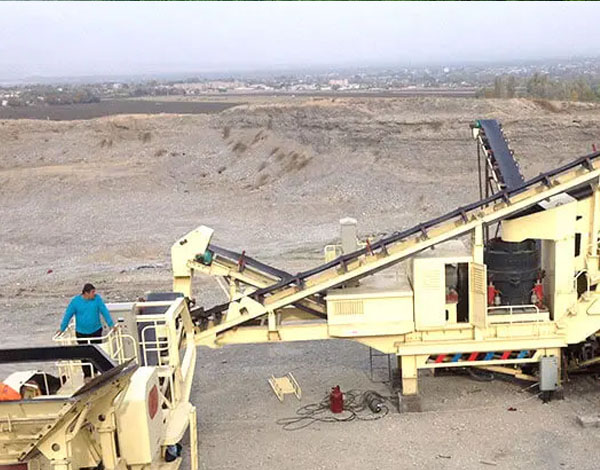
A mobile crusher becomes relevant when demolition material can be processed close to where it is generated. The value depends on project duration, relocation frequency, power conditions, site space, and where the recycled product will be used.
After crushing, the material is smaller but still contains a range of particle sizes. A screen separates those sizes into useful product fractions and identifies oversize that must return for more crushing.
A project might require a fine fraction such as 0-5 mm together with larger recycled aggregate sizes, or it may need only a broad base-course material. The screen arrangement should follow the actual end use rather than copy a quarry configuration automatically.
If light material, soil, or metal continues to appear in one fraction, the problem may be upstream sorting rather than the screen itself.
Not every recycled aggregate needs the same level of control. Material intended for temporary roads, general fill, or some base applications may have different requirements from aggregate intended for concrete or another tightly specified product.
That distinction changes the process. A modest end use may need simple sorting, crushing, and screening. A higher-value product may require tighter feed control, more separation, precise grading, and testing against the relevant local specification.
The safe commercial message is not that demolished concrete can always replace natural aggregate. It is that selected mineral demolition material can be processed into reusable aggregate when the input is controlled and the finished product is matched to an appropriate use.
Construction waste is different from quarry stone because the raw material appears wherever demolition takes place. That creates a logistics choice before equipment is purchased.
A fixed recycling yard can receive material from many projects and justify permanent infrastructure. An on-site mobile system can reduce the need to move bulky rubble away before processing, especially when the recycled aggregate will be reused near the same project.
Neither route is automatically cheaper. Transport distance, project duration, space, dust and noise restrictions, power supply, and the market for recycled aggregate all influence the decision. Mobile equipment is most useful when mobility solves a real site problem.
Return to the truckload that arrived at the beginning. The original pile was mixed demolition waste. After sorting, the wood, plastic, soil, regulated material, and other non-mineral fractions have been directed elsewhere. Reinforcing steel has been removed before or after primary crushing. The remaining mineral material has been crushed and screened into controlled sizes.
At this point the project can ask a product question rather than a waste question. Is the recycled aggregate clean enough, correctly graded, and suitable for the intended use? If not, more crushing alone may not fix it. Feed preparation or separation may need to change.
This is why construction waste recycling should be designed from the incoming material and the final use at the same time. The crusher sits in the middle of that decision, not at the beginning.
A crusher reduces particle size. It does not decide which demolition materials belong together, remove every contaminant, define the market specification, or guarantee that the final aggregate is suitable for a particular structural use.
The value of a construction waste recycling line comes from the sequence around the crusher: separate what should not enter, expose and recover steel, reduce the mineral fraction, screen it into useful sizes, and match those products to realistic applications.
Sentai Machinery can review demolition material photos or video, maximum concrete size, rebar condition, contamination, required capacity, target recycled aggregate sizes, available site space, and mobile or stationary operating needs before recommending a practical crushing and screening route.

 WhatsApp
 Email
Email
 +86 15538010601