
STCrushers Is A Professional Minging Equipment Manufacturer since 2004, Providing High Quality Crushers, Sand Making Machines, Drying Equipment and more.
STCrushers Is A Professional Minging Equipment Manufacturer since 2004, Providing High Quality Crushers, Sand Making Machines, Drying Equipment and more.
A buyer sends a short message: Can your box crusher crush limestone and coal gangue?
The answer may be yes, but that answer is not enough for equipment selection. Limestone and coal gangue can both be crushed by a box crusher in many cases, but the real result depends on feed size, hardness range, moisture, clay content, discharge target, and how strict the finished product requirement is.
This is where many crusher quotations become misleading. A simple crusher may fit the project very well when the material is brittle and the process requirement is not too complex. The same simple crusher may become the wrong choice if the material is too hard, too wet, too abrasive, or if the buyer expects strong aggregate shaping.
A box crusher should be judged by its application boundary. The useful question is not only whether it can crush the material. The useful question is whether it can crush that material steadily under the planned feed condition and final product requirement.
In crusher selection, suitable should not only mean the machine can break the stone once during a test. It should mean the machine can operate with acceptable wear cost, stable discharge size, reasonable power use, and manageable maintenance in daily production.
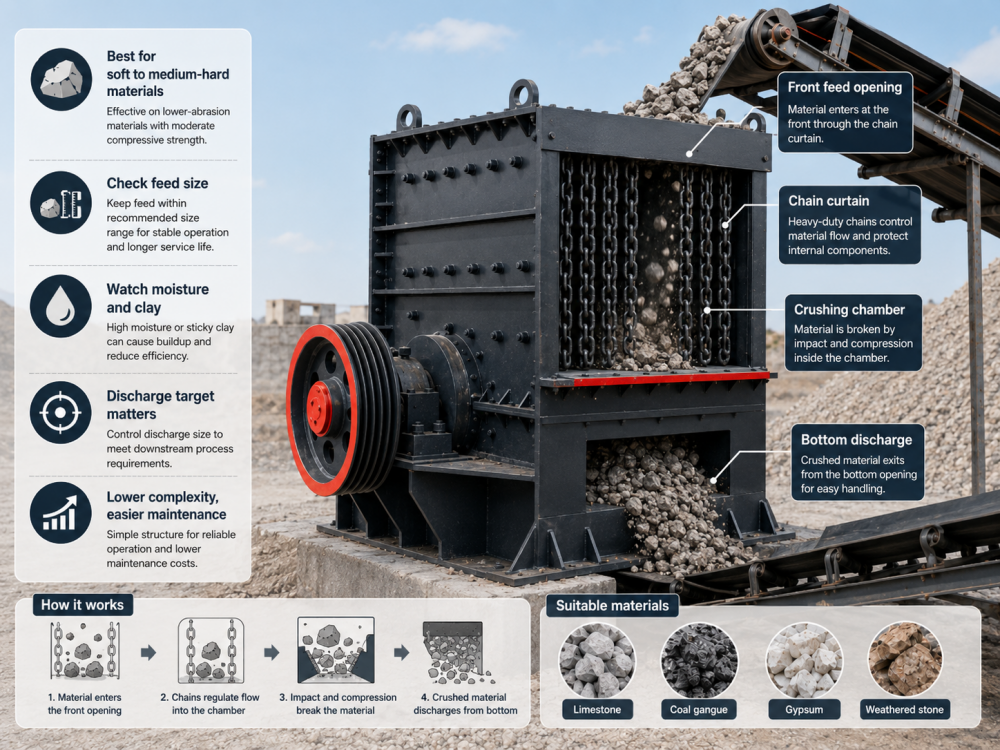
For a box crusher, the strongest value usually comes from simple structure and practical crushing of soft to medium-hard, brittle materials. This can make it useful in limestone, coal gangue, shale, gypsum, and similar applications when the process goal is clear.
But simple structure is not the same as universal application. If the buyer treats one crusher as a solution for every stone, the risk usually appears after installation, not during the first quotation.
Before choosing a box crusher, the first detail to confirm is how the material breaks.
Brittle materials usually fracture more easily under impact and hammering action. Materials such as limestone, coal gangue, shale, and gypsum may fit this type of simple crushing route when the hardness and feed size are within a reasonable range.
Very hard or highly abrasive rock behaves differently. Granite, basalt, quartz-rich stone, and some river stone materials may increase wear quickly or require a more controlled multi-stage crushing route. In these cases, jaw crusher, cone crusher, impact crusher, or VSI shaping may be safer depending on the final product requirement.
Material name alone is not enough. Two limestone sources may have different density, hardness, clay content, and breakage behavior. A buyer should provide real photos, videos, maximum feed size, and if possible, basic hardness or compressive strength information before confirming the crusher model.
A box crusher may accept relatively large feed for suitable materials, but feed size still has limits. Oversized material can increase impact load, create unstable feeding, and shorten wear part life. If large blocks enter too frequently, the machine may run, but the production will not feel smooth.
The discharge target is just as important. Some projects only need crushed material for general building material, road base, or further processing. In that situation, the box crusher may be practical if the product size requirement is not too strict.
If the buyer needs clean aggregate with strong particle shape control or multiple narrow product grades, the box crusher alone may not be enough. Screening, return material control, and sometimes another crusher type may be needed.
A crusher should be selected around the actual finished product, not only around the raw stone.
Moisture and clay can change a simple crushing job into an unstable one.
Dry, brittle material usually feeds and discharges more easily. Wet or clay-rich material may stick, reduce screening efficiency, increase blockage risk, and make the finished material less clean. If the raw material comes from a wet stockpile or contains clay layers, the plant may need pre-screening, washing, or better stockpile management before crushing.
Wear also needs early attention. Hammer heads, liners, screen plates, and other wear parts should be matched with material hardness and abrasiveness. A low purchase price is not helpful if the plant later spends too much on frequent wear part replacement.
For soft and medium-hard materials, a box crusher can be economical. For abrasive materials, the wear cost may change the final decision.
Project condition | Box crusher fit | Safer alternative or action |
Limestone, coal gangue, shale, gypsum, or similar brittle material | Often suitable | Confirm feed size, moisture, and discharge target |
Very hard or highly abrasive rock | Usually not first choice | Consider jaw crusher, cone crusher, impact crusher, or staged crushing |
Strict cubic aggregate shape requirement | May need support | Add impact crusher or VSI shaping when shape control is important |
Wet or clay-rich feed | Use caution | Improve feeding, pre-screening, washing, or stockpile control |
Simple secondary crushing with moderate shape demand | Can be practical | Match with vibrating screen and conveyor layout |
A box crusher can be useful when the project does not need a complicated crushing route. For suitable soft or medium-hard brittle materials, it may reduce the number of crushing stages and keep the process easier to operate.
This is especially useful in small and medium projects where the buyer wants moderate capacity, a simple layout, easier maintenance, and acceptable finished product size. If the line also includes a vibrating screen, the finished material can be separated more clearly and oversized material can be controlled.
In this kind of project, the advantage is not only the crusher itself. The advantage is that the whole line may become easier to arrange. Fewer machines can mean less foundation work, fewer conveyors, simpler maintenance, and a clearer operation flow.
Still, this only works when the material and product requirement match the machine. A simple line should not be forced onto a complex material.
There are also cases where a box crusher should not be the first choice.
If the raw material is very hard or abrasive, a jaw crusher for primary crushing and a cone crusher or impact crusher for secondary crushing may be more suitable. If the buyer needs better cubic aggregate shape, an impact crusher or VSI sand making machine may be needed after primary crushing. If the project needs high capacity limestone crushing with a simplified route, a heavy hammer crusher may be compared with the box crusher.
For wet and sticky material, the safer choice may not be a different crusher immediately. It may be to add screening, washing, or feeding control before the crusher. The process around the machine can be more important than the machine name.
Choosing another crusher is not a sign that the box crusher is weak. It simply means the project requirement has moved outside its best application range.
A useful box crusher quotation needs more than a product name. The buyer should send the material name, photos or videos, maximum feed size, expected discharge size, capacity target, moisture condition, clay content, and final use of the crushed material.
It is also helpful to explain whether the crusher will work alone, after a jaw crusher, before a vibrating screen, or inside a complete stone crushing plant. These details affect model selection, motor power, wear part configuration, screen matching, and conveyor layout.
If the project is still uncertain, a supplier can first give a practical selection path instead of a fixed quotation. This reduces the risk of choosing a machine that looks affordable but does not fit the site.
A box crusher can be a practical choice for suitable soft and medium-hard brittle materials. It can help simplify the crushing process and reduce equipment complexity in the right project.
The key is to respect its application boundary. Material behavior, feed size, discharge target, moisture, clay, wear, screening, and final product use should all be checked before model selection.
A simple crusher works best when the project conditions are also simple enough for it. When the material is harder, wetter, more abrasive, or the product shape requirement is stricter, another crushing route may be the safer investment.
If you are considering a box crusher for limestone, coal gangue, shale, gypsum, or other soft and medium-hard materials, Sentai Machinery can help review your material condition, feed size, discharge target, capacity, moisture, clay content, and site layout.
Share your material photos or videos, expected output size, capacity requirement, and final application. Our team can help recommend whether a box crusher or another crushing configuration is more suitable for your project.
1. Impact Crusher or Hammer Crusher: Which One Fits Limestone Crushing Better
2. Limestone, Granite, or River Stone: How Raw Material Changes Crushing Process Design
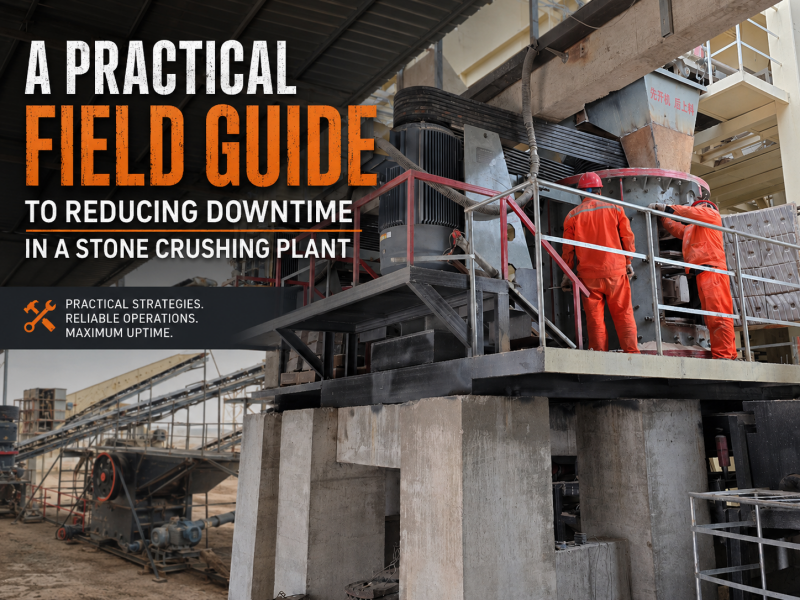
3. A Practical Field Guide to Reducing Downtime in a Stone Crushing Plant
4. Why Is There Too Much Stone Powder in Manufactured Sand
5. Mobile Crusher Project Planning: When a Portable Crushing Setup Makes More Sense


 WhatsApp
 Email
Email
 +86 15538010601