
STCrushers Is A Professional Minging Equipment Manufacturer since 2004, Providing High Quality Crushers, Sand Making Machines, Drying Equipment and more.
STCrushers Is A Professional Minging Equipment Manufacturer since 2004, Providing High Quality Crushers, Sand Making Machines, Drying Equipment and more.
Consider a hypothetical mineral supplier with spare drying hours and an enquiry for a second granular product. Sharing the existing line could avoid another equipment purchase. Before accepting the order, however, the supplier needs to know what happens between the final tonne of the first product and the first acceptable tonne of the next.
Using one rotary dryer for different materials can work when both feeds suit the installed system, carryover meets product limits, and changeovers leave enough productive time. Each material needs its own confirmed operating conditions and capacity basis.
The second customer's specification gives the review a starting point. Final moisture matters, but colour, chemical purity, particle size, and discharge temperature may also determine acceptance. A trace of the previous product could be harmless in one application and unacceptable in another.
Define the permitted carryover and how it will be measured before discussing cleaning time. Two grades of a compatible mineral may offer a realistic starting point for shared drying, subject to verification. A clean, pale product following a darker feed deserves closer scrutiny. The commercial decision depends on the actual specification, including requirements that a moisture test cannot reveal.
An industrial rotary dryer works within limits set by its drum, internals, heating system, drive, fan, and exhaust treatment. Feed rate, heat input, and other available controls offer adjustment within those limits. A different material may still require changes that cannot be made through the control panel.
Wetter feed increases evaporation duty. A finer or lighter feed can change dust entrainment, while sticky material may build up instead of forming a useful curtain. Rotary dryer flight design explains why the same lifters can behave differently as feed properties change. Corrosion resistance and allowable product temperature also need review.
Upstream preparation belongs in this assessment. The guide to pre-dewatering before rotary drying explains how removing separable water changes thermal duty. Different incoming moisture conditions can therefore produce different dry-output capacities on the same line.
Record whether each quoted rate refers to wet feed, dry solids, or finished product. A comparison becomes meaningful only when these capacity bases and their associated moisture conditions are clear.
Material can remain in feed hoppers, chutes, flights, discharge equipment, and collection points after normal production stops. Where captured dust returns to the product, the recovery circuit also becomes a possible route for mixing the two materials.
A changeover review should follow these shared contact points through to storage and loading. Emptying the drum alone does not establish that the next product is free of residue. Cleaning access, the permitted cleaning method, and handling of removed material all affect the interruption. For an existing line, inspect the actual arrangement; a general equipment drawing may not show later modifications or places where deposits have formed.
Review both switching directions. Returning to the first product may involve different residue limits or cleaning demands. Evidence from one successful changeover should not automatically be applied to the reverse sequence.
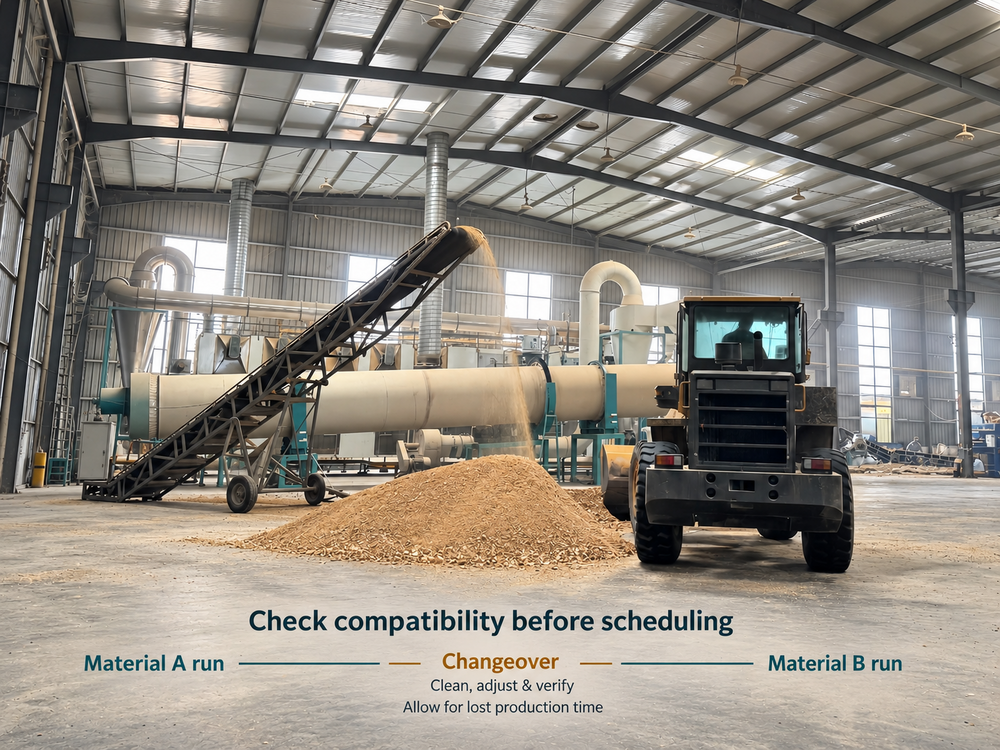
Switching feed creates a transition period. Previous material may still be moving through the system while temperatures, loading, and moisture removal adjust to the new conditions. The first discharge may contain mixed material or fail the new moisture target.
Agree how transition output will be separated, sampled, and assessed before it reaches the saleable stockpile. Moisture results establish dryness; additional checks may be needed for composition or appearance. Release the new product against its agreed acceptance criteria and a representative sampling plan. Neither a universal waiting time nor one convenient spot sample provides a reliable rule for every changeover. Reworking transition material also needs an approved destination and a cost allowance.
The hypothetical supplier now has two capacity questions: how fast each product can run under suitable conditions, and how many useful production hours remain between switches. Both affect the delivery promise.
Build the schedule using the confirmed saleable-output rate for each material. Allow for emptying, cleaning, necessary cooling or reheating, adjustment, and quality confirmation, accounting for activities that can overlap. Also include transition material that must be held, reworked, or discarded. Multiplying one catalogue TPH figure by every scheduled hour would hide these losses.
Longer runs may spread changeover costs over more tonnes, provided orders and storage permit. Frequent small orders can consume the apparent spare capacity. Compare capital saved against labour, restart energy, transition losses, extra stockholding, and delayed shipments. The useful measure is the cost and quantity of accepted product delivered over a realistic production period.
Dedicated drying deserves consideration when both products need continuous production, carryover tolerances are difficult to achieve, or each switch requires substantial mechanical work. A shared installation can become an expensive compromise if neither product runs efficiently.
Compatibility also has a firm technical boundary. Changing from an inert mineral to a combustible or chemically reactive feed requires a separate engineering assessment of the complete system. Suitable construction materials, heating arrangements, and exhaust treatment cannot be assumed from drum dimensions. Even a three cylinder sand dryer selected for one sand duty needs review before another feed is accepted. A product family's broad application range does not establish interchangeability for an installed unit.
Develop the evidence around both products and the switch between them. Representative drying tests can establish behaviour and suitable operating conditions for each feed. For an existing installation, engineering review should determine whether a controlled changeover trial is appropriate and what it must demonstrate.
Record accepted output, moisture consistency, residue findings, transition losses, and time to return to stable production. Testing each material separately leaves the carryover question unresolved. If a cleaning requirement or product limit remains unverified, keep that uncertainty in the investment and delivery assessment until evidence resolves it.
A shared dryer earns its place when it can deliver both products at the required quality and on the required schedule. Count the time and material consumed between production runs alongside normal drying performance. Those changeovers can determine whether the second order creates useful revenue.
Planning to dry two materials on one line? Send Sentai Machinery their descriptions, representative moisture and particle-size data, finished-product requirements, order quantities, and expected switching frequency. For an existing dryer, include its configuration and operating records. We can review the proposed duties and identify what needs confirmation before recommending a shared drying arrangement.
Should Wet Material Be Dewatered Before a Rotary Dryer? When Pre-Dewatering Reduces the Drying Load
How Different Materials Change Rotary Dryer Design
Rotary Dryer Flight Design: Why Material Curtain Quality Changes Drying Efficiency
Rotary Dryer Feed Moisture Fluctuation: Why Fuel Use and Discharge Moisture Become Unstable
Sand Drying Plant Design: What Changes When the Final Moisture Target Is Strict




 WhatsApp
 Email
Email
 +86 15538010601