
STCrushers Is A Professional Minging Equipment Manufacturer since 2004, Providing High Quality Crushers, Sand Making Machines, Drying Equipment and more.
STCrushers Is A Professional Minging Equipment Manufacturer since 2004, Providing High Quality Crushers, Sand Making Machines, Drying Equipment and more.
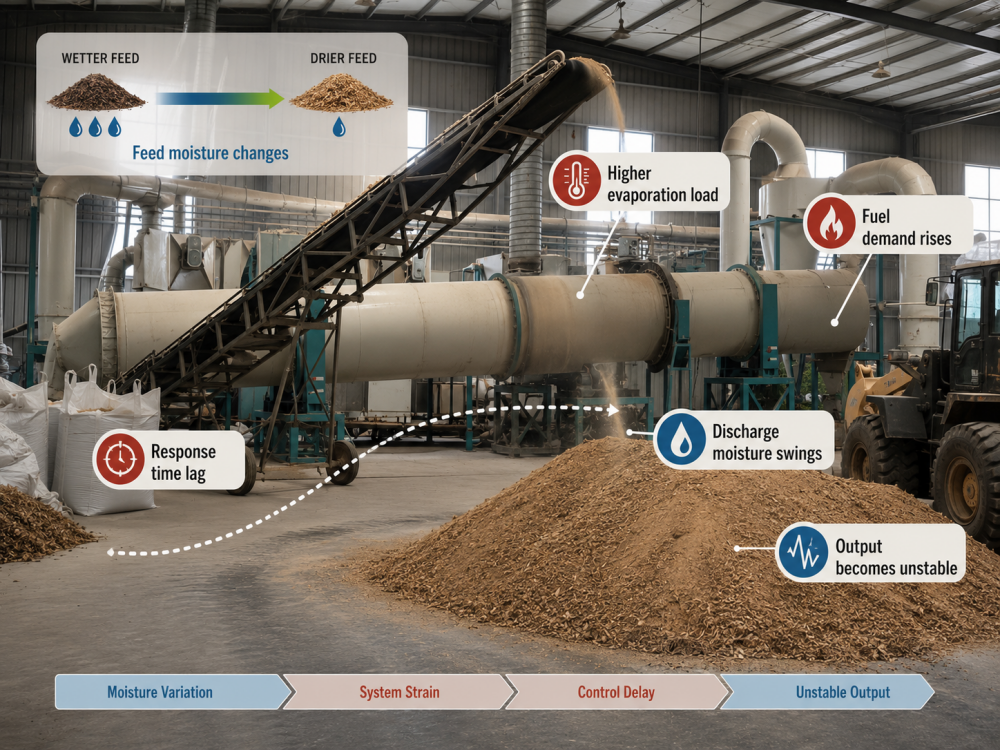
The feeder still shows the same tons per hour. Burner setting, drum speed, and induced draft also appear normal. After a period of operation, however, the discharged material becomes wetter. The operator raises the fuel rate, but the next material leaving the dryer becomes too dry.
This sequence often begins with a change in feed moisture.
A rotary dryer processes both solid material and the water contained in it. If wet feed tonnage stays constant while initial moisture rises, the evaporation load increases even though the feeder display does not move. Because material needs time to travel through the drum, the effect appears at the discharge end later. Fuel adjustment based only on the latest product sample can therefore arrive too late and become too large.
Wet material input and water evaporation are different operating values.
Consider a simplified example. A dryer receives 10 tons per hour and the target final moisture is 5 percent. At 20 percent feed moisture, about 1.58 tons of water must be removed per hour. At 30 percent feed moisture, evaporation demand rises to about 2.63 tons per hour.
The feeder still shows 10 tons per hour, but the dryer must remove more than one additional ton of water each hour. This excludes heat losses and material-specific behavior, yet it shows why wet tonnage alone cannot describe dryer load.
If the system has no thermal margin, discharge becomes wetter, feed rate must be reduced, or fuel demand rises.
Feed moisture does not affect final product immediately.
Material must move from the inlet to the discharge end while it is lifted, scattered, heated, and turned. Response time depends on material condition, drum speed, internal lifting structure, feed rate, and airflow.
A wet batch entering now may not appear as high discharge moisture until later. By then, it may already be near the end of the drum.
The latest discharge sample therefore represents earlier feed conditions, not the material currently entering.
When wetter material enters, more heat is used for evaporation. The material may heat more slowly, and the existing residence time may no longer be enough to reach the same final moisture.
Possible results include higher discharge moisture, lower discharge temperature, increased burner demand, and reduced practical throughput. Moisture can also increase stickiness and make material harder to spread inside the drum.
Increasing temperature can help only within the safe operating range. If material cannot form a suitable curtain, extra heat may dry the outside while moisture remains inside wet lumps.
The first correction may not produce an immediate result. The operator raises fuel, sees little change, and raises it again. Meanwhile, the added heat has not yet reached the discharge result being measured.
When the wet batch finally leaves, the dryer may still be operating at the higher fuel setting. If the next feed is already drier, the system now has more heat than required.
<!--[if !supportLists]-->1. <!--[endif]-->Wet feed enters.
<!--[if !supportLists]-->2. <!--[endif]-->Discharge moisture rises later.
<!--[if !supportLists]-->3. <!--[endif]-->Fuel is increased.
<!--[if !supportLists]-->4. <!--[endif]-->The wet batch passes.
<!--[if !supportLists]-->5. <!--[endif]-->Feed becomes drier.
<!--[if !supportLists]-->6. <!--[endif]-->Product is overdried.
<!--[if !supportLists]-->7. <!--[endif]-->Fuel is reduced sharply.
The dryer can swing between wet and overdried product even without a mechanical fault.
After rain, material may be wetter and more likely to bridge in a hopper. A loader may alternate between a dry surface layer and a wet lower layer. Washed sand may also carry different amounts of free water.
Moisture, bulk density, and actual flow may change together. A fixed feeder speed does not always mean a fixed mass flow. Common causes include poor drainage, unstable dewatering, weak blending, limited buffer capacity, and intermittent loader feeding.
A useful operating record links signals by time instead of looking at isolated values.
Operators can record feed moisture, wet feed rate, fuel rate, inlet and outlet temperature, exhaust humidity where available, final moisture, weather, and feeding interruptions.
The timing relationship matters. A feed sample should be compared with the product produced after that material has passed through the drum, not with the product leaving at the same minute.
Observed change | Possible condition | First response |
Discharge becomes wetter after a delay | Feed moisture increased earlier | Check recent feed samples and heat trend |
Fuel rises but final moisture still swings | Repeated delayed correction | Reduce large step changes and review timing |
Outlet temperature rises after a wet period | Feed has become drier | Recheck current feed moisture |
Capacity falls after rain | Stockpile water load increased | Blend material and review feed rate |
Moisture changes between loader batches | Poor stockpile mixing | Improve blending and buffer storage |
The most stable correction usually begins upstream.
A covered or well-drained stockpile reduces rain-related changes. Blending material from different areas prevents a dry loader bucket from being followed by a saturated one. A buffer bin separates short feeding interruptions from continuous dryer operation.
Regular moisture sampling gives operators a better basis for adjustment. Online measurement may help in suitable applications, but correct installation and calibration still matter. Even a simple sampling schedule is better than changing fuel with no feed moisture record.
Upstream washing, filtration, or dewatering should also be reviewed. The dryer should remove the planned moisture load, not compensate for uncontrolled free water from the previous process.
Some projects cannot avoid wide moisture variation. Outdoor feed may change between dry and rainy seasons, material may come from several suppliers, or sludge may leave upstream equipment with a broad moisture range.
Selection should use minimum, normal, and maximum feed moisture rather than one average figure. The review should also consider burner adjustment range, airflow, residence time, feeding control, and the acceptable final moisture range.
A system designed only for average conditions may run well on normal days but lose output or product stability during wetter periods.
1. Material and physical condition.
2. Minimum, normal, and maximum feed moisture.
3. Wet feed capacity.
4. Target final moisture and acceptable range.
5. Particle size, lump condition, and stickiness.
6. Fuel type and burner adjustment range.
7. Feeding, blending, and stockpile method.
8. Working hours and downstream use.
A rotary dryer can absorb moderate variation, but it cannot correct unlimited changes in water load without affecting fuel, output, or final moisture.
Stable wet feed tonnage does not guarantee stable evaporation duty. Moisture changes take time to move through the drum, so discharge-based adjustment is naturally delayed. Large corrections can turn one wet period into the next overdrying period.
Better stability comes from controlling the complete chain: stockpile drainage, blending, buffer storage, continuous feeding, moisture measurement, heat adjustment, and time-aligned operating records.
Sentai Machinery can review a drying project according to the actual moisture range, wet feed rate, final moisture target, material behavior, fuel condition, and site feeding method. Minimum, normal, and maximum moisture data provide a more reliable basis for rotary dryer selection than one average value.
1. Why Wet Material Condition Matters More Than Dryer Model Alone
2. Why Is My Rotary Dryer Output Lower Than Expected
3. How Different Materials Change Rotary Dryer Design
4. How to Reduce Fuel Consumption in a Rotary Dryer
5. Sand Drying Plant Design: What Changes When the Final Moisture Target Is Strict






 WhatsApp
 Email
Email
 +86 15538010601