
STCrushers Is A Professional Minging Equipment Manufacturer since 2004, Providing High Quality Crushers, Sand Making Machines, Drying Equipment and more.
STCrushers Is A Professional Minging Equipment Manufacturer since 2004, Providing High Quality Crushers, Sand Making Machines, Drying Equipment and more.
The Crushers Machine Arrives, but Installation Still Slows Down
The container arrives on site. The main machine looks fine. The customer opens the boxes and starts checking the loose parts.
Now the real trouble begins.
Bolts are there, but not clearly grouped. Rubber seals are packed together with unrelated small parts. Electrical cables are present, but the site team is not fully sure which section they belong to. A few brackets and connectors are in the box, but nobody wants to guess where they should go.
This kind of delay is more common than many buyers expect.
In overseas equipment projects, the main machine is usually the easiest part to notice. Spare parts and loose accessories are where confusion often starts. And once confusion starts, installation slows down, communication becomes repetitive, and customer confidence drops.
The good news is that this problem is usually avoidable.
Why Spare Parts Confusion Becomes a Bigger Problem Than It Looks
Some people treat spare parts confusion as a small afterthought. It is not.
When accessories are not organized clearly before shipment, the result may include slower installation, repeated back-and-forth communication, uncertainty about whether something is missing, incorrect matching of parts, more pressure on the site team, and loss of trust during the first stage of project delivery.
This is especially serious in overseas projects because the supplier is not standing on site beside the customer. If the customer opens several boxes and cannot quickly understand what belongs to what, even a complete shipment can still feel confusing.
That is why accessory organization is part of delivery quality.
Which Parts Usually Create the Most Confusion
Not all loose parts create the same level of difficulty.
The most common trouble points are usually:
bolts and fasteners
rubber seals and sealing strips
electrical cables and control accessories
ducts and connectors
wear parts
mounting brackets
small accessories packed separately from the main machine
These parts are easy to underestimate because they are smaller than the main equipment body. But from the customer’s point of view, they often create more installation questions than the large machine itself.
A large drum, crusher body, or mill shell is visually obvious. A box of mixed fittings is not.
Why This Problem Happens
In many cases, spare parts confusion does not come from missing goods. It comes from weak preparation before shipment.
1. Parts are packed without clear labels.
2. Different items are mixed together.
3. Box numbers are not linked clearly to the packing list.
4. Shipment photos focus only on the main machine.
5. The supplier assumes the installers will figure it out later.
This is one of the most avoidable problems in overseas delivery.
Quick Management Table
Spare Part Type | What Usually Goes Wrong | Better Shipment Practice |
Bolts and fasteners | Mixed sizes packed together without function grouping | Sort by section and label clearly |
Seals and rubber items | Packed loosely with other accessories | Separate and identify by use location |
Electrical accessories | Cable sets not marked clearly | Label by machine section or control function |
Ducts and connectors | Similar-looking parts easy to confuse | Mark each piece and link to drawing or list |
Wear parts | Present but not clearly identified | Note quantity and use position clearly |
Accessory boxes | Box contents not easy to match with packing list | Number every box and match it to the document |
A Typical Wrong Delivery Scenario
A machine reaches the customer site successfully. The main body is unloaded without issue. Several accessory boxes also arrive.
At first, everything looks complete.
But once installation starts, the site team begins asking:
Which bolts belong to this support section?
Are these seals for the dryer inlet or outlet?
Which cable set belongs to the motor?
Is this bracket part of the feeder or the conveyor?
Is anything missing, or just packed in another box?
Now the supplier has to answer by message, photo, and memory. The customer starts opening every box again. The installation team loses time. The project feels less smooth than it should.
This is not always a production problem. It is usually a packing and identification problem.
What We Should Do Before Shipment
A better shipment practice usually includes the following steps.
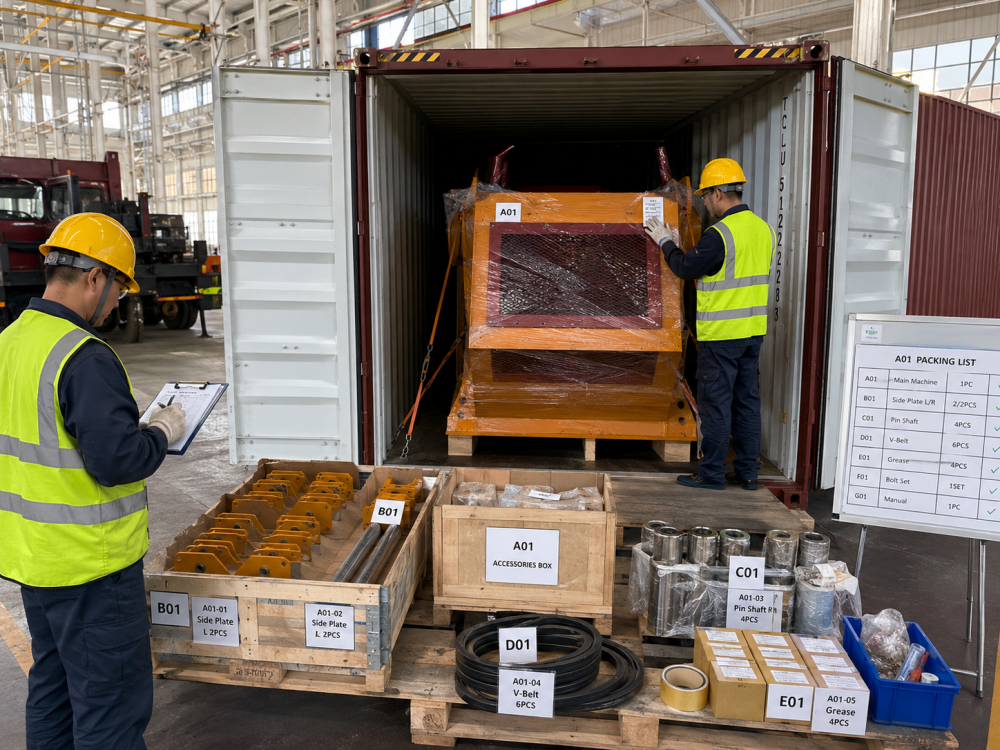
Separate by function.
Do not pack all small parts together just because they fit in one box. Group them according to machine section or function.
Label clearly.
Use simple but direct marking. A label should help the customer understand not only what the part is, but where it belongs.
Number every box.
Each box should correspond clearly to the packing list. If Box 3 contains feeder accessories, that should be obvious in both the marking and the document.
Connect accessories to documentation.
Packing list, shipment photos, and accessory labeling should support each other, not exist separately.
Take accessory photos.
Before shipment, photos of accessory boxes, grouped parts, and labels help reduce confusion later.
Avoid assuming the site team already understands everything.
What is familiar inside the factory is not always clear after overseas delivery. Good preparation should account for that difference.
What Buyers Should Check After Arrival
Once the shipment arrives, buyers can reduce confusion further by checking the following early:
Are all boxes and loose packages counted first?
Are box numbers consistent with the packing list?
Are small parts grouped by machine section?
Are unclear items photographed before installation starts?
Are wear parts separated from standard mounting parts?
Are electrical accessories checked carefully before connection?
This quick review helps the site team avoid disorder later.
Final Thought
In overseas equipment delivery, spare parts confusion is one of the most common avoidable problems.
The machine may be correct. The shipment may be complete. But if accessories are not grouped, marked, and documented clearly, installation can still become slower and more stressful than necessary.
At Sentai machinery, we understand that delivery quality is not only about the main machine. It also includes how loose parts, accessories, and spare components are prepared before shipment. A clearer accessory system usually means a smoother installation experience after arrival.
Planning an overseas equipment shipment? Contact Sentai machinery to discuss spare parts packing, accessory labeling, and delivery preparation before dispatch.
Related Articles:
How to Ship a Ball Mill Overseas: Container Loading and Packing Tips
How We Check a Rotary Dryer Before Shipment
What We Usually Confirm Before Quoting a Sand Making Plant
Suggested Solutions:








 WhatsApp
 Email
Email
 +86 15538010601