
STCrushers Is A Professional Minging Equipment Manufacturer since 2004, Providing High Quality Crushers, Sand Making Machines, Drying Equipment and more.
STCrushers Is A Professional Minging Equipment Manufacturer since 2004, Providing High Quality Crushers, Sand Making Machines, Drying Equipment and more.
A Strong Crusher Alone Does Not Guarantee a Smooth Plant
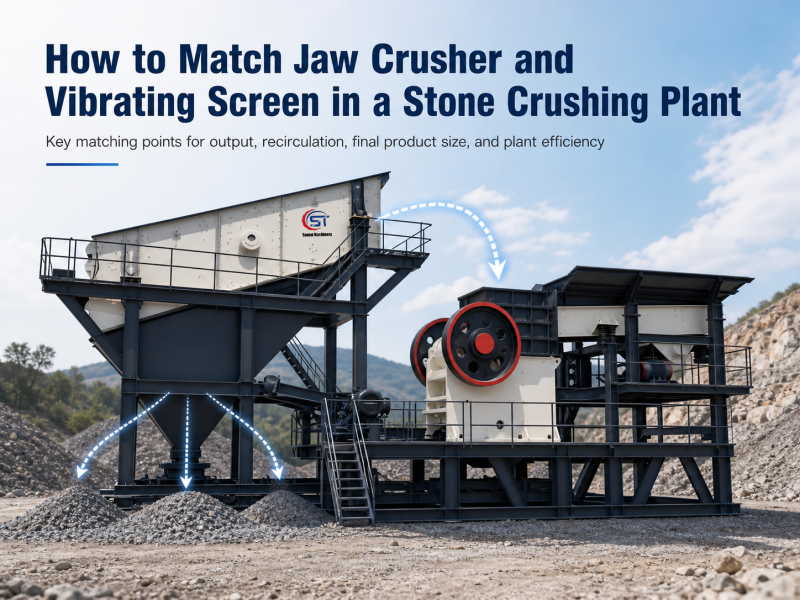
A stone crushing plant may use a reliable jaw crusher and still struggle with low efficiency, unstable product size, or too much return material. In many cases, the problem is not that the jaw crusher is weak. The problem is that the vibrating screen is not properly matched to the crusher discharge and the overall process goal.
This is a common situation in real plants. One machine may look capable on paper, but the line still feels slow, crowded, or unstable in operation. The reason is simple: in a crushing plant, matching matters as much as equipment quality.
A jaw crusher and a vibrating screen should not be selected as two separate machines. They should be selected as one working relationship.
Why This Matching Matters
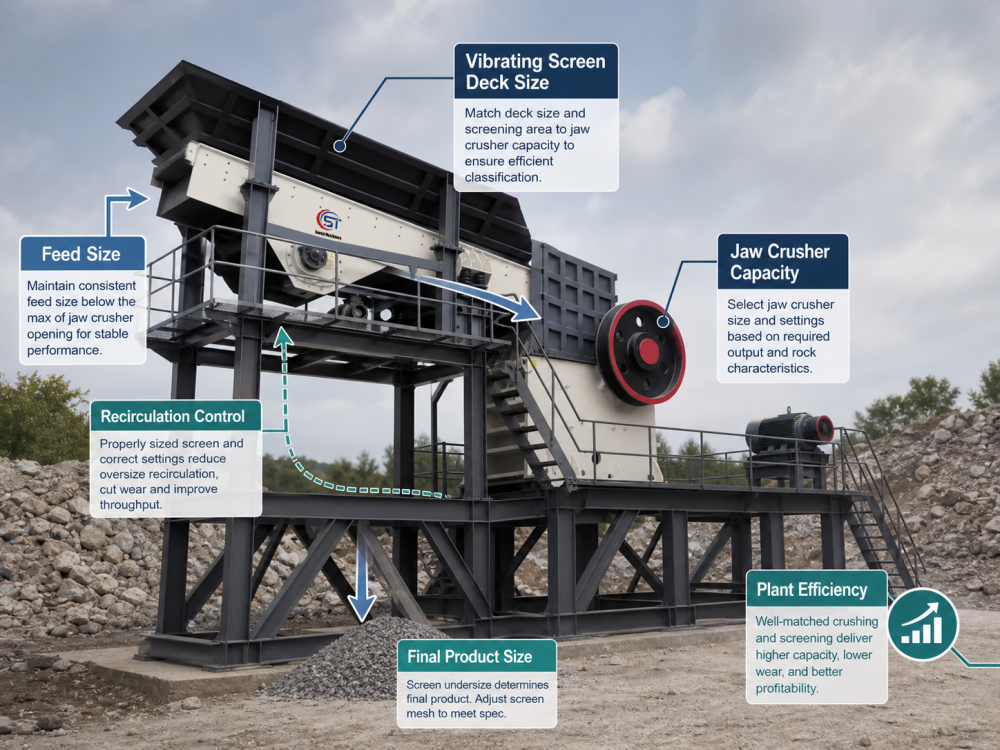
The jaw crusher decides how raw material is reduced in the first crushing stage. The vibrating screen decides how that crushed material is separated into usable product and return material. If the two are not matched well, the line may suffer from excessive recirculation, unstable final size, lower real output, unnecessary wear in later stages, and material flow congestion.
A plant with poor crusher-screen balance can look busy all day and still fail to produce smooth, efficient output. That is why this matching point deserves more attention than it usually gets.
What the Jaw Crusher Decides
The jaw crusher is responsible for the first stage of size reduction. Its discharge condition affects everything after it.
The most important factors include maximum feed size, crusher setting, actual discharge size range, and hourly throughput under real material condition.
If the jaw crusher produces material that is too coarse for the next stage, the screen and any return loop will face more pressure. If the discharge is too inconsistent, the screen cannot separate efficiently. If the crusher capacity is much higher or lower than the screen section can handle, the whole line becomes unbalanced.
So when buyers look at a jaw crusher, they should not only ask whether it can crush the stone. They should ask what kind of discharge and flow it creates for the screen that follows.
What the Vibrating Screen Decides
The vibrating screen is not just a sorting machine. In many plants, it is the section that determines whether the crusher output becomes final product efficiently or keeps circulating inside the system.
A good screen setup helps the plant separate finished sizes clearly, reduce unnecessary return material, improve product consistency, and keep downstream flow stable.
A weak or mismatched screen can create the opposite result. Even if the crusher works well, the line may still feel inefficient because the screen is unable to classify the material at the right speed or by the right size logic.
That is why the screen should be selected according to crusher discharge characteristics, target product sizes, and plant capacity.
5 Matching Points Buyers Often Miss
1. Jaw crusher discharge size versus screen mesh size
If the crusher discharge is too coarse relative to the screen arrangement, too much material may return for re-crushing. This increases internal load and lowers real production efficiency.
2. Capacity balance between crusher and screen
A jaw crusher and screen should be sized around the same realistic plant throughput. If one section is clearly stronger than the other, the weaker one becomes the bottleneck.
3. Number of final product sizes
A simple one- or two-size aggregate line does not need the same screen logic as a plant producing several finished products. More product types usually require more careful screen planning.
4. Material moisture and fines
Wet or fine-heavy material changes screen efficiency. Even a good crusher and good screen may not work well together if material condition was not considered early.
5. Return loop pressure
If too much material returns after screening, the problem may not be the crusher alone or the screen alone. It may be the match between crusher setting, product target, and screen mesh.
Quick Matching Table
Matching Point | What to Check | What Happens If It Is Wrong |
Crusher discharge versus screen mesh | Actual discharge size range and target mesh size | Too much recirculation or poor final separation |
Crusher capacity versus screen capacity | Real tph under site conditions | One section becomes the bottleneck |
Product size requirement | How many final sizes are needed | Plant logic becomes inefficient or unstable |
Material condition | Moisture, fines, and stickiness | Screen efficiency drops and flow becomes messy |
Return material balance | Volume of oversized return material | Line stays busy but finished output remains low |
A Typical Wrong Setup
A common wrong setup looks like this:
The jaw crusher is selected mainly for strong primary crushing. The screen is then chosen later, more by convenience than by process balance. On site, the crusher discharge turns out to be coarser than expected, the screen mesh arrangement is not ideal, and too much material enters the return loop.
The result is familiar: the line looks full, the return belt stays busy, the final product output feels lower than expected, operators keep adjusting the line, and wear and energy cost rise unnecessarily.
In this kind of case, buyers often blame one machine. But the real problem is the relationship between the two.
How to Think About Matching More Practically
A better way to match a jaw crusher and vibrating screen is to start from process questions, not machine names.
For example:
What is the maximum feed size entering the jaw crusher
What discharge size is realistic after primary crushing
How many final product sizes are required
Will the line operate with a closed return loop
How dry or wet is the raw material
What real capacity should the whole line reach
Once these answers are clear, the matching logic becomes much easier. The crusher can be judged by the material flow it creates, and the screen can be judged by whether it can separate that flow efficiently.
What to Confirm Before Final Equipment Selection
Before confirming a jaw crusher and vibrating screen in the same line, buyers should check these points carefully:
Is the jaw crusher discharge range suitable for the planned screen mesh sizes
Is the screen sized for realistic throughput, not catalog throughput
Does the plant need simple separation or multiple finished product grades
Will wet or fine-heavy material reduce screening performance
Is the return loop acceptable or already likely to be overloaded
These questions are more useful than comparing model numbers alone.
Practical Checklist
Question | Why It Matters |
What is the actual jaw crusher discharge size | It directly affects screen selection |
What is the real plant capacity target | The crusher and screen must be balanced around it |
How many product sizes are needed | This changes the screen logic |
What is the raw material condition | Moisture and fines strongly affect screening |
How much return material is acceptable | Too much return flow lowers real efficiency |
Is the process simple or multi-stage | The matching strategy changes with line complexity |
Final Thought
A jaw crusher and a vibrating screen should never be judged as isolated machines. In a stone crushing plant, their relationship affects flow, separation, recirculation, and overall production stability.
At Sentai machinery, we help customers match crushing and screening equipment according to raw material, target output size, plant capacity, and process logic. In many cases, a smoother plant comes not from a stronger single machine, but from better matching between the machines already in the line.
If you are planning a stone crushing plant or trying to improve an existing line, send Sentai machinery your raw material, feed size, target product sizes, and plant capacity for a more practical crusher-screen matching suggestion.
Related Articles:
How to Choose Equipment for a Stone Crushing Plant
A 100 TPH Stone Crushing Plant for Hard Rock: Recommended Configuration and Why
Why Is My Sand Production Line Output Too Low? 7 Common Causes and Fixes
Suggested Solutions :
80-100 tph Stone Crusher Plant
100-150 tph Stone Crusher Plant
 WhatsApp
 Email
Email
 +86 15538010601