
STCrushers Is A Professional Minging Equipment Manufacturer since 2004, Providing High Quality Crushers, Sand Making Machines, Drying Equipment and more.
STCrushers Is A Professional Minging Equipment Manufacturer since 2004, Providing High Quality Crushers, Sand Making Machines, Drying Equipment and more.
Two Suppliers, Two Different Suggestions
A buyer plans to build a limestone crushing line.
One supplier recommends an impact crusher. Another recommends a heavy hammer crusher.
Both sound reasonable. Both suppliers say their machine works well for limestone. Both quotations may even look attractive.
So the real question is not:
Can these machines crush limestone?
They both can.
The real question is:
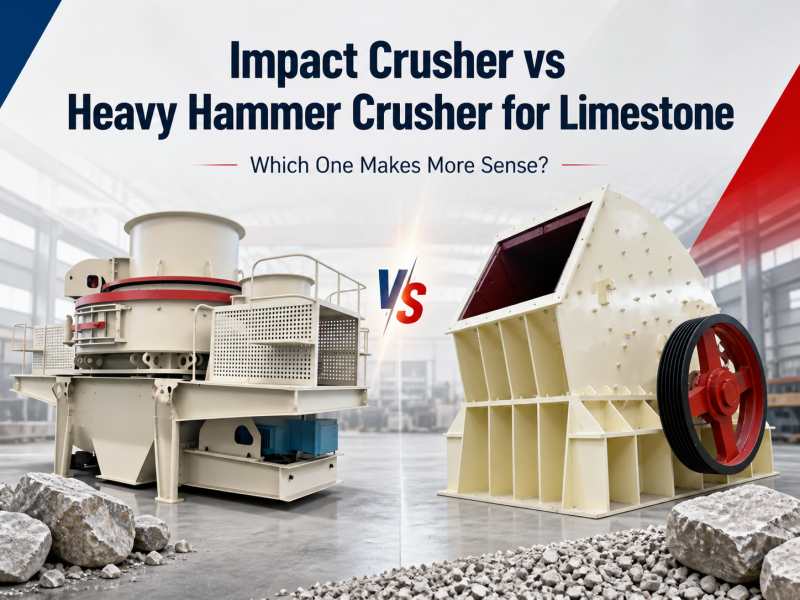
Which one makes more sense for this specific limestone project?
That decision depends on what the buyer really wants from the line:
a simpler process
better finished aggregate shape
easier maintenance logic
lower initial investment
better long term production balance
Limestone gives buyers more flexibility than very hard rock, which is exactly why this decision becomes important. Since limestone is easier to crush, both routes may look acceptable at first. But acceptable is not the same as suitable.
Quick Answer
If the project values better particle shape, staged crushing flexibility, and more control over final aggregate specification, an impact crusher often makes more sense.
If the project values a simpler process, a larger one step crushing ratio, and fewer machines in the line, a heavy hammer crusher may be the better choice.
That is the short answer.
But in real projects, buyers should go further than that.
What Makes Limestone Different in This Decision
Limestone is not granite or basalt.
It is softer, easier to crush, and often more forgiving in process design. That means buyers have more than one reasonable equipment route. In very hard rock projects, the equipment decision is often narrower. In limestone projects, the buyer has more room to choose between:
process simplicity
output control
aggregate shape
investment style
That flexibility is useful, but it can also create confusion.
A buyer may receive two different proposals and assume one supplier must be wrong. In reality, both may be technically possible. The real issue is which route fits the production goal better.
For example:
If the buyer wants multiple aggregate sizes with stronger shape control, the process may favor an impact crusher route.
If the buyer wants a more direct crushing layout with fewer stages, the process may favor a heavy hammer crusher.
So the limestone itself does not decide the machine alone. It decides the range of acceptable solutions.
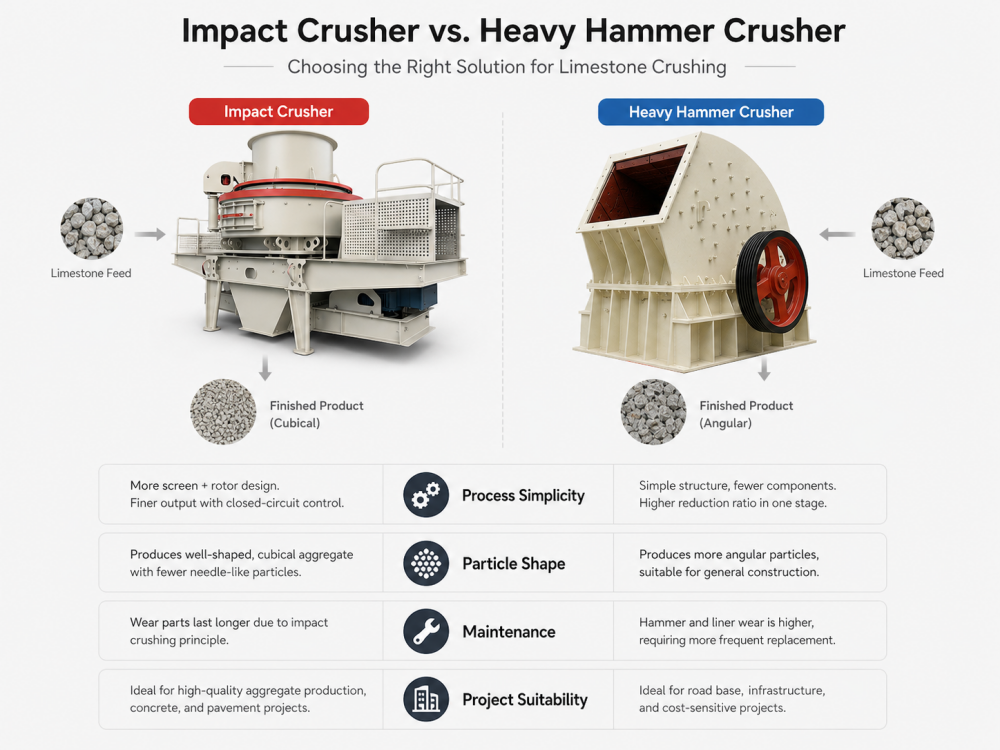
Main Comparison Table
Comparison Point | Impact Crusher | Heavy Hammer Crusher |
Typical role in line | Often used after primary crushing | Can sometimes reduce process stages |
Process simplicity | More staged and flexible | Often simpler and more direct |
Particle shape | Usually strong advantage | Can be acceptable, but depends on setup |
Feed size tolerance | Usually works after primary crushing | Often handles larger feed in simplified routes |
Crushing ratio | Good | Usually larger in one machine |
Line layout | More adjustable | More compact in some cases |
Maintenance logic | Wear parts must be managed carefully | Hammer wear and replacement need attention |
Suitable for | Buyers wanting controlled aggregate production | Buyers wanting simpler limestone crushing process |
When an Impact Crusher Makes More Sense
An impact crusher often makes more sense when the buyer wants better finished aggregate shape and a line that allows more controlled staged crushing.
This route is usually attractive when:
the plant will produce construction aggregate
final product quality matters more
the line already includes primary crushing
the buyer wants better flexibility in controlling final sizes
In many limestone projects, the impact crusher works well as part of a line where the material has already been reduced by a jaw crusher. This staged approach may look slightly less simple than a more aggressive one machine route, but it gives the buyer more control.
An impact crusher often suits buyers who care about:
cleaner aggregate grading logic
more refined output control
finished material quality
a line that can be adjusted more easily later
This does not automatically mean lower total cost. But it often means more process control.
When a Heavy Hammer Crusher Makes More Sense
A heavy hammer crusher may make more sense when the buyer wants a simpler limestone crushing process.
This is especially attractive when:
the raw material is suitable for a high crushing ratio route
the buyer wants to reduce the number of crushing stages
the line is expected to stay relatively simple
the final product requirements are practical rather than highly refined
One of the biggest appeals of a heavy hammer crusher is that it may help simplify the overall line. That can mean:
fewer machines
fewer transfer points
simpler layout
more direct material flow
For some limestone projects, this simplicity is a real advantage.
A heavy hammer crusher often suits buyers who care about:
process simplification
compact layout
strong one step reduction
practical production efficiency without over complicating the line
But buyers should remember: simpler is not always better if the final product target is stricter than the simplified route can comfortably support.
What Buyers Often Compare the Wrong Way
This is where many mistakes happen.
Wrong comparison 1: Only comparing machine price
A cheaper quotation does not automatically mean a better project. One machine may look cheaper, but the full line, wear situation, and operating logic may tell a different story.
Wrong comparison 2: Looking at one machine instead of the whole line
A crusher works inside a process. Feed size, screening, conveyor arrangement, and final product targets all matter. A machine that looks strong alone may still be the wrong choice in the full system.
Wrong comparison 3: Ignoring final aggregate requirements
Some buyers compare crusher options without deciding whether:
final particle shape matters
multiple product sizes are required
the material will be sold into stricter markets
If those answers are unclear, the crusher comparison becomes shallow.
Wrong comparison 4: Assuming simpler always means better
A simpler line can be a real advantage, but only when it still matches the buyer’s output and quality goals.
Practical Selection Checklist
Question | Why It Matters |
What is the maximum feed size | Helps decide whether a simplified route is realistic |
What capacity is required | Affects machine size and line logic |
How important is aggregate shape | Strongly affects whether impact crushing makes more sense |
How many final product sizes are needed | More products usually require better process control |
Does the buyer want a simple or adjustable line | Helps compare direct crushing vs staged crushing |
What maintenance level is realistic on site | Wear part logic matters in long term operation |
Final Thought
For limestone crushing, both an impact crusher and a heavy hammer crusher can be practical choices. The better option depends on what the buyer values more.
If the project needs better particle shape, more flexible staged crushing, and stronger control over final output, the impact crusher often makes more sense.
If the project needs a simpler line, fewer crushing stages, and a more direct limestone crushing route, the heavy hammer crusher may be the better fit.
At Sentai machinery, we help customers compare crushing options based on raw material, feed size, output target, and plant logic. The right crusher is not the one that sounds more powerful. It is the one that fits the project best.
Not sure whether your limestone project should use an impact crusher or a heavy hammer crusher? Send Sentai machinery your feed size, capacity target, and final product requirement for a practical recommendation.
Related Articles:
Best Crusher for Limestone Crushing
How to Choose Equipment for a Stone Crushing Plant
A 100 TPH Stone Crushing Plant for Hard Rock: Recommended Configuration and Why
Suggested Solutions:
40-60 tph Stone Crushing Plant
80-100 tph Stone Crusher Plant

 WhatsApp
 Email
Email
 +86 15538010601