
STCrushers Is A Professional Minging Equipment Manufacturer since 2004, Providing High Quality Crushers, Sand Making Machines, Drying Equipment and more.
STCrushers Is A Professional Minging Equipment Manufacturer since 2004, Providing High Quality Crushers, Sand Making Machines, Drying Equipment and more.
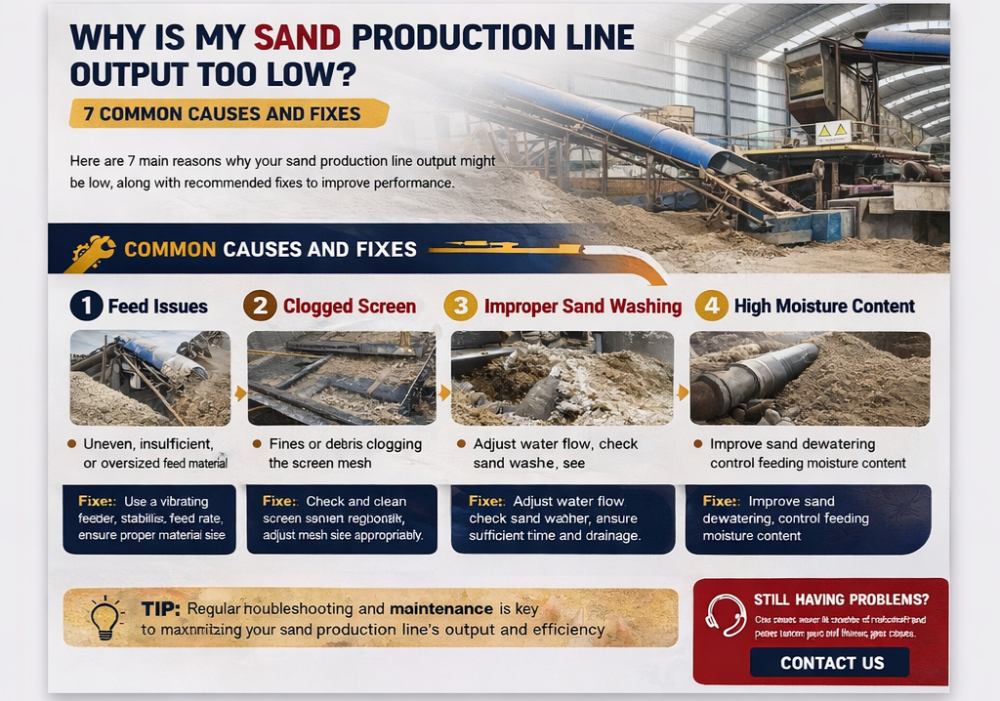
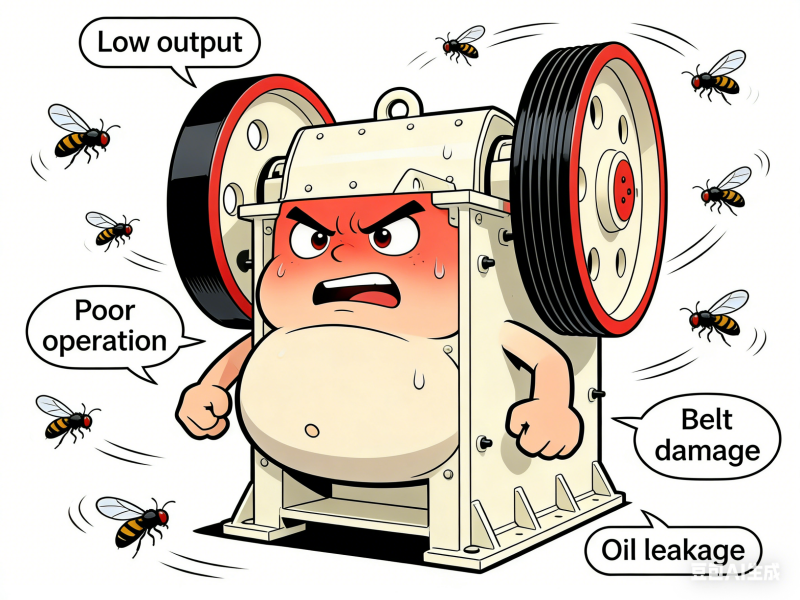
When a Sand Production Line “Looks Busy” but Still Produces Too Little
Many sand plant owners run into the same frustrating situation: the machines are running, the belts are moving, the motors sound normal, but the final output is still far below the expected tons per hour.
On paper, the line was designed for 80 tph, 100 tph, or even 150 tph. In reality, it may only be producing 60%-70% of that target. Some operators first blame the main crusher or the sand making machine. But in most cases, low output is not caused by one machine alone. It is usually a system problem.
A sand production line is like a chain. If one section is feeding poorly, screening badly, or returning too much oversized material, the whole line slows down. So before replacing equipment or assuming the design is wrong, it is better to check the line in a logical order.
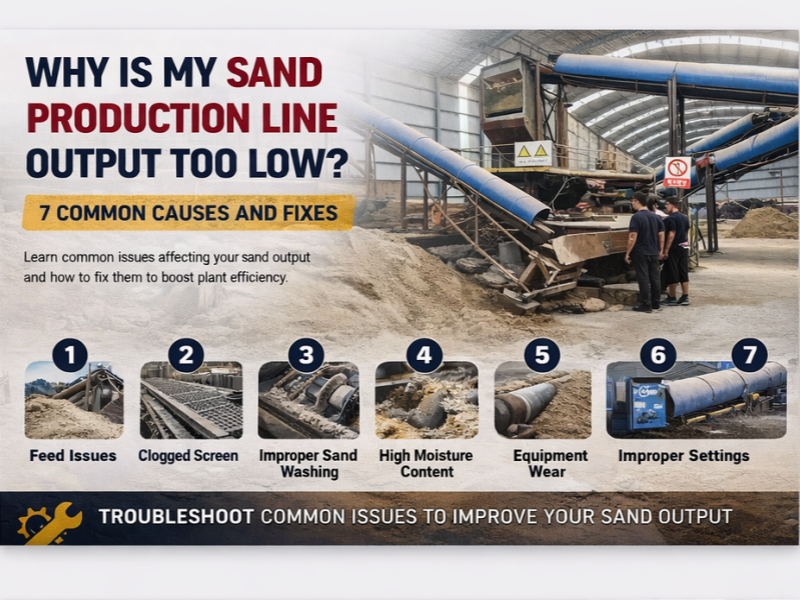
Below are 7 common causes of low output in a sand production line, along with practical ways to identify and fix them.
Quick Troubleshooting Table
Problem Seen on Site | Possible Cause | What to Check First | Recommended Fix |
Output is much lower than design capacity | Feed size too large | Check raw material size before primary crusher | Add pre-screening or reduce oversized feed |
Machines run, but sand output is unstable | Uneven feeding | Observe feeder load and material flow | Adjust feeder and maintain continuous feeding |
Return material is too much | Screen or crusher setup not matched | Check screen performance and recirculation ratio | Rebalance screen size and crusher setting |
Final sand shape is poor and output is low | Sand making machine overloaded or mismatched | Check feed size into sand maker | Improve pre-crushing and feed control |
Plant works normally but capacity stays low | Belt conveyor or screen bottleneck | Compare design throughput of each section | Upgrade or rebalance supporting equipment |
Wet or sticky material slows the whole line | Moisture or clay content too high | Check raw material moisture and fines | Pre-screen, dry, or clean material before processing |
Output fell after months of use | Wear parts badly worn | Inspect crusher liners, hammers, rotor parts, screens | Replace worn parts and restore proper settings |
1. The Feed Material Is Too Large for the Line
This is one of the most common problems, especially in smaller plants trying to process hard stone or irregular quarry feed.
A sand production line may be designed around a certain maximum feed size. But in real operation, large stones beyond that range often enter the plant. When this happens, the primary crusher works harder, the secondary stage gets overloaded, and the sand making machine receives unstable feed.
This creates a chain reaction: lower crushing efficiency, more recirculating material, unstable screening, and lower final sand output.
What to check:
Is the raw material entering the feeder larger than the designed size?
Are there too many oversized rocks from blasting or stockpiling?
Is the jaw crusher receiving feed that is too uneven?
Practical fix:
Control feed size before it enters the line
Add pre-screening if needed
Avoid dumping very large stone directly into the feeder
A lot of “capacity problems” are actually feed problems.
2. The Feeding Rate Is Not Stable
Many operators look at crushers first, but unstable feeding is often the real cause of poor output.
A sand line does not like stop-go feeding. If material comes in heavy, then light, then heavy again, each machine works under changing load. The result is lower efficiency and more unstable final output.
This is especially serious in sand making lines, because shaping machines work best when the feed stays relatively even.
Common site signs:
Feeder occasionally runs empty
Material piles up, then suddenly drops
Motor current fluctuates too much
Output rises and falls during the same shift
Practical fix:
Keep a stable and continuous feed
Adjust feeder amplitude or speed
Improve hopper discharge conditions if material hangs up
If feeding is unstable, the plant may never reach its true design capacity, no matter how good the equipment is.
3. Too Much Material Is Returning in the Closed Circuit
A sand production line often relies on a return loop: oversized material is screened out and sent back for further crushing or shaping.
That is normal. But when the return ratio becomes too high, the plant starts spending too much of its power reprocessing the same material instead of producing finished sand.
Why this happens:
Screen opening is not properly matched
Crusher discharge size is too coarse
Sand making machine feed is too inconsistent
Final product target is set too strict for the current setup
Practical fix:
Rebalance crusher settings and screen mesh size
Check whether the target output size is realistic
Improve feed consistency into the shaping stage
In many cases, a line with low output is actually processing a lot of stone - just not converting enough of it into saleable final sand.
4. The Sand Making Machine Is Not Working Under the Right Conditions
This one is critical.
Many buyers assume that once a sand making machine is installed, good sand and high output will naturally follow. In reality, the sand maker is one of the most sensitive machines in the line. If the feed size, feed volume, or upstream crushing is not matched, output can drop quickly.
Typical signs:
High wear but low output
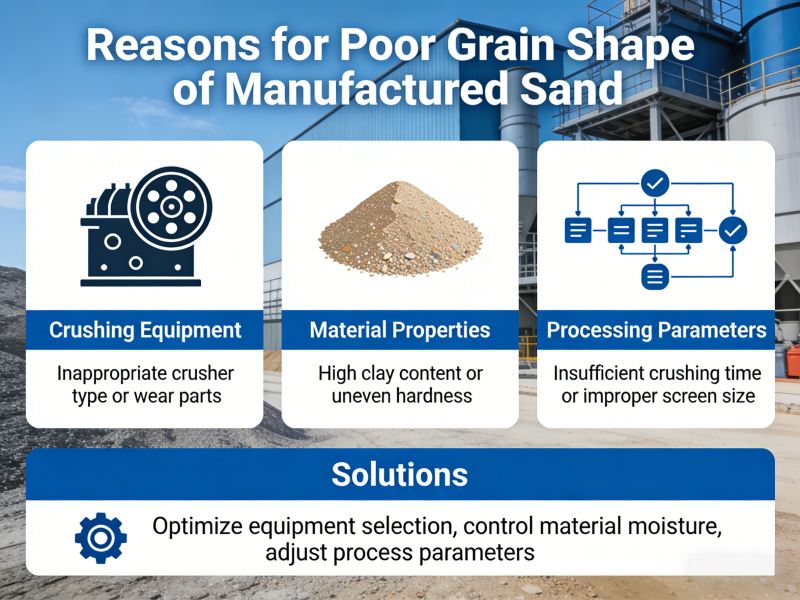
Poor grain shape
Too much stone powder
Unstable current draw
Final sand quantity below expectation
Practical fix:
Reduce oversized feed before the sand making stage
Improve upstream crushing and screening
Check whether the selected sand maker matches the raw material
This is a common mistake in plant planning: trying to make one machine solve problems that should have been solved earlier in the line.
5. One Supporting Machine Has Become the Real Bottleneck
Sometimes the main crusher gets blamed unfairly.
The actual bottleneck may be a vibrating screen that is too small, a return conveyor that cannot carry enough material, a feeder that cannot maintain proper supply, a discharge belt that limits flow, or a stockpile arrangement that interrupts operation.
A plant’s output is never defined by its strongest machine. It is defined by its weakest section.
Practical fix:
Identify the slowest point in the system
Upgrade or rebalance that section
Do not evaluate output based on the crusher alone
This is one reason why complete plant configuration matters more than buying a single big machine.
6. Raw Material Moisture or Clay Content Is Too High
This issue is often underestimated.
A sand line designed for dry or relatively clean stone may lose a lot of output if the actual raw material contains high moisture, sticky fines, clay, or muddy particles.
These materials can block chutes, blind screens, reduce crushing efficiency, make material movement unstable, and lower final sand quality.
Practical fix:
Separate dirty material before feeding
Add cleaning or drying steps if necessary
Reduce wet sticky feed during unstable weather conditions
A line that runs well in dry season may perform very differently in wet conditions.
7. Wear Parts Have Reduced Real Performance
This is the most boring cause - and also one of the most real.
A line may have run well when it was new, but after months of work, jaw plates wear, impact parts wear, hammers lose shape, sand making parts lose efficiency, screen mesh gets damaged, and liners no longer hold proper geometry.
The plant still runs, but not like it used to.
Practical fix:
Replace worn parts on time
Do not wait until output drops badly
Treat wear monitoring as part of production management
A surprising number of output problems are solved not by redesigning the plant, but by restoring the machines to their proper working condition.
What Should You Check First?
If your sand production line output is too low, do not start by assuming the whole design is wrong.
A better order is:
Check feed size
Check feeding stability
Check return ratio
Check supporting equipment bottlenecks
Check moisture and clay
Inspect wear parts
Only then judge whether the equipment selection itself is wrong
This order saves time and avoids unnecessary equipment replacement.
When Low Output Is Really a Configuration Problem
Sometimes the issue is not operation. Sometimes the line itself is not well matched.
This is more likely when hard rock is being processed with too light a setup, target capacity was unrealistic from the start, too much is being asked from a single crusher or sand maker, or the plant was designed around price instead of process balance.
In that case, no amount of operator adjustment will fully solve the problem. The line needs reconfiguration.
That is why a sand production line should always be designed as a system, not as a list of separate machines.
Final Thought
Low output in a sand production line usually has a practical reason. In most cases, it is not a mysterious problem and not a single-machine problem. It comes from feed, circulation, wear, moisture, or poor system matching.
The good news is that once the real bottleneck is identified, output can often be improved without rebuilding the whole plant.
At Sentai machinery, we help customers evaluate sand production line problems based on raw material, capacity target, site conditions, and process matching. In many projects, the fastest way to improve output is not buying more equipment - it is fixing the right part of the line first.
Related Articles:
What Equipment Is Needed for a Sand Making Plant?
How to Design a 100 TPH Sand Production Line

 WhatsApp
 Email
Email
 +86 15538010601