
STCrushers Is A Professional Minging Equipment Manufacturer since 2004, Providing High Quality Crushers, Sand Making Machines, Drying Equipment and more.
STCrushers Is A Professional Minging Equipment Manufacturer since 2004, Providing High Quality Crushers, Sand Making Machines, Drying Equipment and more.
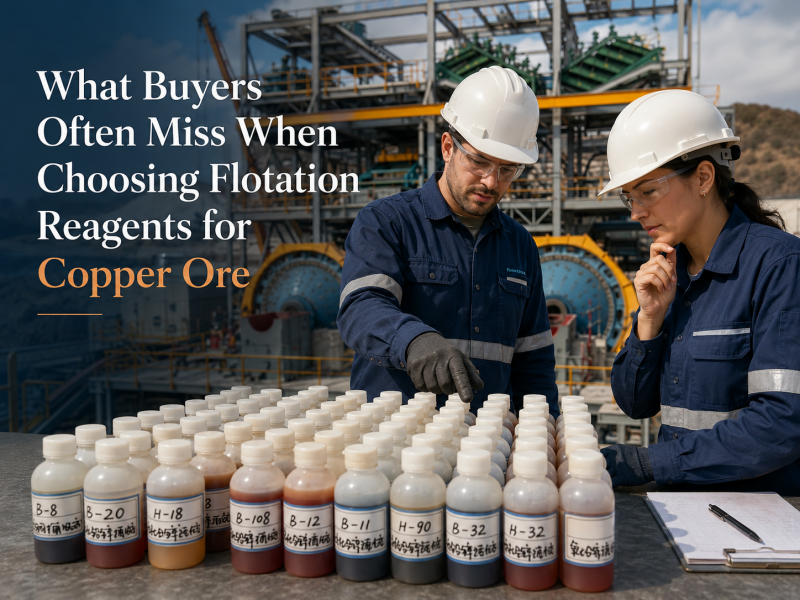
Many Buyers Focus on Equipment First and Reagents Much Later
That is understandable.
When planning a copper ore processing plant, buyers usually pay attention first to jaw crusher, ball mill, spiral classifier, flotation machine, thickener, and dryer.
These are visible, expensive, and easy to compare in a quotation.
Flotation reagents feel different. They are often treated as something that can be adjusted later after the plant starts running.
That is where many misunderstandings begin.
In a copper flotation project, reagent selection is not only an operating detail. It directly affects recovery, concentrate grade, froth stability, process consistency, and operating cost.
This does not mean equipment becomes less important. It means a good flotation line still depends on good process chemistry. If reagent logic is weak, the flotation machine may be blamed for problems that did not begin with the machine itself.
Why Reagent Choice Matters More Than Many Buyers Expect
A flotation circuit does not separate copper minerals by mechanical force alone. It depends on chemical selectivity.
That means reagent choice influences which minerals attach to bubbles, how stable the froth becomes, how much gangue enters the concentrate, and how recovery changes when ore conditions shift.
This is why two plants using similar flotation machines may not produce the same result.
The machine may be the same. The reagent system may not be.
So when buyers think about flotation only in terms of equipment model, they are missing part of the process logic.
1. Ore Type Changes Reagent Logic
This is one of the first things buyers often underestimate.
Not all copper ores behave the same way. Sulfide ores, oxide ores, mixed ores, and more complex ore bodies do not always respond to the same reagent logic.
Even when the buyer simply says copper ore, that is not enough for meaningful reagent discussion.
Questions that matter include:
Is the ore mainly sulfide or oxide
Is the copper mineral chalcopyrite, bornite, chalcocite, malachite, or mixed
Are there difficult gangue minerals
Is there oxidation or slime problem
Does the ore vary a lot between batches
If these points are unclear, reagent discussion becomes too generic.
What buyers often assume
We can finalize the reagent later after the equipment is chosen.
What happens in reality
The flotation line may still run, but reagent adjustment becomes harder, recovery may be unstable, and the plant may take longer to reach acceptable performance.
2. Grinding Fineness Affects Reagent Response
This is where reagent logic and equipment logic connect directly.
A flotation reagent does not work in isolation. Its effect depends heavily on the condition of the slurry entering flotation. One of the biggest factors is grinding fineness.
If valuable copper minerals are not sufficiently liberated, even a well chosen reagent system may struggle.
If the ore is over-ground and too much slime is produced, flotation behavior may also become more difficult to control.
So when buyers think about reagent selection, they should not separate it from ball mill performance, classifier control, and target liberation size.
This is a very practical point:
Poor grinding can make reagent performance look weak.
And poor reagent logic can make equipment performance look weak.
That is why these issues should be discussed together.
3. More Reagent Is Not the Same as Better Result
This is a common misunderstanding in many flotation discussions.
Some people think of reagent adjustment in a very simple way: If recovery is low, just add more.
That is risky.
Higher dosage does not automatically mean higher effectiveness. In some cases, excessive or poorly controlled reagent use may increase operating cost, worsen selectivity, create unstable froth, bring more gangue into concentrate, and make recovery look temporarily active but less efficient in reality.
This is one reason reagent selection should not be treated as trial and error without structure.
Better way to think
The important question is not:
How much reagent can we add?
The better question is:
What reagent logic fits this ore and current slurry condition?
4. One Working Formula May Not Stay Good Forever
Buyers sometimes assume that once a reagent combination works, the problem is solved permanently.
In reality, flotation performance may change when ore grade shifts, mineral association changes, moisture changes, grinding condition changes, feed becomes more oxidized, or upstream control becomes unstable.
That means a reagent program that worked well last month may become less suitable later.
This does not mean flotation is unreliable. It means flotation is sensitive to feed condition and process discipline.
A serious project should be prepared for that reality instead of assuming reagent choice is a one time checkbox.
5. Weak Reagent Thinking Can Make Good Equipment Look Bad
This is probably the most important practical point in this article.
When recovery is poor or froth behavior is unstable, buyers often suspect flotation machine quality, cell size, impeller design, or equipment brand.
Sometimes that suspicion is reasonable.
But in other cases, the real problem is that the reagent approach is too rough, too generic, or poorly matched to the ore and grinding result.
That is why some projects spend a lot of time blaming equipment when the bigger issue is process logic.
A strong flotation machine still needs suitable feed condition, suitable reagent choice, suitable dosage control, and suitable process stability.
Without that, even good equipment can look ordinary.
Quick Judgment Table
What Buyers Focus On | What They Often Miss | Better Way to Judge |
Flotation machine model | Reagent choice affects actual separation result | Evaluate chemistry and equipment together |
Recovery number only | Recovery depends on ore, grinding and reagents together | Check the full process condition |
Reagent dosage | More dosage does not always mean better flotation | Focus on fit, not quantity alone |
One successful formula | Ore variation may change flotation response | Keep reagent logic flexible |
Equipment quotation | Process chemistry may decide real plant performance | Do not judge flotation by machinery alone |
A Typical Wrong Assumption
A buyer builds a copper flotation line and focuses mainly on flotation cell model, ball mill size, capacity, and total price.
The assumption is simple:
Once the equipment is installed, reagent adjustment can always be solved later.
But after startup, feed ore varies, grinding fineness is not fully stable, froth becomes inconsistent, and recovery does not match expectation.
Now the plant starts asking whether the flotation machine is good enough.
Sometimes the machine is not the main problem. Sometimes the project underestimated reagent logic from the beginning.
This is why reagent discussion should not be pushed too far into the background.
What Should Be Confirmed Before Final Reagent Discussion
Before going deeper into reagent selection, buyers should have a clearer picture of ore type and main copper minerals, whether the ore varies significantly, target recovery and concentrate grade, grinding fineness target, slurry condition stability, and whether there are known gangue or slime issues.
These questions make reagent discussion more realistic.
Without them, the conversation stays too abstract.
Final Thought
Choosing flotation reagents for copper ore is not separate from choosing the process. It is part of process logic.
Buyers do not need to become chemical specialists. But they should understand one important truth:
Good flotation results come from equipment, ore condition, grinding, and reagent logic working together.
At Sentai machinery, we help customers look at copper beneficiation projects as a full process, not only as a list of machines. In many cases, better early understanding leads to more stable recovery later.
Planning a copper ore flotation project? Send Sentai machinery your ore type, capacity target, and current process information for a more practical beneficiation discussion.
Related Articles:
What Affects Flotation Recovery in a Copper Ore Processing Plant
Ball Mill vs Rod Mill: Which One Should You Choose for Your Plant?
How to Choose a Ball Mill for Mineral Processing
Suggested Solutions:

 WhatsApp
 Email
Email
 +86 15538010601