
STCrushers Is A Professional Minging Equipment Manufacturer since 2004, Providing High Quality Crushers, Sand Making Machines, Drying Equipment and more.
STCrushers Is A Professional Minging Equipment Manufacturer since 2004, Providing High Quality Crushers, Sand Making Machines, Drying Equipment and more.
The Same Crusher Type Does Not Always Produce the Same Aggregate Shape
Two plants may both use impact crushing for limestone or other medium-hard stone, yet the final aggregate shape can look very different.
One line produces cleaner, better-shaped stone with more attractive finished material. Another line creates more flaky pieces, unstable grading, or aggregate that looks less suitable for higher-value use.
Many buyers assume the reason must be simple: one crusher is good and the other is bad.
In reality, finished aggregate shape depends on more than the crusher model alone.
Yes, the impact crusher matters. But feed size, material condition, reduction logic, wear condition, and process arrangement all play a role. If those factors are not matched well, even a good impact crusher may not produce the shape the buyer expected.
Why Aggregate Shape Matters
Some people talk about aggregate shape as if it is only an appearance issue. It is not.
Aggregate shape affects how the finished material is perceived by customers, how suitable the stone is for different construction uses, how well the final product matches market expectations, and whether the crushing line looks well configured or poorly balanced.
In many projects, buyers focus first on capacity. That makes sense. But when aggregate enters a more demanding market, product shape becomes more important.
A line that produces enough tonnage but poor particle shape may still struggle commercially.
That is why aggregate shape should be judged as part of line performance, not as an optional extra.
The Impact Crusher Is Important, But It Is Not the Only Reason
An impact crusher is widely chosen because it can help improve particle shape. That is one of its key strengths.
But it is a mistake to assume: if I use an impact crusher, good aggregate shape is automatic.
The crusher can only work with the material and process conditions it receives.
If the feed is too large, too mixed, too wet, or unstable, the finished shape may suffer. If wear parts are badly worn, the material may no longer be broken in the way the buyer expects. If the crusher is placed in the wrong stage of the process, it may be doing work that should have been handled earlier.
So the question is not only: Do I have an impact crusher?
The better question is: Is the impact crushing process set up to produce good aggregate shape?
1. Feed Size Entering the Impact Crusher
This is one of the most important factors.
If the feed entering the impact crusher is too large or too inconsistent, the crusher may spend more energy on basic size reduction and less on shape improvement. In that case, the finished product may contain more irregular material than expected.
A properly prepared feed usually gives the impact crusher a better chance to do what it does well.
What often goes wrong
oversized material enters too frequently
feed size varies too much
the upstream jaw crusher is not set appropriately
operators assume the impact crusher can correct everything later
Practical point
Good shape often starts before the impact crusher, not only inside it.
2. Material Type and Hardness
Impact crushing does not behave exactly the same across all materials.
Limestone is usually more forgiving than very hard rock. That is one reason why impact crushers are often recommended for limestone and similar applications. But even within limestone projects, not all stone behaves identically.
Differences in hardness, brittleness, and internal structure can change breakage pattern, amount of fines, final particle shape, and wear speed of impact parts.
This means the same crusher setup may give different shape results under different stone conditions.
Practical point
When buyers compare shape results from two plants, they should first ask whether the material itself is really comparable.
3. Crusher Setting and Reduction Logic
Aggregate shape is influenced by how the crushing work is distributed.
If the crusher is being asked to take too much reduction in one step, the finished product may become less controlled. If the reduction logic is more balanced, the impact crusher often has a better chance to improve product shape.
This is why crusher setting and overall process logic matter. A line that chases simplicity too aggressively may save one stage, but it may also lose some control over the final result.
What often goes wrong
one machine is expected to do too much
reduction ratio is pushed too hard
final shape expectation is high, but process control is too rough
Practical point
A well-balanced process often gives better shape than an overloaded crusher.
4. Whether the Crusher Is Working in the Right Stage
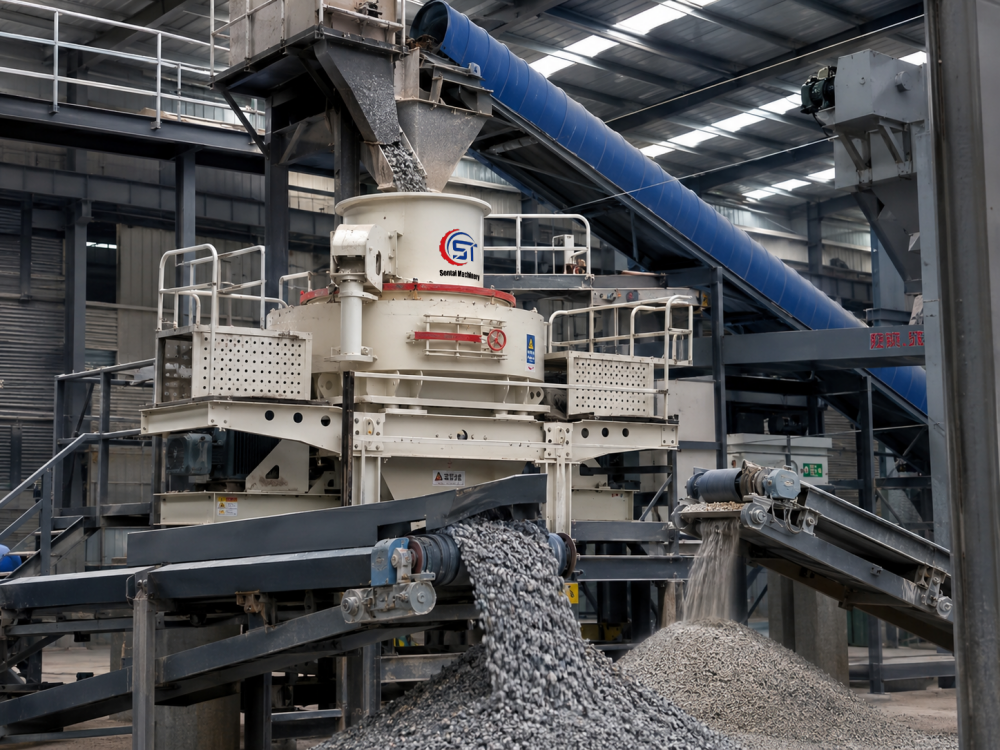
An impact crusher usually works best when it is doing the right kind of job in the right place.
If it is used after proper primary crushing, it can often focus more effectively on shaping and controlled reduction. If it is placed in a process position where feed condition is too rough or unstable, shape control may become weaker.
This is why stage arrangement matters.
The same machine can look good in one plant and ordinary in another simply because the process position changed.
Practical point
The question is not just: What crusher model is this?
It is also: What role is this crusher expected to play in the line?
5. Wear Condition of Impact Parts
This factor is often ignored until the finished product quality has already dropped.
As impact parts wear, the crusher may still run, but the breakage behavior changes. The line may continue producing stone, yet the shape gradually becomes less controlled.
This is one of the easiest ways a plant slowly loses product quality without immediately noticing why.
What often goes wrong
wear parts are used too long
replacement is delayed because the machine still works
shape decline is blamed on raw material or capacity pressure
Practical point
A crusher that is still operating is not always a crusher that is still producing the same quality.
Quick Judgment Table
Factor | Why It Affects Shape | What Often Goes Wrong |
Feed size | The crusher needs reasonably prepared feed to shape material well | Feed is too large or too inconsistent |
Material type | Different stone breaks differently | Buyers compare unlike materials |
Reduction logic | Too much work in one step weakens control | Process is pushed too hard |
Crusher stage position | The machine performs differently depending on its role | Crusher is used in the wrong stage |
Wear condition | Worn parts change breakage behavior | Plant delays replacement too long |
A Common Wrong Assumption
A buyer sees an impact crusher in a quotation and assumes the final aggregate shape will naturally be excellent.
But on site:
feed is larger than expected
wear parts are already tired
the process is overloaded
the crusher is doing more reduction work than shaping work
the material itself is not behaving like the original assumption
Now the final product looks less attractive than expected.
The buyer may say: The impact crusher is not good enough.
Sometimes that is not the real problem. Sometimes the crusher is being blamed for a process condition it did not create.
What Plant Owners Should Check First
Before assuming the machine is the problem, plant owners should check:
Is the feed size entering the impact crusher appropriate
Is the material type the same as originally expected
Is the reduction logic too aggressive
Is the crusher working in the right process stage
Are the impact parts worn too far
Has the final product requirement become stricter than the current setup can support
This checklist often leads to a more useful answer than jumping straight to machine replacement.
Final Thought
Finished aggregate shape in an impact crushing process is influenced by more than the machine model alone.
A good impact crusher can help produce better-shaped stone, but only when feed condition, material behavior, process arrangement, and wear control are all working in the right direction.
At Sentai machinery, we help customers judge crushing performance based on the whole process, not only the equipment name. In many cases, better aggregate shape comes from better process matching, not simply from buying another machine.
CTA
If your crushing line is producing aggregate with unsatisfactory shape, send Sentai machinery your raw material type, feed size, capacity target, and current process flow for a more practical suggestion.
Related Articles:
Impact Crusher vs Heavy Hammer Crusher for Limestone: Which One Makes More Sense?
Best Crusher for Limestone Crushing
Suggested Solutions:
80-100 tph Stone Crusher Plant
100-150 tph Stone Crusher Plant

 WhatsApp
 Email
Email
 +86 15538010601