
STCrushers Is A Professional Minging Equipment Manufacturer since 2004, Providing High Quality Crushers, Sand Making Machines, Drying Equipment and more.
STCrushers Is A Professional Minging Equipment Manufacturer since 2004, Providing High Quality Crushers, Sand Making Machines, Drying Equipment and more.
A Dusty Plant Does Not Always Mean a Bad Plant, But It Usually Means Something Is Wrong
A stone crushing plant can still produce aggregate when the site is dusty everywhere. That is exactly why many plant owners tolerate the problem for too long. The line is running, trucks are loading, and material is coming out, so dust gets treated as something normal.
But in real operation, heavy dust is rarely just a visual problem.
Too much dust can make the workplace uncomfortable, increase material loss, reduce screen efficiency, create maintenance trouble, damage the plant image when customers visit, and add pressure when local environmental requirements become stricter. In some plants, dust is not caused by one machine. It is a sign that several small problems are happening at the same time.
The good news is that dust problems in a stone crushing plant can often be reduced without rebuilding the whole line. The key is to identify where the dust is coming from and which section of the plant is letting it spread.
Where Dust Usually Comes From
In a typical crushing plant, dust does not come from one point only. It usually appears in several places at the same time:
feeder inlet where raw material falls into the hopper
crusher inlet and outlet
transfer points between conveyors
vibrating screen discharge points
return material loop
stockpiles and final discharge areas
Some plants also become much dustier when raw material contains too many fines before crushing begins. In that case, the line is already carrying loose powder before it even reaches the main crusher.
Quick Dust Control Table
Dust Problem Area | Common Cause | Practical Fix |
Feeder and hopper area | Dry fines and uncontrolled dropping height | Add covers, improve feeding stability, and use water spray if suitable |
Crusher inlet and outlet | Open structure, weak sealing, fine material discharge | Improve sealing and install localized dust control |
Transfer points | Material falling freely between belts | Add skirts, covers, and tighter transfer point control |
Vibrating screen section | Fine material separation and open discharge points | Cover key sections and reduce unnecessary dust escape |
Stockpile area | Dry finished material and uncontrolled discharge height | Manage drop height and control dust at discharge |
Whole plant | Poor housekeeping and dust accumulation | Clean regularly and manage fine material before it builds up |
1. Raw Material Is Too Dry and Contains Too Many Fines
Some plants are dusty not because the crushing line is badly designed, but because the raw material itself makes dust easy to generate.
If the material is very dry, brittle, and already contains a large amount of fine particles, every movement in the line can release dust. The feeder, crusher, screen, and conveyor discharge points will all throw fine powder into the air more easily.
This often happens in quarry sites during dry seasons, or in plants processing material that has already gone through repeated handling.
What to check first:
Is the material arriving already full of powder and fines
Has dust become worse during dry weather
Is the stockpile condition changing before feeding
Practical fix:
pre-screen excessive fines if needed
reduce unnecessary material dropping and rehandling
consider controlled spray points where suitable
If the material itself is very dusty, the plant cannot be expected to stay clean by sealing alone.
2. The Crusher and Screen Area Is Too Open
In many stone crushing plants, the crusher and screen sections are installed with too much open exposure. This makes maintenance convenient, but it also gives dust an easy way out.
When crushed stone leaves the crusher or screen at high speed, fine material escapes quickly if the machine body, discharge area, or nearby chute is poorly sealed.
This problem is especially obvious in older plants or plants that were built more for quick startup than for operating cleanliness.
What to check first:
Are the crusher outlet and screen discharge sections too exposed
Are there missing skirts, covers, or side plates
Has sealing become loose after months of operation
Practical fix:
improve sealing at the main dust release points
add covers where the structure is too open
repair or replace worn skirts and side protection
A plant does not need to be fully enclosed everywhere. But the sections that throw the most fines should not stay open by default.
3. Transfer Points Are Letting Dust Escape
Transfer points are often ignored because they do not look like the main production equipment. But in dusty plants, they are often one of the biggest sources of airborne fine material.
When crushed stone drops from one conveyor to another, or from a chute to a belt, fine dust escapes easily if the transfer point is poorly controlled. The faster the flow and the greater the drop height, the worse the dust tends to be.
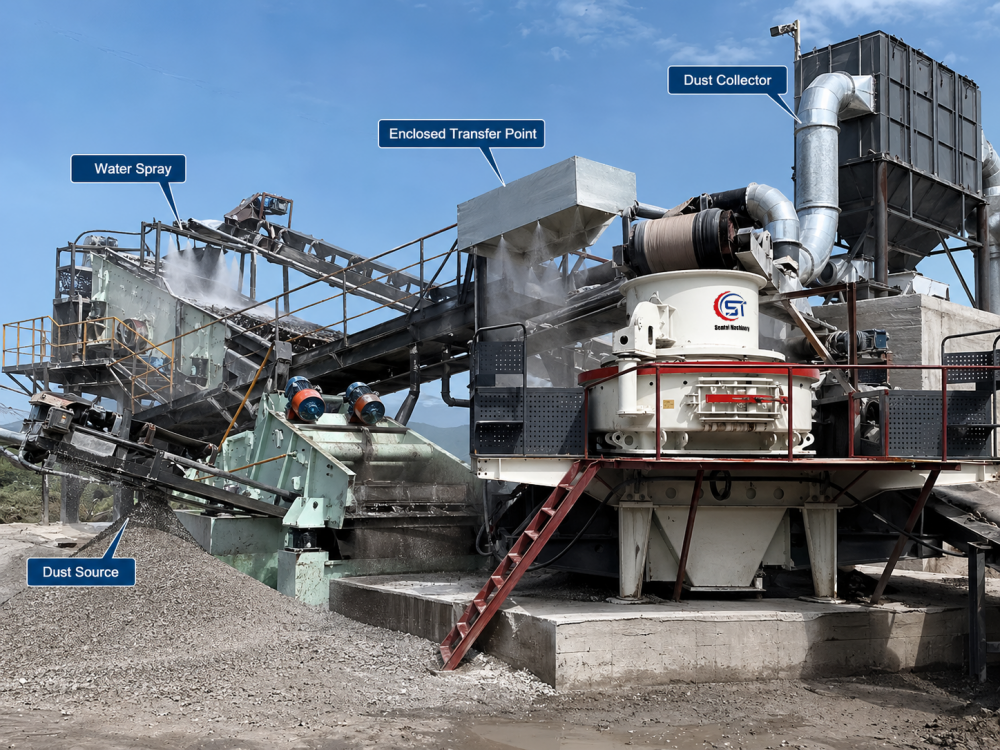
What to check first:
Is the material falling too freely at transfer points
Are the belt skirts too loose
Is there visible dust every time material changes direction
Practical fix:
reduce unnecessary drop height
improve transfer point covers and skirts
make sure material flow stays centered and controlled
Many plants spend money on main equipment but ignore small transfer sections that release dust all day long.
4. Water Spray Exists, but the Arrangement Is Weak
Some plants already have water spray, but the dust problem remains serious. In many of these cases, the issue is not whether spray exists. It is whether the spray is being used in the right place and in the right amount.
A badly arranged spray system may:
miss the actual dust source
use too little water to control fines
use too much water and create sticky material problems
work in one area while dust escapes from another
What to check first:
Is spray positioned at the actual dust release point
Is the spray too weak, too strong, or too inconsistent
Is the material becoming sticky after spraying
Practical fix:
place spray where dust is generated, not where it has already spread
balance water use carefully
do not treat spray as the only dust solution
Water spray can help, but it should support plant control, not replace it.
5. The Screen and Return Loop Are Throwing Too Much Fine Material
In some plants, the crushing section looks acceptable, but the screen and return loop create a lot of dust. This usually happens when there is too much recirculating fine material or when the screen discharge area is too open.
If the line keeps moving a large amount of fine and dry material back through the system, dust naturally becomes harder to control.
What to check first:
Is the return ratio too high
Is the screen separating more fines than expected
Are discharge and return belts creating visible dust clouds
Practical fix:
review screen mesh and product targets
reduce unnecessary recirculation where possible
improve covers and discharge control around the screen
Sometimes a dusty plant is not only a dust problem. It is also a process balance problem.
6. Poor Housekeeping Makes a Moderate Dust Problem Look Severe
Not every dusty site has a major equipment defect. In some cases, the line has a moderate dust problem, but poor housekeeping makes the site look much worse.
Dust and fine material collect:
under conveyor frames
around transfer points
beside the crusher foundation
near stockpiles
along access roads
Once these fines build up, every truck movement, every wind gust, and every new discharge point sends more dust back into the air.
What to check first:
Are fines building up around the same areas every day
Are there places where spillage is not being cleaned
Is site traffic spreading fine material across the yard
Practical fix:
establish a simple cleaning routine
remove accumulated fine material before it spreads
treat housekeeping as part of plant control, not as an afterthought
A cleaner plant usually feels more professional to both workers and visiting customers.
What Can Be Improved Without Rebuilding the Whole Line
Many owners worry that dust reduction means expensive reconstruction. In reality, several useful improvements can often be made without changing the full plant layout.
Examples include:
better sealing around the crusher and screen
covers on key transfer points
improved belt skirts
more controlled discharge height
better fines handling and cleaning routine
targeted spray improvement
These changes do not always solve everything, but they often reduce dust enough to make the plant easier to manage and more acceptable for daily operation.
When Dust Means the Plant Design Itself Needs Adjustment
There are also cases where dust is not just a maintenance issue. It comes from deeper design weaknesses.
This is more likely when:
the line is too open from the beginning
the screen and return loop are poorly matched
the plant handles too much fine dry material for its current layout
transfer point design was never properly considered
the process creates more recirculating fines than expected
In these cases, patchwork fixes may help only a little. The plant may need more serious redesign around flow control, enclosure, screening balance, or discharge layout.
Final Dust Control Checklist
Before spending money on major upgrades, check these points:
Is the raw material especially dry or fine
Are the main dust release points identified clearly
Are crusher and screen sections too open
Are transfer points properly covered
Is spray being used in the right place
Is recirculating fine material making the problem worse
Is poor housekeeping adding to the dust
This checklist is simple, but it helps separate small operating issues from larger design problems.
Final Thought
Dust problems in a stone crushing plant should not be treated as something completely normal. Some dust is expected in crushing work, but excessive dust usually means the plant is losing control somewhere.
In many cases, the solution is not one expensive machine. It is a combination of better sealing, better transfer control, smarter spray use, improved screening balance, and stronger site housekeeping.
At Sentai machinery, we help customers evaluate crushing plant conditions based on raw material, line layout, output requirements, and actual operating problems. In many projects, reducing dust starts with identifying the most obvious weak point in the line instead of rebuilding the whole plant.
Related Articles
How to Choose Equipment for a Stone Crushing Plant
A 100 TPH Stone Crushing Plant for Hard Rock: Recommended Configuration and Why
Why Is My Sand Production Line Output Too Low? 7 Common Causes and Fixes
Suggested Solutions Page Links:
80-100 tph Stone Crusher Plant
100-150 tph Stone Crusher Plant





 WhatsApp
 Email
Email
 +86 15538010601