
STCrushers Is A Professional Minging Equipment Manufacturer since 2004, Providing High Quality Crushers, Sand Making Machines, Drying Equipment and more.
STCrushers Is A Professional Minging Equipment Manufacturer since 2004, Providing High Quality Crushers, Sand Making Machines, Drying Equipment and more.
When buyers ask about a sand making plant, one of the first questions is usually: How many tons per hour can this line produce? That sounds simple. But in real projects, capacity is one of the most misunderstood numbers. Many buyers assume that 100 tph always means 100 tph of finished sand, that all raw materials can reach the same output, and that the supplier quotation should always match the final site result. In practice, a sand making plant is a system, and its real output depends on raw material, feed size, moisture, return ratio, final product specification, and daily operation. Two plants that both say 100 tph on paper may perform very differently in the field.
Material Type | Capacity Reality |
Limestone | Usually easier to reach design output |
River stone | Depends on size and hardness, often moderate difficulty |
Granite | Harder to process, real output may be lower |
Basalt | Abrasive and demanding, often more difficult to maintain full capacity |
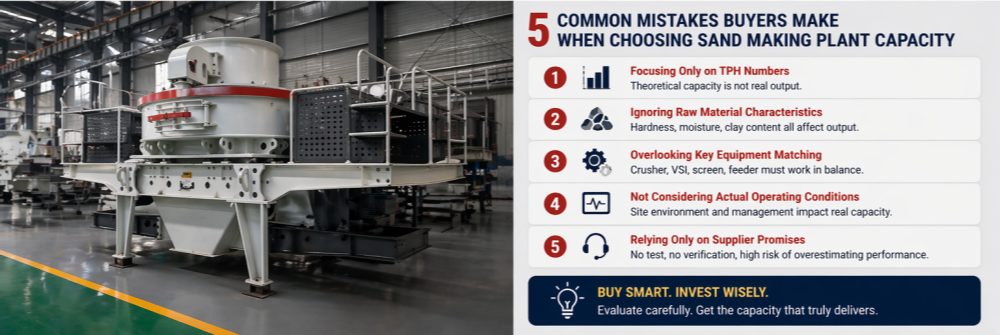
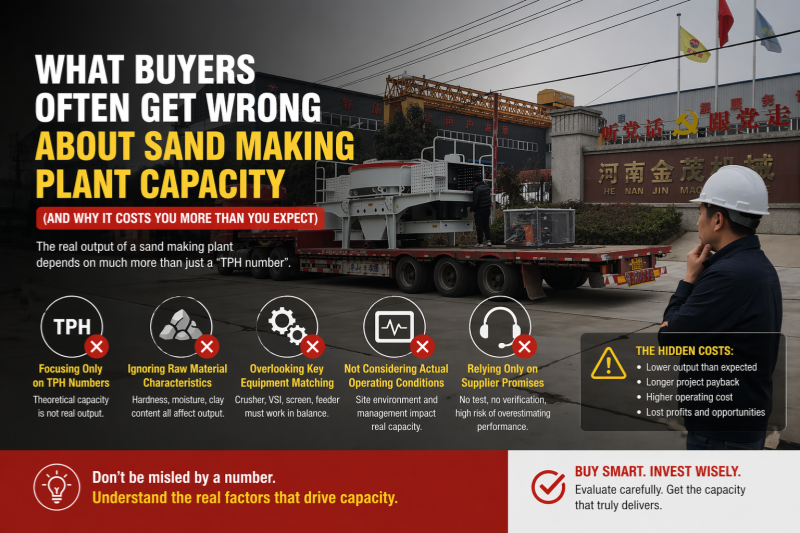
This is the most common misunderstanding. A buyer sees 100 tph sand making plant and naturally thinks that the line will produce 100 tons of finished sand every hour. Sometimes that is close to reality. Sometimes it is not. The reason is that tph can refer to different things: raw material feeding capacity, crushing section throughput, shaping section capacity, or final qualified sand output. These are not always the same number. If the line includes recirculation, screening, and shaping, the system may process a large amount of material internally while the final saleable sand output is lower than the feed amount. A better question is: Does this capacity mean raw feed, total circulation, or final qualified sand output?
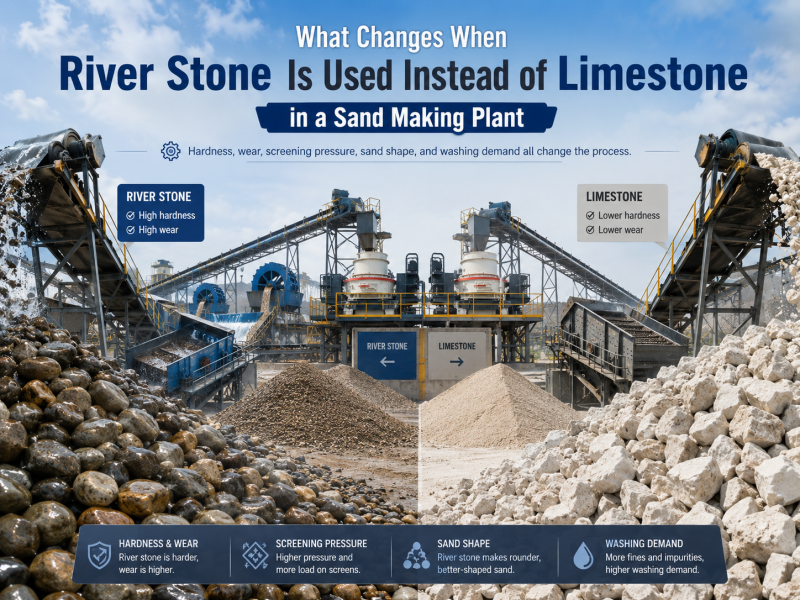
Some buyers compare quotations as if stone type makes little difference. But a 100 tph sand making plant for limestone is not the same as a 100 tph line for granite, basalt, or river stone. Harder and more abrasive materials usually mean lower real throughput, higher wear, more return material, and heavier load on shaping equipment. Softer materials are often easier to crush and shape, so the same model may produce more usable output under the same nominal capacity. That is why buyers should not ask only whether a machine can do 100 tph. They should ask whether the line can do 100 tph with their own material.
Feed size has a direct effect on plant output, but many buyers underestimate it. A line may be quoted at a certain capacity assuming the feed entering the sand making stage is already within a suitable range. If the real feed is too large or inconsistent, the line slows down. This often happens when primary crushing is not enough, when raw material contains too many oversized stones, or when screening before shaping is unstable. The result is lower output, unstable grain shape, more recirculation, and faster wear. Buyers should always confirm the maximum raw feed size, the feed size after primary crushing, and the feed size entering the sand making machine.
This is where many buyers get surprised after installation. On paper the line is sized correctly, but in real operation wet material or muddy fines reduce performance. Typical effects include screen blockage, chute sticking, unstable feeding, lower crushing efficiency, and lower final sand quality. This is especially common in rainy conditions, river stone projects, or sites where raw material is not cleaned before entering the line. Buyers should ask whether the quoted output is based on dry material, whether there is clay or muddy fines, and whether washing or cleaning will be required.
Another common misunderstanding is assuming the line can produce several finished sizes, very strict grading, high quality grain shape, and low powder content while still maintaining the same easy capacity number. In reality, the more demanding the finished product requirement is, the more pressure goes onto screening, return material control, shaping efficiency, and washing if used. A line producing simple construction sand is not the same as a line producing tighter, cleaner, more market-sensitive finished products. Capacity should always be discussed together with the number of final products, size ranges, shape requirement, powder content requirement, and whether washing is required.
Question | Why It Matters |
Does tph mean feed or finished sand? | Avoids misunderstanding of output |
What material is being processed? | Hardness changes real capacity |
What is the feed size? | Feed condition affects plant efficiency |
Is the material dry or wet? | Moisture can reduce output |
How many finished sizes are required? | Product requirement changes real throughput |
Is there a return loop? | Recirculation affects final output |
Is the whole line balanced? | One bottleneck can reduce total capacity |
Some buyers compare only the sand making machine model. That is risky. A sand making plant's real output depends on the whole line: feeder, jaw crusher, secondary crushing, sand making machine, screen, conveyors, return loop, and control system. If one section is weak, the whole plant slows down. A line is never defined by its strongest machine. It is defined by its weakest bottleneck. So instead of asking what is the capacity of the sand making machine, buyers should ask what is the realistic capacity of the whole plant under working conditions.
A sand making plant capacity number is useful, but only when it is understood correctly. Many buyers do not fail because the supplier lies to them. They fail because they compare one capacity number without asking what conditions that number actually depends on. The smarter way is to discuss capacity together with material type, feed size, moisture, final product requirement, and full process configuration. At Sentai machinery, we help customers evaluate sand making plant capacity based on actual raw material and production goals, not only nominal tph figures. A realistic capacity plan prevents disappointment later and leads to a more practical plant design.
Not sure whether a sand making plant capacity quote matches your real project? Send Sentai machinery your raw material, feed size, target product sizes, and moisture condition for a more practical capacity evaluation.
Related Articles:
How to Choose Equipment for a Sand Making Plant
How to Design a 100 TPH Sand Production Line
Why Is My Sand Production Line Output Too Low? 7 Common Causes and Fixes
Suggested Solutions Page Links:
 WhatsApp
 Email
Email
 +86 15538010601