
STCrushers Is A Professional Minging Equipment Manufacturer since 2004, Providing High Quality Crushers, Sand Making Machines, Drying Equipment and more.
STCrushers Is A Professional Minging Equipment Manufacturer since 2004, Providing High Quality Crushers, Sand Making Machines, Drying Equipment and more.
Sand drying is an important step in many industrial applications. Dry sand is widely used in mortar production, foundry applications, dry mix products, construction materials, and other processing fields where moisture control is critical. When wet sand cannot meet downstream requirements, a reliable drying system becomes essential. This is why many producers choose a rotary dryer for sand drying.
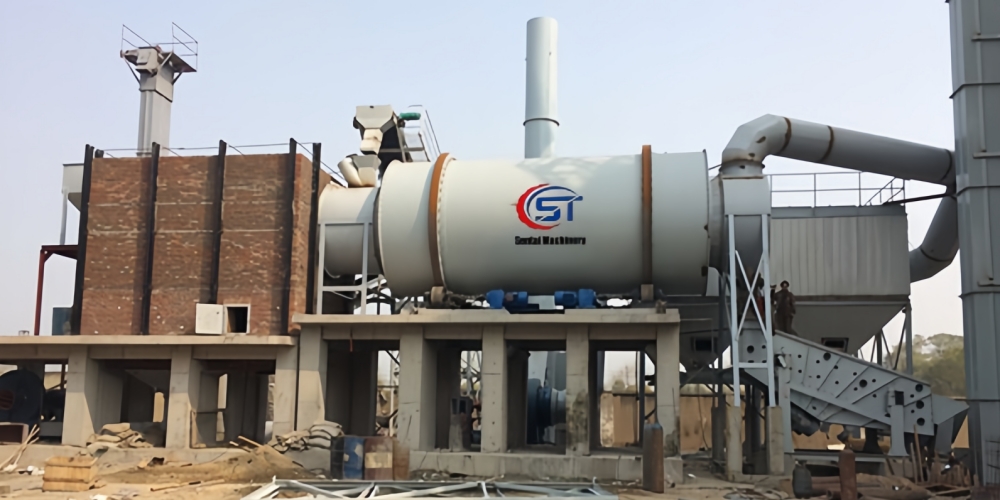
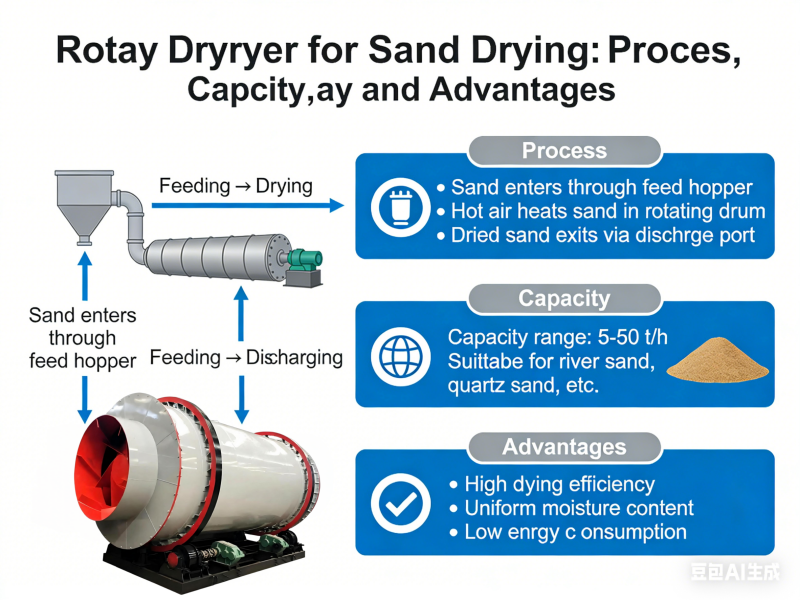
A rotary dryer for sand drying uses a rotating drum together with a heat source and airflow system to reduce the moisture content of sand efficiently. The material enters the dryer, is lifted and scattered inside the rotating drum, and exchanges heat with the hot air. As the process continues, moisture is gradually removed and the dried sand is discharged at the outlet.
The basic sand drying process usually includes feeding, heat exchange inside the drum, discharge, dust collection, and airflow control. In a complete system, the rotary dryer works together with a burner or furnace, feeder, discharge device, cyclone or dust collector, induced draft fan, and control system. Good system matching is important because the dryer itself is only one part of the whole drying line.
One of the main advantages of using a rotary dryer for sand is its continuous operation capability. For projects that require stable throughput over long production cycles, rotary drum drying is a practical and widely used solution. It can be designed for different capacities and integrated into larger sand processing systems.
Another important advantage is adaptability to different capacity requirements. Some users need a compact drying system for small or medium production, while others need larger-capacity drying lines for commercial sand processing. The correct dryer model should be selected according to wet feed amount, initial moisture content, required final moisture, and working hours.
When discussing capacity, buyers should remember that sand drying capacity is not just about tons per hour in general. It depends heavily on how wet the sand is before drying and how dry it needs to be afterward. Drying mildly wet sand to a moderate final moisture target is very different from drying highly wet sand to a strict low-moisture standard. This is why the same drum size may perform differently in different projects.
The heat source is also a major factor in sand drying performance. Different projects may use coal, gas, diesel, biomass, or other heat sources depending on local conditions and operating cost considerations. A well-matched heat source improves fuel efficiency and helps keep final moisture more stable.
Rotary dryers also offer the advantage of process flexibility. In some sand plants, the dryer is integrated into a larger line that includes crushing, screening, or mixing systems. In others, it works as a stand-alone drying unit. The system layout can be adjusted according to site conditions and production goals.
Another key benefit is stable moisture reduction when the system is properly designed. Downstream products often perform better when sand moisture is controlled within a suitable range. This is especially important in dry mortar, foundry, and other applications where inconsistent moisture can affect final product quality.
A typical sand drying system may include: - Feeding device - Rotary drum dryer - Heat source system - Dust collection equipment - Induced draft fan - Conveyors or storage units - Electrical control system
When selecting a rotary dryer for sand drying, buyers should prepare the following information: - Sand type and particle size - Initial moisture content - Required final moisture - Target capacity per hour or per day - Heat source condition - Site layout and environmental requirements.
In summary, a rotary dryer is a highly practical solution for sand drying when the process is designed around actual material and production requirements. The right dryer can support continuous operation, stable moisture control, and efficient use of heat while fitting into a larger sand processing system.
At Sentai machinery, we provide rotary drying solutions for sand and other industrial materials based on actual capacity and moisture requirements. With the correct process design, a sand drying system can improve product quality and support more stable downstream production.
Looking for a rotary dryer for sand drying? Contact Sentai machinery with your sand moisture, target capacity, and fuel condition for a suitable drying solution.

 WhatsApp
 Email
Email
 +86 15538010601