
STCrushers Is A Professional Minging Equipment Manufacturer since 2004, Providing High Quality Crushers, Sand Making Machines, Drying Equipment and more.
STCrushers Is A Professional Minging Equipment Manufacturer since 2004, Providing High Quality Crushers, Sand Making Machines, Drying Equipment and more.
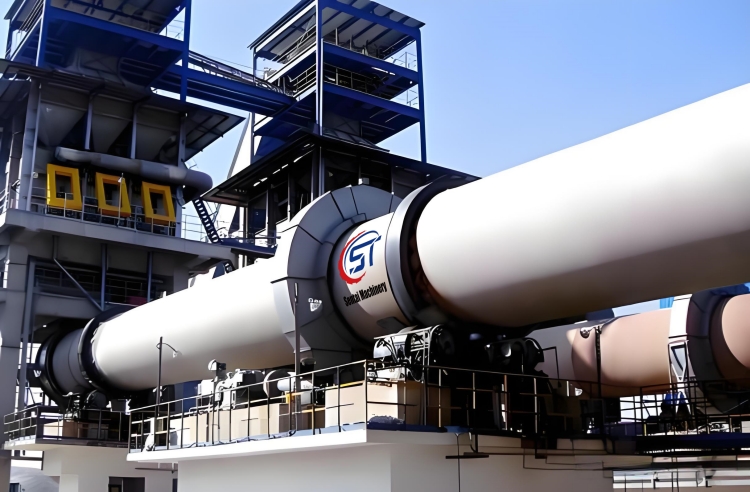
When buyers plan a ceramsite rotary kiln plant, they often focus on kiln size, output, fuel consumption, and burning temperature. These are important, but they do not decide the result alone.
In many ceramsite projects, the stability of the rotary kiln begins before the material enters the kiln. Pellet quality has a direct effect on heating, expansion, dust generation, material movement, fuel consumption, discharge condition, and final product strength.
If the pellets entering the kiln are unstable in size, moisture, or strength, the kiln will be harder to control. Even with a suitable rotary kiln, the final ceramsite may show uneven expansion, high breakage rate, unstable particle strength, or excessive powder.
For Sentai Machinery, ceramsite rotary kiln plant design should not start only from the kiln body. It should start from raw material behavior and pellet quality.
Ceramsite can be produced from different raw materials, including clay, shale, fly ash, sludge, tailings, and other suitable solid waste materials. These materials do not behave the same during mixing, pelletizing, drying, and calcination.
Some materials have good plasticity and are easier to form into pellets. Some materials are too dry, too loose, too fine, or too sticky. Some solid waste materials may have unstable moisture or composition. These differences affect pellet formation before the rotary kiln stage.
Important raw material conditions include:
1. Moisture content
2. Plasticity
3. Particle fineness
4. Chemical composition
5. Organic matter content
6. Sticky or loose behavior
7. Mixing uniformity
8. Required binder or adjustment material
If the raw material mix is unstable, the pellets may not form evenly. Some pellets may be too soft, some may be too wet, and some may break before reaching the kiln. This creates unstable feeding and affects the whole calcination process.
Pellet size is one of the most important factors in ceramsite production.
If pellet size is too large, the outside may heat faster than the inside. The internal and external temperature difference can affect expansion, strength, and final structure. If pellet size is too small, the material may create more dust, move differently in the kiln, and burn too quickly.
If the size range is too wide, the kiln must handle large pellets and small pellets at the same time. This makes it harder to control heating and residence time. Large pellets may be underburned, while small pellets may be overburned or broken.
A stable pellet size range helps the kiln maintain more uniform heating and better final product consistency.
For this reason, pelletizing and screening should be considered as part of the rotary kiln plant design. The kiln cannot fully correct unstable pellet size from the previous stage.
Moisture control is another key point.
If pellet moisture is too high, rapid heating inside the kiln may cause cracking, bursting, or deformation. When water inside the pellet evaporates too quickly, internal pressure can damage the pellet structure.
If moisture is too low, the pellets may have poor strength before entering the kiln. They may break during conveying, screening, or feeding. This can increase fine powder and make kiln operation less stable.
Uneven moisture is also a problem. If some pellets are wet and some are dry, they will react differently in the kiln. The result may be uneven expansion and inconsistent product quality.
In many ceramsite projects, drying or moisture adjustment before the kiln is necessary.Rotary dryer or other drying equipment may be used when the raw material or pellets need better moisture control before calcination.
Pellets must have enough strength to pass through conveying, screening, feeding, preheating, and kiln rotation.
If green pellets break too easily, fine powder will increase before and inside the kiln. Excessive powder can affect airflow, increase dust load, change material movement, and reduce product quality.
Inside the rotary kiln, the material keeps rolling and moving forward. Weak pellets may break during this movement. Once too much powder appears, the material bed becomes less stable and the kiln may become harder to operate.
Good pellet strength does not mean the pellets should be too hard or impossible to expand. It means they should remain stable before the proper firing and expansion stage.
This balance depends on raw material mix, pelletizing condition, moisture control, and pre-kiln handling.
Screening after pelletizing can help remove oversized pellets, undersized pellets, and loose powder before the material enters the kiln.
This step is often underestimated.
Oversized pellets may not heat evenly. Undersized pellets may burn too quickly or become powder. Loose powder can increase dust and reduce kiln stability. A vibrating screen can help improve the feed consistency entering the rotary kiln.
Screening is not only for product size control. In ceramsite production, it also supports process stability.
A more stable feed size allows the kiln to maintain more consistent temperature, residence time, and material movement. This helps reduce quality fluctuation during continuous production.
Rotary kiln temperature, kiln speed, residence time, and fuel control are still essential in ceramsite production. However, these conditions work best when the feed material is stable.
If pellet size, moisture, and strength keep changing, the operator must constantly adjust the kiln. This can increase fuel consumption and reduce product consistency.
Stable pellets make kiln control easier. The burning system can maintain a more predictable heat profile. The material can move more evenly through preheating, calcination, expansion, and cooling stages.
In other words, pellet quality and kiln control are not separate issues. They are connected parts of the same production system.
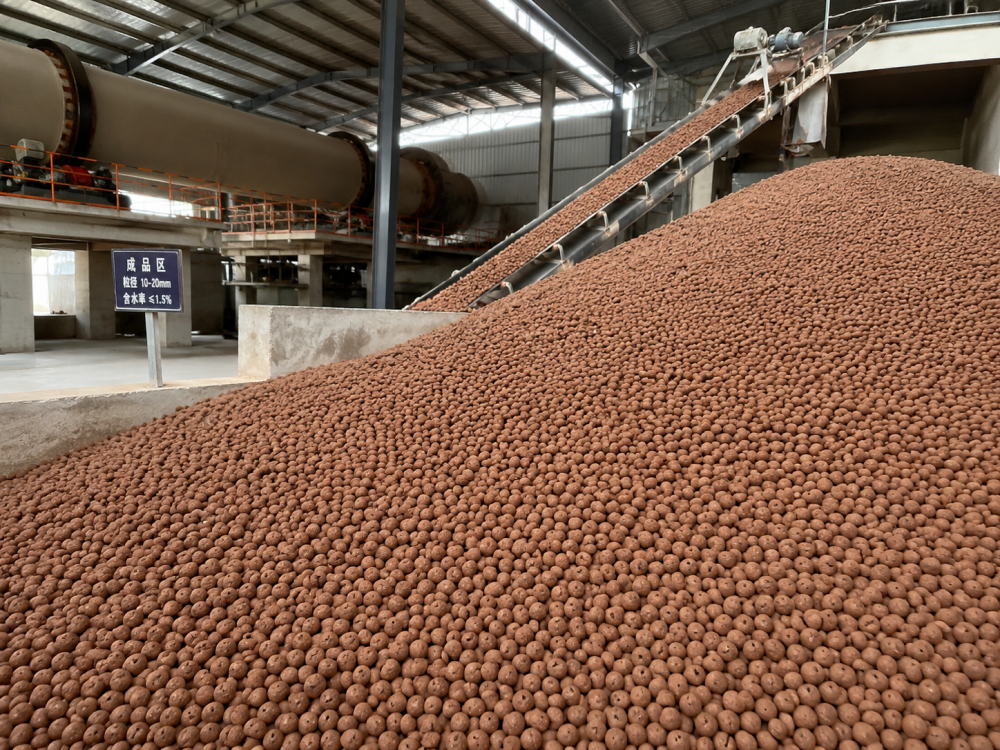
Clay and shale materials may have better forming behavior in many cases. The design focus is usually on crushing, mixing, pelletizing, drying, kiln temperature control, and stable expansion.
Sludge, fly ash, and similar solid waste materials may have more variable moisture and composition. The plant may need more attention to mixing, moisture adjustment, pellet strength, drying, dust collection, and exhaust gas treatment.
Tailings may need careful testing before production. Particle fineness, composition, plasticity, and binder requirement should be checked. Pellet forming and kiln firing behavior must be confirmed before final equipment selection.
These scenarios show that ceramsite rotary kiln plant design should follow raw material behavior, not only the target output.
A common mistake is asking only for rotary kiln size.
Kiln size is important, but it cannot solve unstable pellet quality. If the pellets are not suitable, the kiln may face dust, uneven heating, unstable discharge, and poor final product quality.
Another mistake is ignoring raw material mixing. If the material composition changes frequently, pellet quality will also change.
Some buyers also skip screening before the kiln. This may allow oversized pellets, small particles, and loose powder to enter the kiln together, making operation less stable.
Another misjudgment is treating solid waste ceramsite projects as simple calcination projects. When sludge, fly ash, or tailings are used, raw material testing and process adjustment become more important.
A useful discussion should start from the raw material.
First, provide material type, moisture, composition, particle size, plasticity, and photos or videos. If the project uses sludge, fly ash, or tailings, material testing is especially important.
Second, explain the target ceramsite product. The supplier needs to know the expected particle size, bulk density, strength, and final application.
Third, confirm the pelletizing condition. The supplier should understand whether the material can form stable pellets and whether drying or screening is needed before the kiln.
Fourth, discuss capacity, fuel, site layout, dust collection, cooling, and storage.
A complete ceramsite rotary kiln plant should include raw material preparation, mixing, pelletizing, screening, drying if needed, rotary kiln calcination, cooling, dust collection, and conveying. These parts should be designed as one system.
Ceramsite rotary kiln plant design should not focus only on kiln size and burning temperature.
Pellet quality strongly affects kiln stability. Raw material mix, pellet size, moisture, strength, screening, feeding, temperature control, and cooling all work together to decide the final product result.
For buyers, the better question is not only "What size rotary kiln do I need?" A more useful question is "Can my raw material form stable pellets for continuous kiln operation?"
When pellet quality is controlled before the kiln, the rotary kiln becomes easier to operate and the final ceramsite quality becomes more stable.
If you are planning a ceramsite rotary kiln plant, Sentai Machinery can help review your raw material condition, pelletizing requirement, moisture control, target product size, capacity, fuel condition, cooling method, dust collection requirement, and site layout.
Share your raw material photos or videos, material analysis, moisture data, target output, and final ceramsite application. Our team can help recommend a suitable ceramsite rotary kiln production plant based on your project conditions.
1. Ceramsite Rotary Kiln Production Line: Process and Benefits
2. What Is a Rotary Kiln and How Does It Work
3. Why Raw Material Preparation Matters Before Rotary Kiln Calcination
4. What Affects Calcined Product Quality in a Rotary Kiln
5. Why Rotary Kiln Output Is Not Only Decided by Kiln Size

 WhatsApp
 Email
Email
 +86 15538010601