
STCrushers Is A Professional Minging Equipment Manufacturer since 2004, Providing High Quality Crushers, Sand Making Machines, Drying Equipment and more.
STCrushers Is A Professional Minging Equipment Manufacturer since 2004, Providing High Quality Crushers, Sand Making Machines, Drying Equipment and more.
Consider a hypothetical inquiry: "We have natural gypsum with some free moisture and need continuous production. Can a three-cylinder dryer handle it?" The material name and operating plan help, but the supplier still needs to know what the buyer wants to produce. Is the goal drier gypsum for handling or further processing, or hemihydrate plaster for a building product?
That distinction determines the next discussion. Gypsum drying reduces free moisture, while calcination changes the material's chemically bound water content. A project may require either duty or a combination. Before selecting equipment, define the finished product and the conditions under which it will be accepted.
This gypsum drying vs calcination guide follows that inquiry from an initial equipment question to the information needed for a useful proposal.
Free moisture is water held on particle surfaces or between particles. Removing it can improve handling and prepare gypsum for another process while aiming to preserve its dihydrate form. The water within the gypsum crystal structure has a different role. Producing hemihydrate involves controlled removal of part of that chemically bound water through calcination.
For a buyer, the practical consequence is straightforward: a low free moisture reading alone does not prove that the product is suitable plaster. Conversely, when the customer needs dried dihydrate, unintended calcination can change the product they receive. The target must therefore specify both the required moisture condition and the intended material form.
Ask how moisture was measured and what the laboratory result represents. A figure described simply as "water content" is incomplete unless the test method distinguishes the relevant water fractions. Keep the original laboratory report with the inquiry so the equipment supplier can interpret it correctly.
Start with the customer's next operation. Gypsum going into storage for later processing has a different specification from plaster supplied to a board plant or a bagged building plaster producer. Even products described as hemihydrate can have different processing and performance requirements.
The table below is a starting point for that conversation. The buyer's actual product specification should define the acceptance limits.
Intended use | Main processing question | Information to confirm |
Dried gypsum raw material | Can free moisture be removed while preserving the required material form? | Final free moisture, particle size, purity, and limits on unwanted conversion |
Feed for an existing calciner | What condition does the next machine require? | Feed moisture range, size distribution, temperature, and steady feed rate |
Hemihydrate plaster product | Which calcining route meets the customer's specification? | Required phase composition, fineness, setting behavior, water demand, and strength criteria |
These requirements also clarify what "qualified output" means. Agree on sampling, test methods, and acceptance responsibilities before comparing production guarantees. A material that meets an hourly tonnage target but fails the customer's product tests does not meet the same commercial objective.
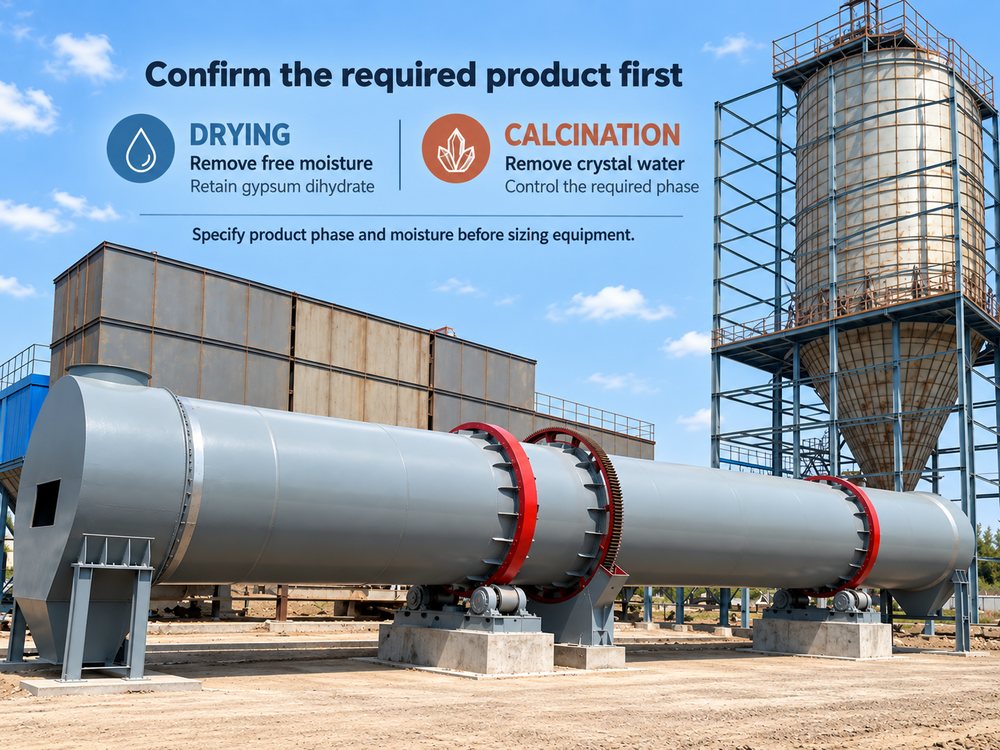
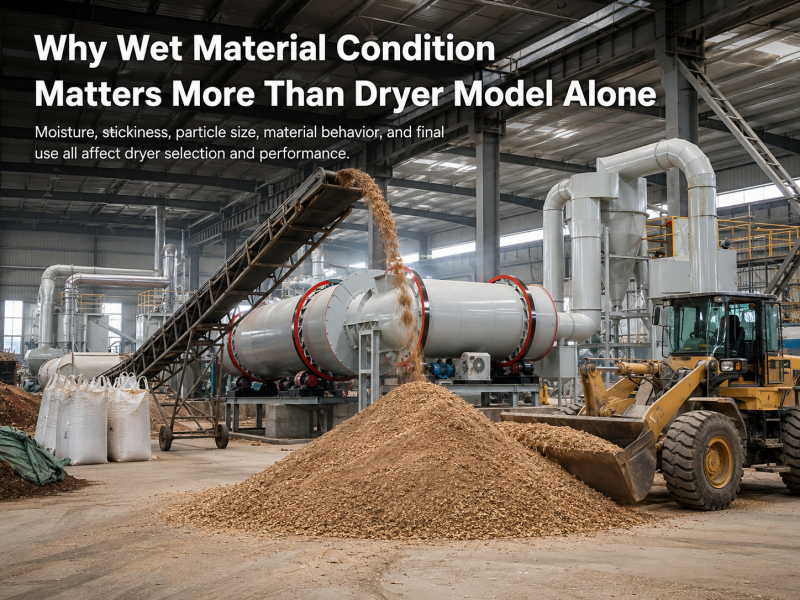
A rotary dryer can be considered when the task is to reduce free moisture in a suitable gypsum feed. Selection still depends on particle size, stickiness, moisture variation, and the product's sensitivity to heating. Our guide to how different materials change rotary dryer design explains why the material condition matters before a model is chosen.
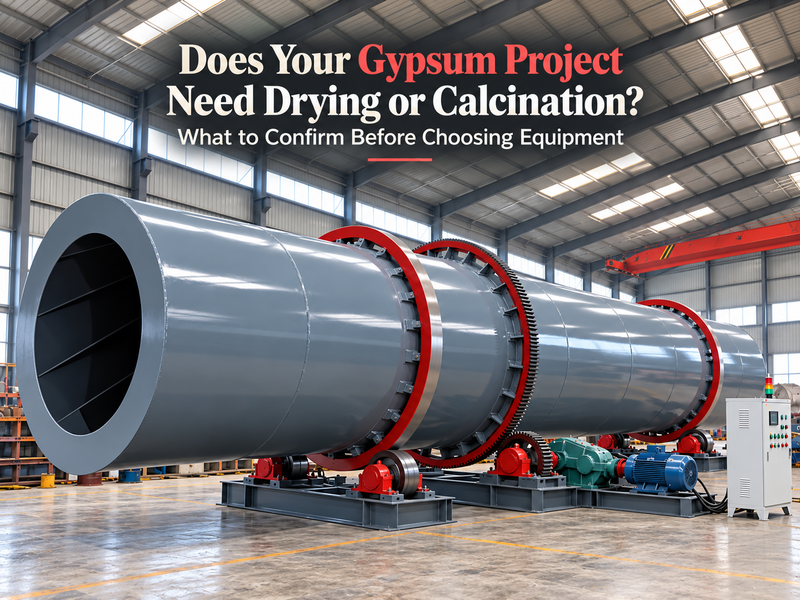
The same review applies to a three-cylinder dryer. Its arrangement does not, by itself, establish that it can produce qualified hemihydrate. Increasing the heating temperature is insufficient evidence: the proposed system must deliver the necessary treatment consistently and demonstrate the required product properties.
When calcination is required, assess a suitable calcining process. A rotary kiln is one possible equipment category, alongside other gypsum-specific technologies. Suitability depends on the feed, product specification, and process design. Some systems combine drying and calcination; others separate the duties. Neither arrangement should be assumed from the initial phrase "gypsum dryer."
For quotation purposes, ask where crushing, grinding, heating, dust collection, cooling, and storage sit in the proposed flow sheet. Identify which stages already exist and which the new supplier must provide. A proposal for the thermal section alone should have a clearly defined interface with the rest of the plant.
An inquiry stating tonnes per day should also identify whether that figure refers to wet feed or finished product. Drying removes free water, and calcination releases chemically bound water as well, so feed and product tonnages cannot automatically be treated as equal. The expected material balance needs to reflect the actual feed and target conversion.
Operating hours matter too. In a hypothetical drying project, 1,000 tonnes of wet feed processed over 20 effective hours requires an average feed rate of 50 tonnes per hour. That calculation defines the feed duty only; it does not establish the product rate, evaporation capacity, or a suitable machine size.
Provide the expected moisture range rather than only the average. Feed moisture fluctuations change the drying load even when wet feed tonnage stays constant. Planned shutdowns and the available production window should also be stated so the supplier can explain the operating assumptions behind its proposal.
Send the gypsum source, available analysis, particle size distribution, and measured free moisture range. Natural gypsum and synthetic gypsum should be identified clearly, together with known impurities or handling problems. Photos can show the physical condition, while representative samples may be needed for process testing.
Describe the intended product using the customer's specification, including the required material form and relevant quality tests. Add the capacity basis, operating hours, available fuel, power supply, site constraints, and existing equipment. If fuel selection is still open, the biomass fuel guide outlines information to discuss before choosing a compatible heating system.
Ask the supplier to state what is included, what remains subject to testing, and which product requirements the proposed process is designed to meet. This makes alternative quotations easier to assess before committing to a machine.
A useful gypsum equipment inquiry begins with a clear product definition. Establish whether the task is free moisture removal, controlled calcination, or both, then match the process and capacity to that requirement.
Share your raw material report, target product, daily capacity, operating hours, and fuel conditions with Sentai Machinery. These details help the team review the proposed drying or calcining duty and identify the testing needed before equipment selection.
Why Wet Material Condition Matters More Than Dryer Model Alone
Rotary Dryer Feed Moisture Fluctuation: Why Fuel Use and Discharge Moisture Become Unstable
Why Raw Material Preparation Matters Before Rotary Kiln Calcination
Can a Rotary Dryer Use Biomass Fuel? What Buyers Should Check Before Ordering

 WhatsApp
 Email
 +86 15538010601