
STCrushers Is A Professional Minging Equipment Manufacturer since 2004, Providing High Quality Crushers, Sand Making Machines, Drying Equipment and more.
STCrushers Is A Professional Minging Equipment Manufacturer since 2004, Providing High Quality Crushers, Sand Making Machines, Drying Equipment and more.
A buyer receives two quotations for the same nominal ball mill size. Both list similar shell dimensions, capacity, and motor power, but one price is much lower.
The difference may be hidden in the supply list. One offer includes the motor, reducer, liners, lubrication equipment, control cabinet, export packing, and spare parts. The other covers mainly the mill body and attached transmission components.
A lower price is not automatically incomplete, and a higher price is not automatically better. The offers become comparable only after the technical duty, equipment boundary, services, packing, and trade terms are placed on the same basis.
Check the process requirement before the model number. Confirm that both suppliers received the same material, feed size, capacity, target fineness, wet or dry grinding method, daily operating hours, downstream process, voltage, and frequency.
If one quotation assumes an easier duty, its motor, liner arrangement, media requirement, and expected output may differ even when the shell dimensions look similar. Ask each supplier to state the design basis so those assumptions are visible.
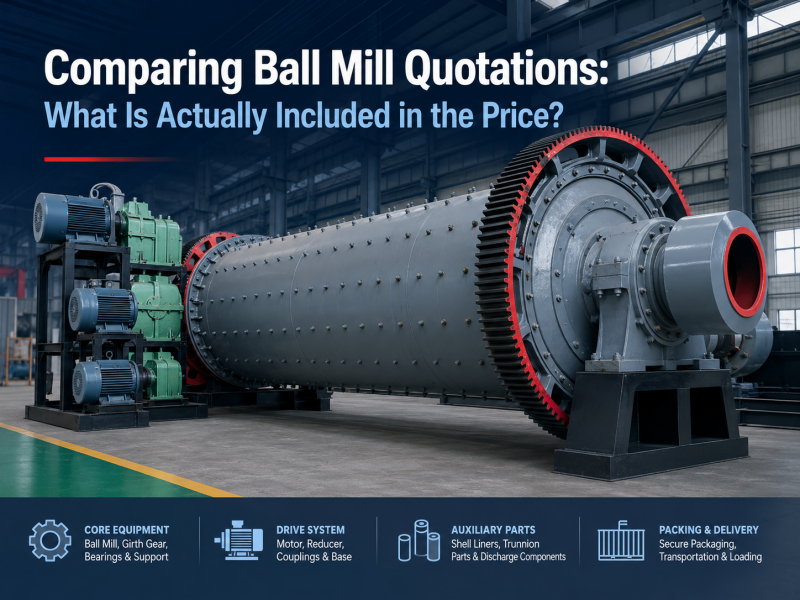
The phrase complete ball mill does not always define the same boundary. The quotation should state whether it includes the cylinder, end covers, hollow shafts or trunnions, feeding and discharge assemblies, main bearings, bearing housings, girth gear, pinion, base, guards, and internal liners.
Foundations, anchor bolts, platforms, chutes, and guards may be included or listed separately. Materials of construction should also be identified. A line that says one set of ball mill is too broad for a serious comparison.
The drive package should identify the main motor, reducer, couplings, pinion assembly, transmission guard, and any auxiliary drive needed for maintenance.
Motor power alone is not enough. Voltage, frequency, insulation class, protection grade, and starting method should be confirmed before manufacturing. If one supplier includes a complete drive package and another lists the motor or reducer as optional, those options must be added before comparing totals.
Liners may be installed before shipment, supplied loose, or excluded. The offer should identify the liner material, quantity, fastening parts, and installation scope.
The first charge of steel balls is another common difference. One supplier may include a recommended media weight and grading, while another expects the buyer to purchase it locally. Spare liners, bolts, seals, and other maintenance items should be separated from the operating set.
Any service-life estimate should remain conditional because ore hardness, abrasiveness, feed size, and operating practice affect wear.
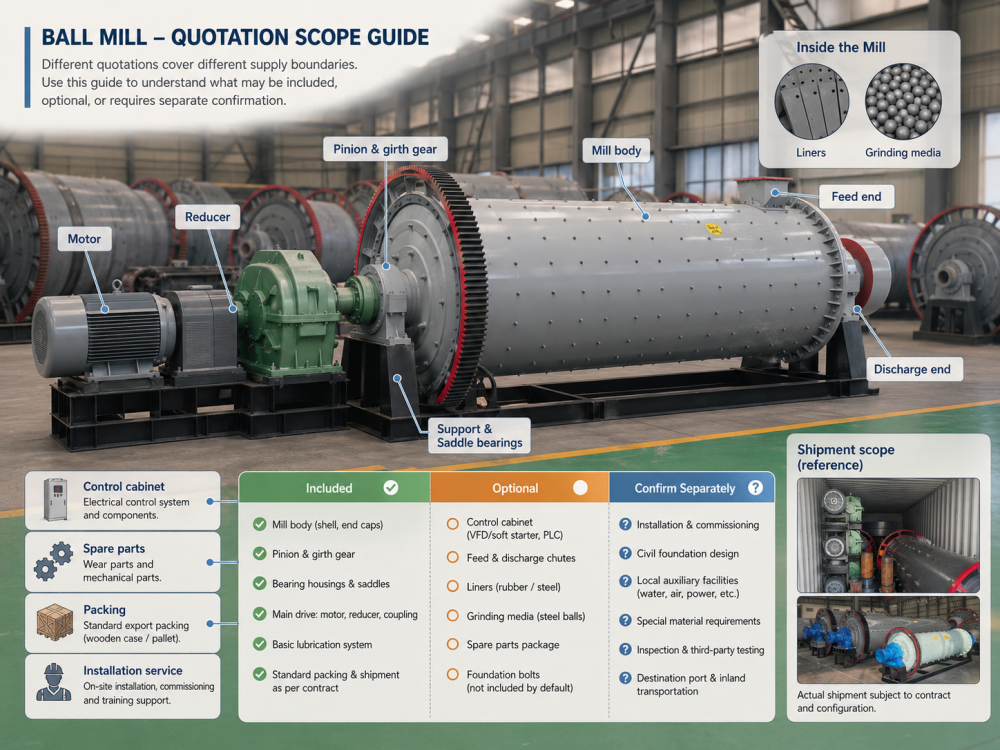
Depending on the design, the quotation may need to identify the lubrication station, pipes, fittings, instruments, local control box, electrical cabinet, interlocks, and protection devices.
The buyer should also ask where cable and piping responsibility ends. Field cables, transformers, water pipes, slurry pumps, feeders, classifiers, and conveyors are often outside the ball mill package unless written into the scope. Exclusions are normal when they are clear.
The quotation should list the general arrangement drawing, foundation drawing, installation and operation manuals, electrical diagram, lubrication instructions, packing list, spare-parts list, and motor or reducer documents.
The foundation drawing is time-sensitive because civil work may start before shipment. Buyers should also confirm document language, format, and issue schedule.
Installation support may mean remote guidance, one technician supervising local workers, mechanical installation, commissioning, operator training, or a combination.
The offer should define who provides cranes, local labor, electrical work, travel, visas, accommodation, welding tools, trial-run power, and grinding-media loading. Clear wording prevents either side from expecting a service that was never priced.
A free spare-parts package should list exact items and quantities. Recommended spares for one or two years can be quoted separately, especially when the project is far from the supplier.
The warranty clause should identify its starting point, duration, covered components, exclusions, and claim process. Wear parts are normally treated differently from manufacturing defects, while motors and reducers may follow their own supplier terms.
EXW, FOB, CFR, and CIF prices represent different delivery boundaries. A low EXW price may still require inland transport, export handling, port charges, sea freight, and insurance before the equipment reaches the destination port.
The quotation should specify export packing, rust protection, lifting marks, and protection for loose liners, motors, reducers, controls, and spares. Large ball mills may require the main body and accessories to be shipped separately.
Destination-port charges, customs clearance, inland delivery, unloading, and site lifting are normally outside a CIF equipment quotation unless expressly included. Compare offers at the same trade term and destination.
Quotation item | Offer A | Offer B | Question before comparison |
Mill body | Included | Included | Same structure and materials? |
Motor and reducer | Included | Optional | Same power system and drive scope? |
Liners | Installed | Excluded | Same material, quantity, and fasteners? |
Grinding media | First charge included | Excluded | What weight and grading are supplied? |
Lubrication and control | Included | Partly included | Where do piping, wiring, and controls end? |
Spare parts | Itemized set | Not stated | Which parts and quantities are included? |
Packing | Export seaworthy packing | Basic protection | Suitable for the planned shipment? |
Installation | Remote guidance | On-site supervision | Are travel and local costs included? |
Trade term | FOB | EXW | What cost remains before destination arrival? |
After clarification, ask each supplier to issue a revised summary using the same structure. It should show the base equipment, mandatory accessories, options, spare parts, services, packing, trade term, delivery time, payment terms, and quotation validity.
The final purchase order should attach the agreed technical specification and supply list. The total price then represents a defined package rather than a model name.
Two ball mills with the same nominal size can still represent different purchases. The difference may be in the drive, liners, grinding media, controls, documents, packing, installation support, spares, or delivery terms.
A useful comparison standardizes the grinding duty and checks every included and excluded item. This reveals the real lowest price without hiding the additional equipment and services needed before operation.
Sentai Machinery can prepare an itemized ball mill quotation based on the material, feed size, capacity, grinding fineness, local power supply, delivery port, and requested service boundary. Send the project data and preferred trade term so the technical and commercial scope can be reviewed together.
1. How to Choose a Ball Mill for Mineral Processing
2. What Buyers Should Confirm Before Choosing a Ball Mill for Ore Grinding
3. What Buyers Often Miss When Matching a Ball Mill and Spiral Classifier
4. How to Ship a Ball Mill Overseas: Container Loading and Packing Tips
5. What Photos and Documents Should Be Prepared Before Overseas Equipment Shipment
1. Ball Mill

 WhatsApp
 Email
Email
 +86 15538010601