
STCrushers Is A Professional Minging Equipment Manufacturer since 2004, Providing High Quality Crushers, Sand Making Machines, Drying Equipment and more.
STCrushers Is A Professional Minging Equipment Manufacturer since 2004, Providing High Quality Crushers, Sand Making Machines, Drying Equipment and more.
Many buyers begin a ball mill inquiry with a simple question:
How much is a ball mill for 5 tons per hour?
This question is understandable, but it is not enough for correct equipment selection. In ore processing, a ball mill is not a stand-alone machine that can be selected only by hourly capacity. It works between crushing, classification, and beneficiation. If the information before and after grinding is not clear, the selected model may be too small, too large, or not suitable for the final recovery process.
For Sentai Machinery, a useful ball mill inquiry should not start only from price. It should start from ore condition, feed size, target grinding fineness, grinding method, classifier matching, and downstream beneficiation process.
The more complete the information is, the easier it is to recommend a practical ore grinding solution.
Different ores behave differently in grinding.
Gold ore, copper ore, iron ore, lead-zinc ore, manganese ore, and other minerals do not have the same hardness, density, mineral composition, or liberation requirement. Even within the same ore type, the grinding difficulty may be different because of ore structure and gangue minerals.
For example, some gold ores need fine grinding before flotation or leaching. Some iron ores may need suitable grinding before magnetic separation. Some copper ores require grinding conditions that help the following flotation process.
If the ore type is not clear, the ball mill selection becomes too general. A buyer should provide the ore name, basic material description, photos or videos, and any available test information.
If the ore has already been tested, the report is very useful. If not, a simple sample test or at least a clear material description can help avoid wrong equipment matching.
A ball mill is designed for grinding, not for primary crushing.
Before material enters the ball mill, it should usually be crushed to a suitable size. If the feed size is too large, the ball mill will consume more energy, grinding efficiency will drop, and the liner and grinding media may wear faster. The mill may still run, but it will not work under efficient grinding conditions.
This is why buyers should confirm the size of material entering the ball mill, not only the size of the raw ore.
1. Raw ore size before crushing
2. Crusher type used before grinding
3. Actual feed size to the ball mill
4. Whether the feed size is stable or mixed
If the crushing stage is not planned well, the grinding stage will carry extra load. A good ore processing plant should match crusher discharge size with ball mill feed requirement.
The target grinding fineness is one of the most important points in ball mill selection.
Different beneficiation processes need different grinding results. Flotation, magnetic separation, gravity separation, and leaching may require different particle sizes. The goal is not always to grind as fine as possible. The goal is to grind enough for mineral liberation and downstream processing.
If the product is too coarse, valuable minerals may not be fully liberated. Recovery may be low. If the product is too fine, over-grinding may increase energy cost, create more slime, and make later separation more difficult.
Buyers should confirm the required discharge fineness before choosing a ball mill. If the exact fineness is not known, the supplier should understand the downstream process and help judge a reasonable grinding target.
For many ore projects, the ball mill and classifier should be considered together because the classifier controls which particles return to the mill and which particles move forward to the next process.
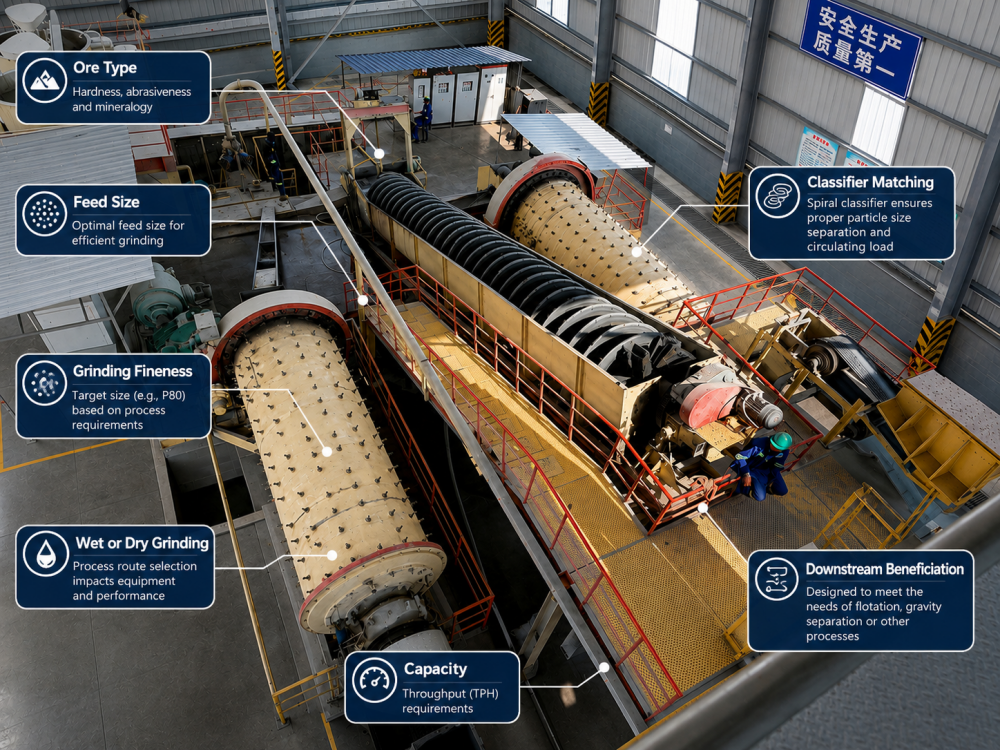
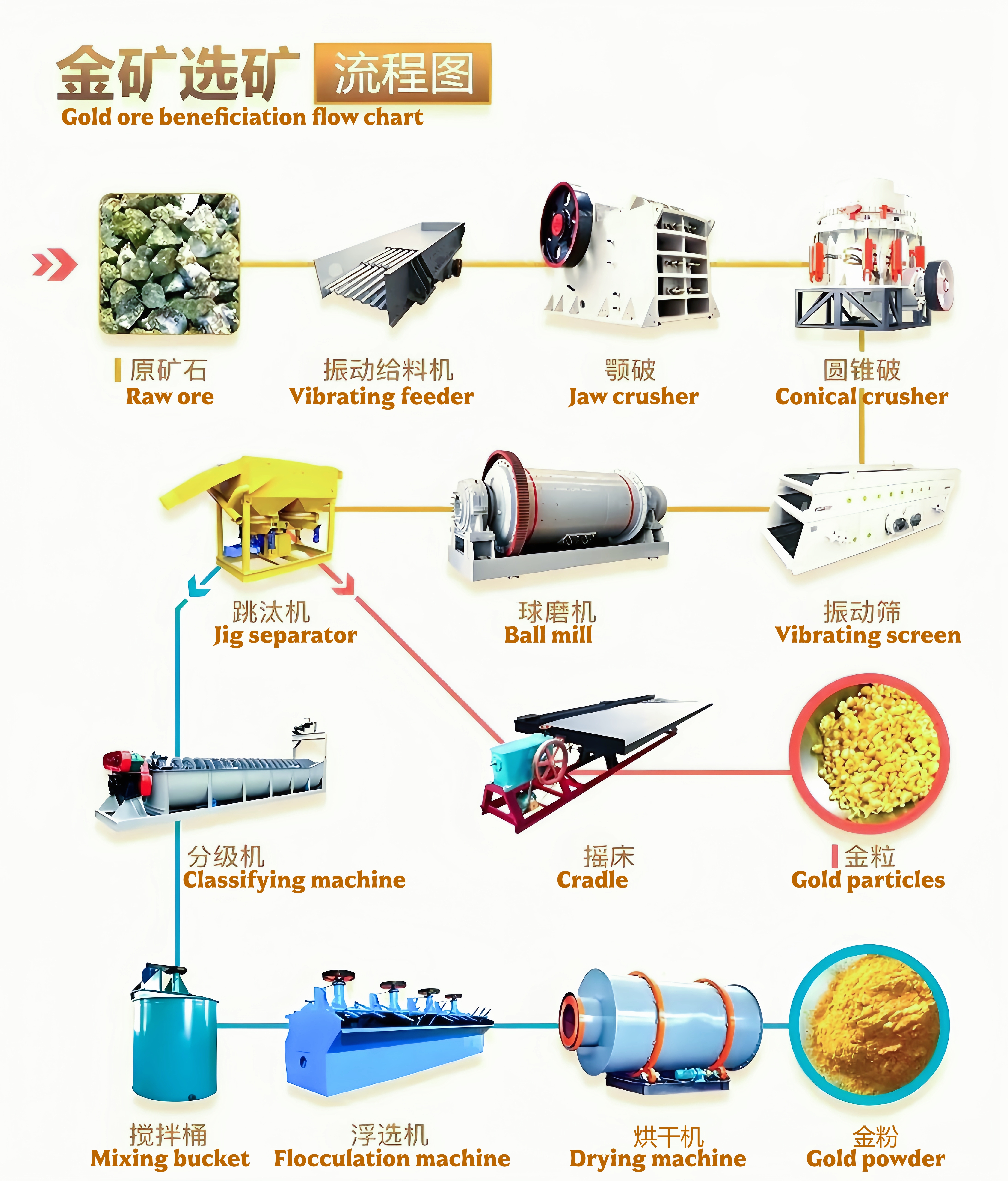
Ore grinding can be wet or dry, but many beneficiation processes use wet grinding because the following separation stage also works with slurry.
Wet grinding is commonly connected with spiral classifier, flotation machine, magnetic separator, or other mineral processing equipment. It helps material flow through the plant as slurry. However, wet grinding requires water supply, slurry handling, and proper process arrangement.
Dry grinding may be used in some special material or process conditions, but it is not the default answer for every ore.
Before choosing a ball mill, buyers should confirm whether the project will use wet grinding or dry grinding. This decision affects the mill structure, discharge method, classifier matching, water use, foundation, and plant layout.
Capacity should be discussed carefully.
When a buyer says 5 tons per hour, the supplier needs to know whether this means raw ore feed, crushed feed to the ball mill, or final qualified grinding product. These are not always the same.
If the classifier returns a large amount of coarse material back to the ball mill, the circulating load inside the grinding circuit may be higher than the final output. If the ore is hard or the target fineness is very fine, the same ball mill may produce less qualified material per hour.
This is why capacity should be connected with ore hardness, feed size, target fineness, and classifier performance.
A correct inquiry should include:
1. Planned processing capacity per hour or per day
2. Working hours per day
3. Feed size to the ball mill
4. Target grinding fineness
5. Downstream beneficiation process
Without these details, capacity may be misunderstood.
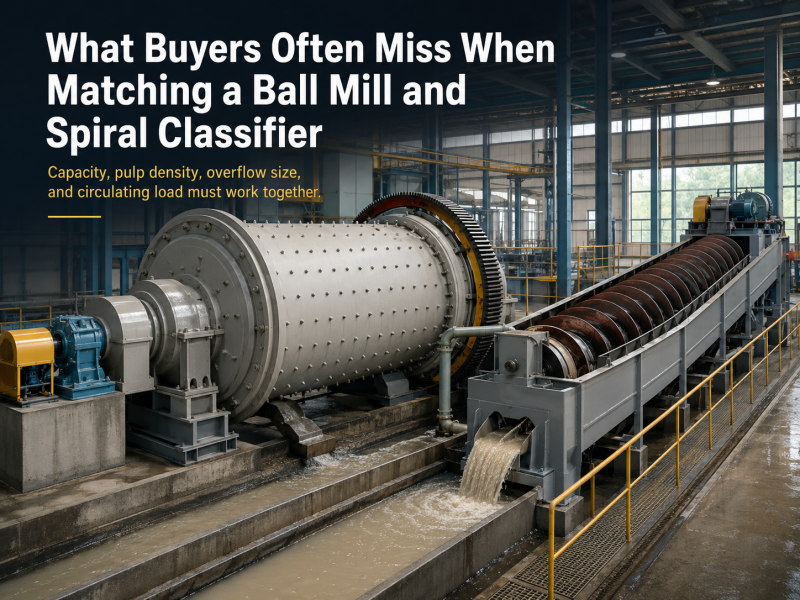
In many ore grinding circuits, the ball mill is used together with a spiral classifier.
The ball mill grinds the ore. The classifier separates particles according to size. Qualified fine material moves to the next process, while coarse material returns to the ball mill for further grinding.
If the classifier is not matched properly, the whole grinding circuit may become unstable. Too much coarse return material can increase mill load. Poor classification can send unsuitable particles to flotation, magnetic separation, or other beneficiation stages.
Buyers should not ask for a ball mill only if the actual project needs a closed grinding circuit. They should also confirm whether a spiral classifier, pump, slurry tank, or other supporting equipment is needed.
A ball mill quote without classification discussion may look simple, but it may not represent the real plant requirement.
The ball mill should be selected according to what happens after grinding.
If the next process is flotation, the grinding fineness should support mineral liberation and reagent reaction. If the next process is magnetic separation, the grinding result should help magnetic minerals separate from gangue. If the next process is gravity separation, over-grinding may not always be helpful, especially when coarse valuable minerals need to be recovered.
This means ball mill selection is not only a mechanical decision. It is a process decision.
Before recommending equipment, the supplier should know whether the project is for gold, copper, iron ore, or another mineral, and whether the planned process is flotation, magnetic separation, gravity separation, CIP, or another route.
A ball mill is heavy equipment. Site conditions matter.
Before final selection, buyers should confirm foundation conditions, available space, power supply, water supply, crane or lifting conditions, and access roads for transportation. They should also consider maintenance space around the mill, classifier, motor, reducer, and discharge area.
If the site space is limited, the plant layout may need adjustment. If power supply is unstable, the drive system and control method should be considered carefully. If water supply is limited, wet grinding and slurry transport need special attention.
Equipment selection should match the real site, not only the process drawing.
Before asking for a ball mill quotation, buyers can prepare the following information.
Information Needed | Why It Matters |
Ore type | Helps judge grinding behavior and process route |
Raw ore size | Helps design the crushing stage |
Feed size to ball mill | Affects mill load and grinding efficiency |
Required capacity | Decides model selection and plant scale |
Target grinding fineness | Affects mill size and classifier matching |
Wet or dry grinding | Affects structure and process layout |
Downstream process | Connects grinding with recovery result |
Classifier requirement | Helps form a stable grinding circuit |
Water and power supply | Affects operation and site design |
Site layout condition | Affects foundation, installation, and maintenance |
Choosing a ball mill for ore grinding should not be based only on price, model name, or hourly capacity.
A suitable ball mill depends on ore type, feed size, grinding fineness, wet or dry grinding method, classifier matching, downstream beneficiation process, and site conditions.
For buyers, the better question is not only "How much is a ball mill?" A more useful question is "What grinding result does my ore processing plant need, and what information should I confirm before choosing the mill?"
When these conditions are clear, the supplier can recommend a more suitable ball mill and grinding circuit for the project.
If you are planning an ore grinding project, Sentai Machinery can help review your material condition, feed size, grinding target, processing capacity, classifier requirement, and downstream beneficiation process.
Send us your ore photos or videos, raw material size, expected capacity, target fineness, wet or dry grinding plan, and final separation method. Our team can help recommend a suitable ball mill and ore processing solution.
1. What Buyers Often Miss When Matching a Ball Mill and Spiral Classifier
2. Why Crushing Size Before Ball Milling Affects Grinding Cost
3. How Grinding Stability Affects Flotation Performance
4. Why Is Magnetic Separator Recovery Lower Than Expected
5. What Buyers Should Know Before Choosing Equipment for a Small Gold Ore Processing Plant

 WhatsApp
 Email
Email
 +86 15538010601