
STCrushers Is A Professional Minging Equipment Manufacturer since 2004, Providing High Quality Crushers, Sand Making Machines, Drying Equipment and more.
STCrushers Is A Professional Minging Equipment Manufacturer since 2004, Providing High Quality Crushers, Sand Making Machines, Drying Equipment and more.
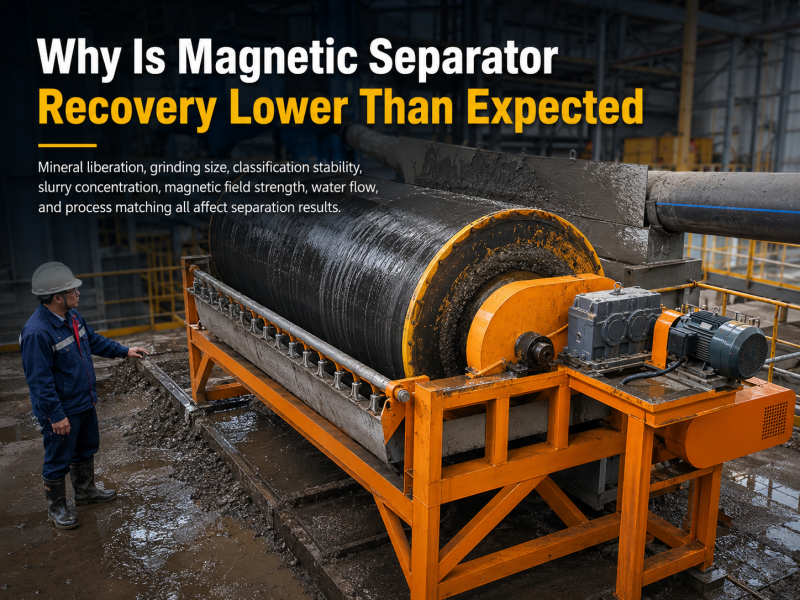
In many beneficiation plant projects, the magnetic separator looks like it is working normally.
The drum is rotating. Slurry is entering the tank. Concentrate is being discharged. Tailings are flowing away from the separation area. From outside, the equipment seems to be running.
But the buyer may still find a serious problem.
Recovery is lower than expected.
Some valuable magnetic minerals remain in the tailings. The concentrate grade changes during the shift. The final result is not as stable as the buyer expected.
At this point, many people first blame the magnetic separator. They may think the magnetic field is not strong enough, the drum is too small, or the machine model is wrong. Sometimes equipment selection can be part of the problem. But in many cases, low magnetic separator recovery is caused by the whole process, not only by the separator itself.
For Sentai Machinery, this kind of problem should be checked from the final result backward. Start from concentrate and tailings, then look back at grinding, classification, slurry condition, magnetic field matching, and process design.
Before adjusting the magnetic separator, the buyer should first define the problem clearly.
Low recovery means too much valuable magnetic material is still left in the tailings. Low concentrate grade means too much unwanted material is entering the concentrate. These two problems are different.
If recovery is low, the plant may need better liberation, better magnetic capture, suitable slurry concentration, or another separation stage. If concentrate grade is low, the plant may need better classification, cleaner separation, lower entrainment, or a different magnetic separation arrangement.
Some sites try to solve both problems by only increasing magnetic field strength. This is not always effective. A stronger magnetic field may capture more magnetic particles, but it may also bring more gangue into the concentrate if the material is not properly liberated or classified.
So the first step is to check both concentrate and tailings, not only the machine setting.
A magnetic separator can only separate what has been properly liberated.
If magnetic minerals are still locked together with gangue minerals, the separator cannot fully recover them as clean concentrate. Even if the magnetic field captures part of the particle, the final concentrate grade may be unstable because valuable minerals and gangue are still connected.
This is common in iron ore processing when the grinding size is too coarse. The ore may look crushed and ground, but the useful minerals are not separated enough from the surrounding rock.
In this situation, the real problem starts before magnetic separation. The ball mill, grinding time, classification result, and ore characteristics must be checked.
A magnetic separator is not a replacement for proper grinding and liberation.
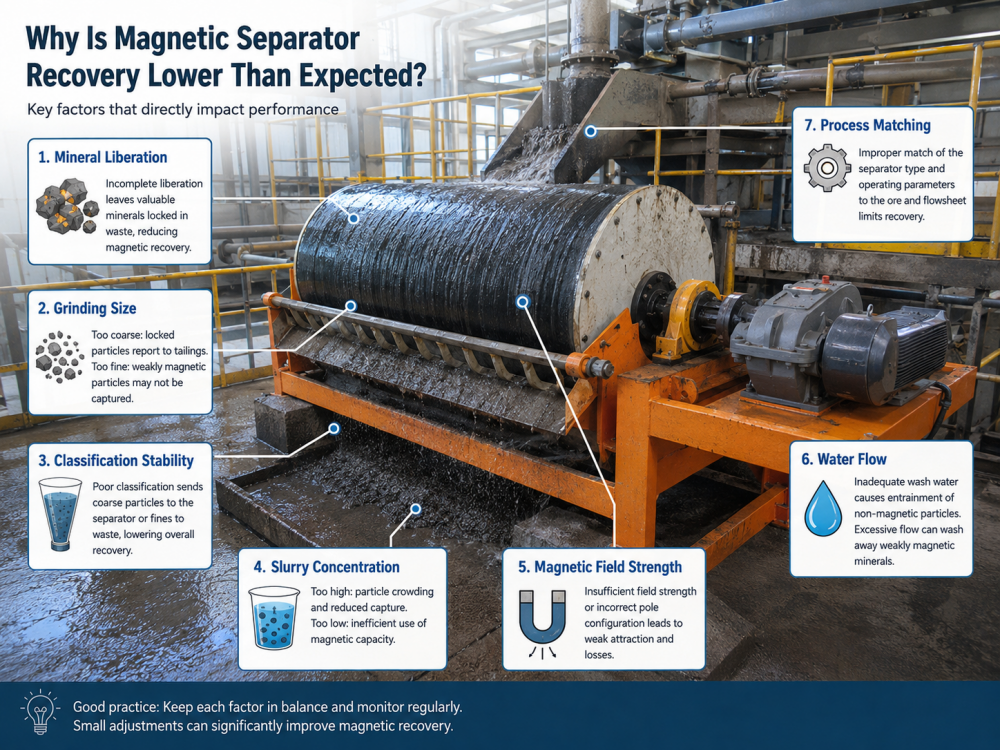
Grinding fineness is one of the most important factors for magnetic separation recovery.
If the material is too coarse, useful minerals may not be released. Recovery can be low because the separator cannot capture locked particles effectively.
If the material is ground too fine, another problem may appear. Very fine particles can be harder to control in slurry. They may be carried away with water flow, mix with slime, or reduce separation efficiency. Over-grinding can also increase energy cost before the separation stage.
This means the goal is not simply to grind as fine as possible. The goal is to reach a suitable particle size where magnetic minerals are liberated enough, while avoiding unnecessary over-grinding.
That is why the ball mill and spiral classifier should be considered together with the magnetic separator. If grinding and classification are unstable, the magnetic separation result will also be unstable.
The spiral classifier or other classification equipment affects what material enters the magnetic separator.
If classification is unstable, coarse particles and fine particles may enter the magnetic separator at the same time in an uncontrolled way. The separator then receives a changing feed condition, and the recovery result becomes difficult to control.
For example, if too much coarse material enters the magnetic separator, liberation may be insufficient. If too much fine slime enters, the separation area may become overloaded, and valuable particles may be lost with tailings.
Stable magnetic separation needs stable feed size.
This is why beneficiation plants should not judge the magnetic separator alone. They should also check the grinding and classification circuit before the separator.
Slurry concentration is another common reason for low recovery.
If the slurry is too thick, particles may not separate smoothly. Magnetic particles, gangue, and water flow may move together in a crowded condition. This can reduce magnetic capture efficiency and make concentrate quality unstable.
If the slurry is too thin, the separator may not receive enough solids per unit time, and production efficiency may drop. Valuable fine particles may also be carried away more easily if water flow is not controlled well.
The problem becomes worse when slurry concentration changes during production. A magnetic separator needs a stable feed condition. If concentration goes up and down, the separation zone cannot stay balanced.
So the site should not only check capacity in tons per hour. It should also check slurry flow, pulp density, and whether feeding is continuous.
Many buyers think that higher magnetic field strength always means better recovery. This is not always true.
Different minerals need different magnetic separation conditions. Strongly magnetic minerals and weakly magnetic minerals do not require the same magnetic field. Coarse particles and fine particles also behave differently.
If the magnetic field is too weak for the mineral type, recovery may be low because useful particles are not captured effectively. If the magnetic field is too strong, the separator may capture more unwanted material, especially when the ore is not well liberated or contains mixed particles.
The right magnetic separator should be selected according to ore type, mineral magnetic property, particle size, feed concentration, and target concentrate requirement.
Magnetic field strength is important, but it must be matched with the real ore condition.
Inside the magnetic separator, water flow, tank condition, drum surface, and discharge area all affect the final result.
If water flow is not suitable, valuable magnetic particles may be washed away with tailings. If the tank has accumulated material or the flow is not smooth, separation efficiency may drop. If the drum surface, scraper, or discharge area is not maintained well, concentrate discharge may become unstable.
In some cases, the separator model is suitable, but poor operation or maintenance reduces recovery.
The site team should check whether the magnetic separator is operating under stable mechanical and slurry conditions, not only whether the drum is rotating.
Some ores cannot be handled well by only one magnetic separation stage.
Depending on ore condition, a plant may need roughing, cleaning, and scavenging. Roughing helps recover more useful minerals. Cleaning helps improve concentrate grade. Scavenging helps reduce valuable mineral loss in tailings.
If the ore is complex or the target result is strict, one separator may not solve both recovery and grade problems at the same time.
A proper beneficiation process should be designed around ore test data and final concentrate requirements. The magnetic separator is important, but the separation stages must also be arranged correctly.
When magnetic separator recovery is lower than expected, buyers can check the process in this order.
Check Point | What to Look At | Why It Matters |
Tailings result | Magnetic minerals left in tailings | Shows whether recovery is low |
Concentrate grade | Useful mineral percentage | Shows whether separation is clean |
Liberation | Mineral locked with gangue or released | Decides whether separation is possible |
Grinding size | Too coarse or over-ground | Affects recovery and stability |
Classification | Stable or mixed feed size | Controls feed to separator |
Slurry concentration | Too thick, too thin, or changing | Affects separation zone |
Magnetic field | Match with mineral type | Affects capture efficiency |
Water flow | Stable or excessive washing | May carry away useful particles |
Equipment condition | Drum, tank, scraper, discharge | Affects operation stability |
Process stages | Roughing, cleaning, scavenging | Affects final recovery and grade |
This diagnosis path helps buyers avoid changing the magnetic separator blindly before checking the whole beneficiation process.
Low magnetic separator recovery is not always caused by the separator itself.
The real reason may come from insufficient mineral liberation, unsuitable grinding size, unstable classification, poor slurry concentration control, mismatched magnetic field strength, improper water flow, equipment wear, or incomplete process design.
For buyers, the better question is not only "Is the magnetic separator strong enough?" A more useful question is "Can the material entering the separator be separated effectively under stable process conditions?"
When the problem is checked from concentrate and tailings backward, the plant can find the real bottleneck more accurately and improve both recovery and concentrate stability.
If your magnetic separator recovery is lower than expected, Sentai Machinery can help review your beneficiation process according to ore type, grinding size, classification result, slurry concentration, magnetic separator model, magnetic field requirement, tailings condition, and target concentrate grade.
Send us your ore photos or videos, particle size data, current recovery result, concentrate grade, tailings condition, and processing capacity target. Our team can help analyze the possible cause and recommend a suitable magnetic separation and iron ore processing solution.
1. What Buyers Often Miss When Matching a Ball Mill and Spiral Classifier
2. Why Crushing Size Before Ball Milling Affects Grinding Cost
3. How Grinding Stability Affects Flotation Performance
4. What Buyers Should Know Before Choosing Equipment for a Small Gold Ore Processing Plant
5. What Buyers Often Ignore When Choosing a Vibrating Screen

 WhatsApp
 Email
Email
 +86 15538010601