
STCrushers Is A Professional Minging Equipment Manufacturer since 2004, Providing High Quality Crushers, Sand Making Machines, Drying Equipment and more.
STCrushers Is A Professional Minging Equipment Manufacturer since 2004, Providing High Quality Crushers, Sand Making Machines, Drying Equipment and more.
A Busy Crushing Line Is Not Always an Efficient One
A stone crushing plant may look busy all day.
Material keeps moving on the belts. The screen keeps separating. The return belt keeps sending oversized material back. The crusher keeps working.
From a distance, everything appears active.
But the final output may still feel lower than expected.
In many plants, one hidden reason is not the main crusher alone. It is the return material ratio inside the line.
If too much material keeps circulating back for re-crushing, the plant may spend a large part of its energy reprocessing material instead of producing final saleable aggregate efficiently. This is why some lines look full and active but still do not feel productive.
A high return material ratio is not always a sign of a serious failure. But it is often a sign that the line is not balanced as well as it should be.
Quick Answer
A high return material ratio means the plant is spending too much time and capacity reprocessing material instead of turning it into final product efficiently.
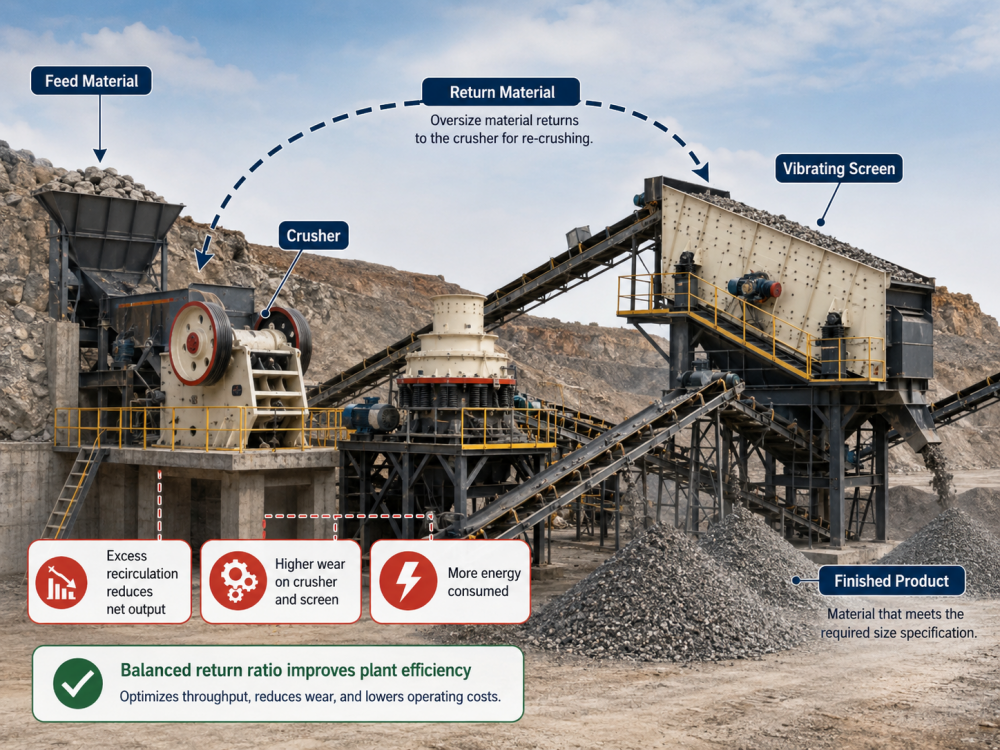
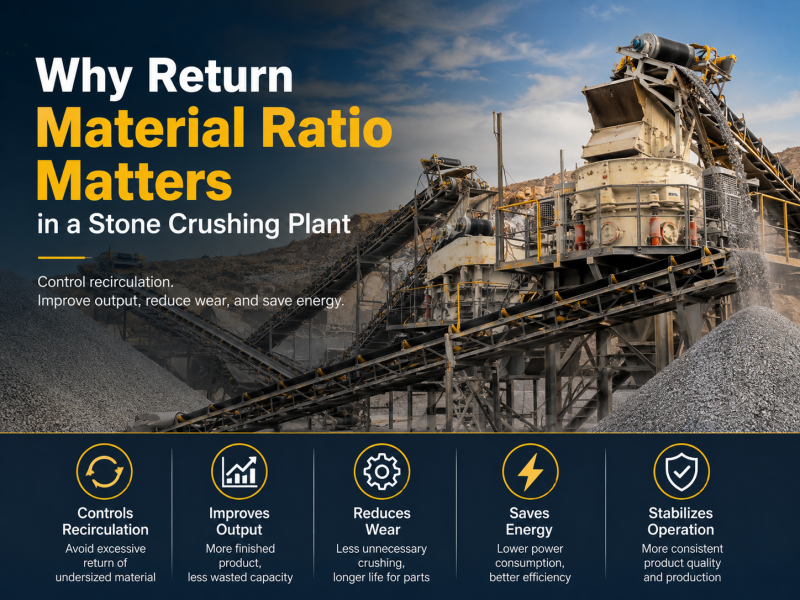
That usually leads to lower real output, higher wear, more power consumption, heavier screen pressure, and less stable plant performance.
In simple terms, too much recirculation often means the line is working hard but not working smart.
Why Return Material Ratio Matters More Than Many Buyers Think
Some buyers do not pay much attention to return material ratio because it feels like a normal part of closed-loop crushing.
That is partly true. Some return flow is normal.
But when the return ratio becomes too high, it starts to affect the whole plant.
It affects real throughput because the line may be processing a large internal flow, but the final finished product output does not rise in proportion.
It affects wear because more recirculation means more repeated crushing and more repeated screening. That increases wear on crushers, screens, and conveyors.
It affects energy use because if the same material keeps moving through the line again and again, power is being consumed without equivalent value being created.
It affects plant stability because heavy return flow can make the line more sensitive to feed changes, screen blockage, and operating adjustment.
This is why return material ratio is not just a technical detail. It is a useful sign of how balanced the plant really is.
What Return Material Ratio Actually Tells You
A high return material ratio usually tells you something deeper about the line.
It may suggest:
crusher discharge is not well matched to screening requirement
screening logic is not suitable for the final product target
feed size is not consistent enough
the line is chasing a stricter product than the current setup can comfortably produce
one stage is putting too much pressure on the next stage
So return material ratio is not only a number. It is a signal.
A plant with healthy process balance will still have some circulating material, but not so much that the return loop starts dominating plant behavior.
1. Crusher Discharge Is Not Well Matched to Screen Requirement
This is one of the most common reasons.
If the crusher discharge size distribution does not match what the screen is expected to separate, too much material may go back into the return loop.
This often happens when the discharge is too coarse, the crushing stage is not reducing material in the intended range, or the line expects a tighter result than the crusher is currently producing.
In that case, the screen is not doing anything wrong. It is only sending back what the crusher did not reduce appropriately.
Practical point
A high return ratio may be a crusher-setting issue as much as a screening issue.
2. Screen Mesh or Screening Logic Is Not Suitable
Sometimes the crusher is not the main problem. The screening logic is.
If screen mesh selection is too tight, too aggressive, or not well matched to the final product goal, the plant may send back more material than necessary.
That does not always mean the screen is poor quality. It may simply mean the line is trying to separate material in a way that creates too much internal pressure.
What often goes wrong
mesh setup does not match realistic crusher discharge
final size split is stricter than the line can comfortably support
screening arrangement looks good on paper but creates too much recirculation in practice
Practical point
A return loop problem may begin with separation logic, not only with crushing force.
3. Feed Size Is Too Inconsistent
A stable line needs reasonably stable feed.
If the feed entering the crusher changes too much in size, the discharge result becomes harder to control. That often leads to more oversized material reaching the screen, which then increases return flow.
This problem becomes worse when upstream feeding is rough, oversized stones enter too frequently, the material mix changes throughout the day, or the plant is trying to run near capacity without stable feed preparation.
Practical point
In some plants, the return ratio looks like a crusher problem, but it actually starts with inconsistent feed.
4. Final Product Target Is Too Strict for the Current Setup
Some plants ask the line to produce very controlled aggregate sizes with a relatively simple configuration.
That can work up to a point. But if the final target is stricter than the line is naturally suited for, the return loop will carry the pressure.
This often happens when buyers want tighter finished size control, more refined aggregate shape, more product size separation, or higher quality output from a relatively simple process route.
The line may still run, but internal recirculation becomes heavier.
Practical point
A plant can be overloaded by quality expectation as well as by tonnage.
5. Process Balance Between Stages Is Weak
A crushing plant should be judged as a system, not as a list of machines.
If one stage is too strong, too weak, or poorly matched to the next stage, the return loop often becomes the place where imbalance shows up.
For example:
the crusher pushes material faster than the screen can classify well
the screen returns too much load back to a stage that is already under pressure
conveyor and return flow layout create bottlenecks
In these cases, the return ratio becomes high not because one machine is bad, but because the system is not working as a coordinated whole.
Quick Diagnosis Table
Return Material Problem | What It Causes | What to Check First |
Too much oversized return | Lower real finished output | Check crusher discharge range |
Return belt always heavily loaded | Internal flow dominates plant time | Check screen logic and mesh setup |
Line looks busy but output stays modest | Energy is spent on recirculation | Check how much material is being reprocessed |
Wear rises too quickly | Crushers and screens work harder than necessary | Check whether recirculation is excessive |
Plant becomes hard to stabilize | Flow pressure keeps shifting | Check feed consistency and stage balance |
A Common Wrong Assumption
A plant owner sees a lot of circulating material and thinks: The line is processing strongly.
This is a very understandable misunderstanding.
The belts are moving. The machines are loaded. The return line is active. Everything looks powerful.
But that does not necessarily mean the plant is efficient.
If too much material is simply going around the loop again and again, the line may be consuming wear life, power, and operator attention without turning enough of that activity into final product.
In that situation, a busy line is not the same as a productive line.
What Plant Owners Should Check First
Before trying to solve high return flow by guesswork, plant owners should check:
Is crusher discharge too coarse for the current screen setup
Is screen mesh logic realistic for the final product target
Is the return belt carrying more load than it should
Is feed size stable enough
Has the final product requirement become stricter than the line can support comfortably
Is the process balance between crushing and screening weak
These questions usually lead to a more useful diagnosis than blaming one machine alone.
Final Thought
Return material ratio matters because it reveals how efficiently the crushing line is turning internal flow into finished product.
Some return flow is normal. But when it becomes too high, the plant may start losing efficiency, increasing wear, and using more power than necessary.
At Sentai machinery, we help customers evaluate crushing lines as complete systems. In many cases, lowering unnecessary return material is not about buying a bigger machine. It is about improving process balance, equipment matching, and realistic product targeting.
If your stone crushing plant looks busy but still feels inefficient, send Sentai machinery your raw material type, feed size, output target, and process layout for a more practical suggestion.
Related Articles:
Why Is My Sand Production Line Output Too Low? 7 Common Causes and Fixes
How to Match Jaw Crusher and Vibrating Screen in a Stone Crushing Plant
What Determines Finished Aggregate Shape in an Impact Crushing Process
Suggested Solutions:
80-100 tph Stone Crusher Plant
100-150 tph Stone Crusher Plant


 WhatsApp
 Email
Email
 +86 15538010601