
STCrushers Is A Professional Minging Equipment Manufacturer since 2004, Providing High Quality Crushers, Sand Making Machines, Drying Equipment and more.
STCrushers Is A Professional Minging Equipment Manufacturer since 2004, Providing High Quality Crushers, Sand Making Machines, Drying Equipment and more.
Many buyers spend a long time comparing crushers, but treat the vibrating screen as a simple supporting machine.
In practice, however, screening performance often decides whether a crushing plant runs smoothly or keeps struggling with circulation pressure, unstable product size, and unnecessary process imbalance.
A crushing line may have a strong crusher, sufficient motor power, and a large production target, yet still fail to operate efficiently if the screening stage is not properly matched to the process.
This is why experienced plant operators usually pay close attention not only to crushing capacity, but also to screening efficiency and material classification behavior.
A vibrating screen does much more than separate stone by size. In many plants, it directly influences:
- return material ratio
- crusher pressure
- plant balance
- aggregate quality
- production stability
When choosing a vibrating screen, many buyers focus mainly on screen size and capacity.
But in real crushing plants, screening performance is also strongly affected by mesh arrangement, feed distribution, vibration condition, process balance, and crusher discharge behavior.
A larger screen alone does not automatically create better screening efficiency.
In many crushing and sand making plants, the vibrating screen becomes the center point of process balance.
It decides how materials are separated, how much oversized material returns for re-crushing, how stable the final aggregate sizes remain, and how much pressure moves back toward the crusher.
If screening performance becomes unstable, the effects often spread across the whole line.
Poor screening efficiency may cause excessive oversized circulation, increasing internal flow pressure.
If too much material returns from the screen, the crusher may spend more time reprocessing material instead of generating final product.
Unstable screening may create fluctuating aggregate sizes and inconsistent finished material quality.
A crushing line works best when crushing and screening stages stay balanced. Weak screening performance often disrupts that balance.
This is why the vibrating screen should not be treated as a secondary machine in the production line.
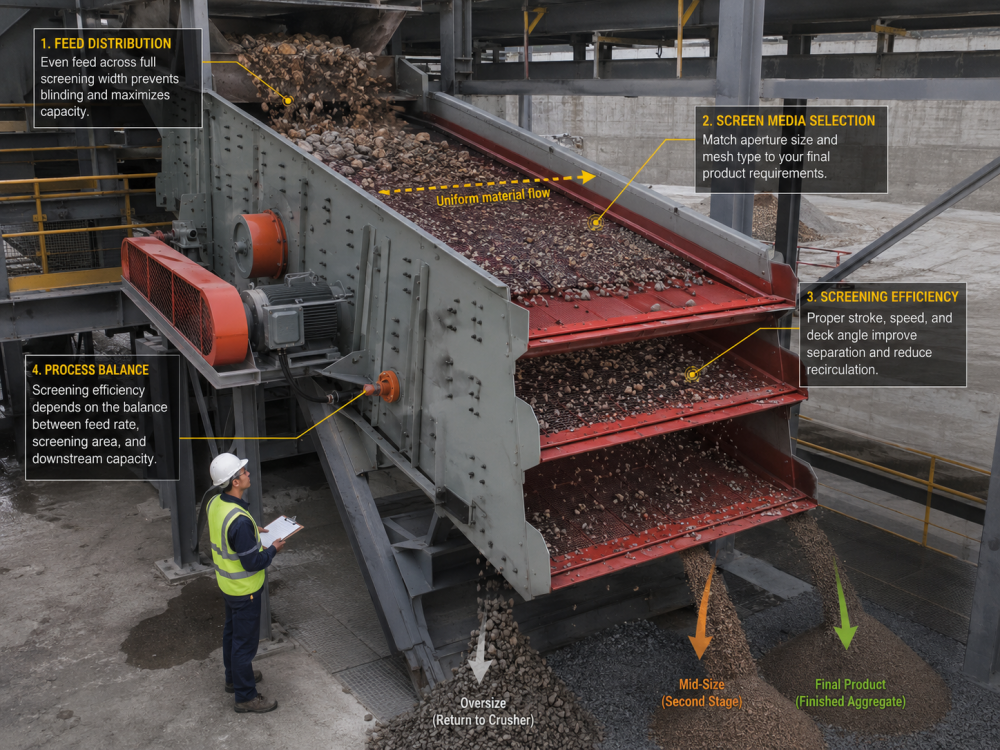
Some buyers assume that a larger screen automatically means better screening performance.
That is not always true.
Screening efficiency depends on several factors working together:
- vibration behavior
- material distribution
- screen angle
- mesh selection
- feed consistency
- material moisture
A large screen with poor material distribution may still perform worse than a properly balanced medium-sized screen.
Practical point: Screen size matters, but process matching matters more.
Mesh selection is one of the most underestimated parts of screen selection.
The mesh arrangement directly affects final product classification, return material pressure, screening efficiency, and crusher circulation load.
If mesh sizes are too aggressive or too strict for the crusher discharge condition, the line may create unnecessary recirculation.
This often leads to overloaded return belts, lower real throughput, unstable plant behavior, and increased wear.
Common mistake: Some plants chase very strict finished product separation without adjusting the overall process balance accordingly.
Even a good vibrating screen can perform poorly if material distribution is uneven.
When material enters the screen improperly, one section of the screen becomes overloaded while another section becomes underutilized. Effective screening area decreases, and the screen may no longer perform according to its rated capacity.
This may reduce separation efficiency and increase oversized carryover.
Feed problems often come from unstable conveyor discharge, uneven material flow, excessive feed concentration, and poor upstream arrangement.
Practical point: Screening efficiency depends not only on the screen itself, but also on how material reaches the screen surface.
Some plant owners notice excessive return material and immediately assume: We need a bigger screen.
Sometimes that helps. Sometimes it does not.
If the real problem comes from unsuitable crusher discharge, unstable feed, unrealistic mesh arrangement, or process imbalance, then a larger screen alone may not solve the issue.
The plant may simply continue circulating material at a larger scale.
Practical point: Circulation problems should be analyzed as system problems, not only screen size problems.
The vibrating screen and crusher should never be treated as isolated machines.
They continuously affect each other.
If screening efficiency drops, more oversized material returns, crusher pressure increases, internal circulation becomes heavier, and throughput stability becomes weaker.
Over time, this may increase wear, energy consumption, and operational instability.
This is why many crushing line problems that appear to be crusher problems may actually begin at the screening stage.
Screen Problem | What It Causes | What to Check First |
Excessive return material | Internal circulation pressure rises | Check mesh selection and crusher discharge |
Unstable aggregate size | Product consistency becomes weaker | Check screening efficiency and feed distribution |
Screen overload | Material flow becomes unbalanced | Check feed concentration and throughput |
Crusher pressure increases | More re-crushing is required | Check return flow from the screen |
Large screen but poor efficiency | Effective screening area is not fully used | Check material distribution across the screen |
A buyer compares two screens and thinks: The larger one must perform better.
In reality, screening performance is not decided by size alone.
A screen works efficiently only when feed distribution is reasonable, vibration condition is stable, mesh arrangement matches the process, crusher discharge stays within realistic range, and circulation pressure remains balanced.
Without those conditions, even a large screen may struggle to improve actual plant performance.
Before selecting a vibrating screen, plant owners should check:
- What finished product sizes are required
- How stable the crusher discharge will be
- Whether the feed condition is consistent
- How much circulation pressure already exists in the line
- Whether mesh arrangement matches realistic production goals
- Whether the screen is balanced with crusher capacity
- Whether future production expansion is expected
These points usually matter more than simply comparing screen dimensions alone.
A vibrating screen is not just a supporting machine in a crushing plant. In many cases, it becomes one of the key factors that decides process balance, circulation pressure, product stability, and plant efficiency.
Choosing the right screen is not only about buying larger equipment. It is about building a more balanced and stable crushing process.
At Sentai machinery, we help customers evaluate vibrating screen selection together with crusher matching, return material behavior, and overall production line balance.
Looking for a vibrating screen for your crushing or sand making plant? Contact Sentai machinery with your raw material type, target product sizes, and production capacity for a more suitable screening solution.
Related Articles:
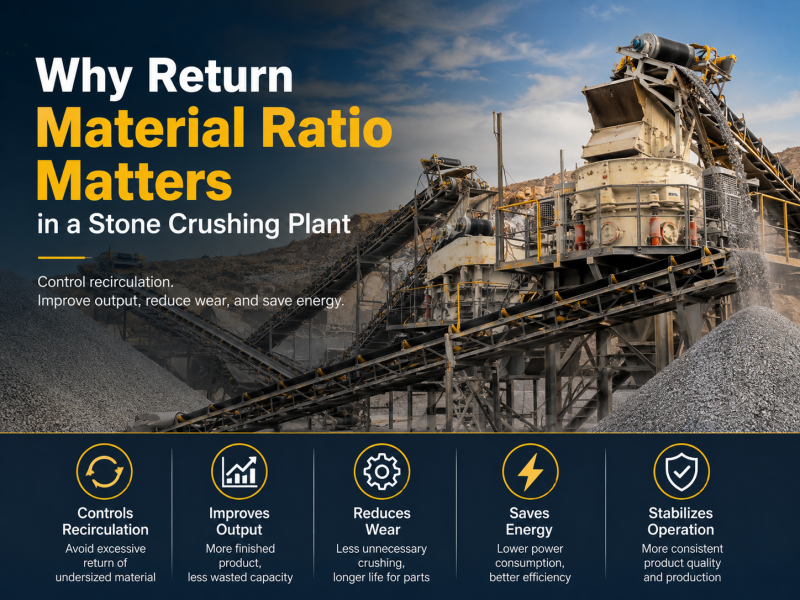
- Why Return Material Ratio Matters in a Stone Crushing Plant
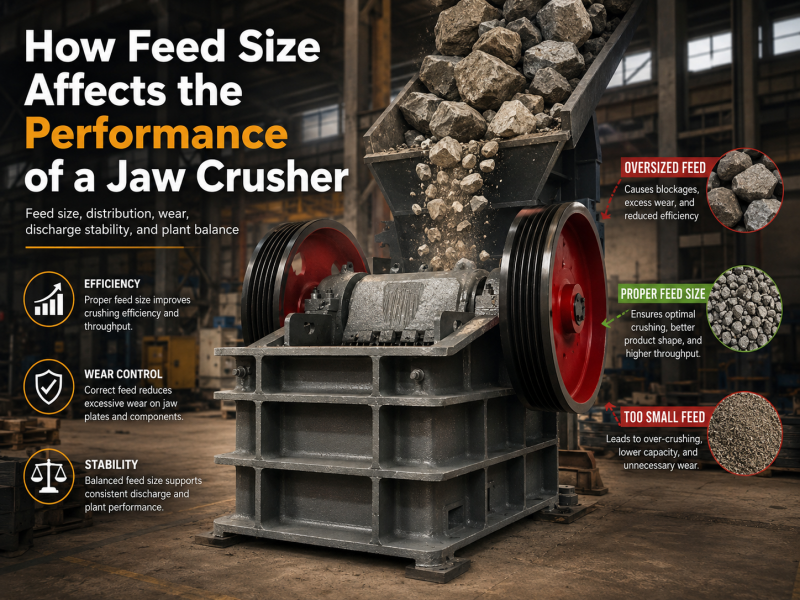
- How to Match Jaw Crusher and Vibrating Screen in a Stone Crushing Plant
- Why Is My Sand Production Line Output Too Low?
Suggested Solutions:


 WhatsApp
 Email
Email
 +86 15538010601