
STCrushers Is A Professional Minging Equipment Manufacturer since 2004, Providing High Quality Crushers, Sand Making Machines, Drying Equipment and more.
STCrushers Is A Professional Minging Equipment Manufacturer since 2004, Providing High Quality Crushers, Sand Making Machines, Drying Equipment and more.
Many buyers treat crushing and grinding as two separate steps.
The crusher reduces large ore into smaller pieces. The ball mill grinds the crushed material into finer particles. On paper, the process looks simple.
In real production, these two stages are closely connected. If the crushing stage does not control the feed size properly, the ball mill may have to handle material that is too coarse, too uneven, or too difficult to grind. The result is higher power consumption, heavier mill load, faster wear, and unstable grinding fineness.
For Sentai Machinery, when we discuss a ball mill or ore processing project with an overseas buyer, we do not only ask about ball mill capacity. We also need to know the feeding size before grinding and whether the crushing stage can prepare suitable material for the mill.
A ball mill can grind ore, but it should not be used to solve every problem left by poor crushing.
Some buyers think that a larger motor or bigger ball mill can solve grinding problems.
This is not always true.
If the material entering the ball mill is too large, the mill needs more time and energy to reduce it to the required fineness. The grinding media must spend more work breaking coarse particles instead of efficiently grinding material in a controlled size range.
A larger ball mill may increase capacity potential, but if the feed size is not suitable, the actual grinding cost may still remain high. In some cases, improving the crushing stage can be more practical than simply increasing ball mill size.
This is why feed size before ball milling should be confirmed before selecting the grinding system.
When oversized particles enter the ball mill, they increase the internal load.
The mill must use more impact and grinding force to break these coarse pieces. This can reduce the effective grinding of smaller particles and make the whole process less efficient.
Oversize feed may also cause unstable operation. The mill may run with heavier noise, higher current, lower output, and more uneven discharge. Operators may need to reduce feeding rate to protect the equipment, which lowers practical capacity.
In this situation, the problem may not be the ball mill itself. The problem may be that the crushing stage is not preparing the right feed size.
Feed size is not only about the maximum size. Size distribution also matters.
If some particles are too large while others are already fine, the ball mill must handle a mixed condition. Coarse particles need more grinding time, while fine particles may become overground.
This can create unstable discharge fineness. In a beneficiation plant, unstable fineness may affect classification, flotation, magnetic separation, or gravity separation.
A more stable feed size helps the ball mill work in a more predictable way. It also helps the spiral classifier or other classification equipment control the grinding circuit more effectively.
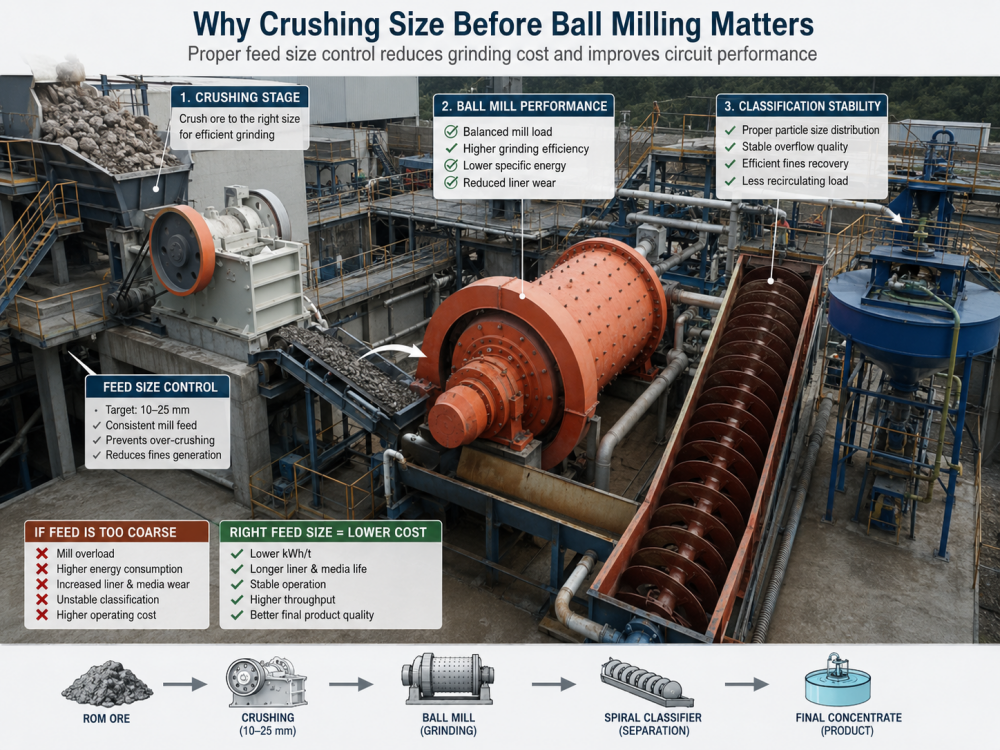
Ball milling is usually one of the main energy consuming stages in ore processing.
If the crushing stage leaves too much work for the ball mill, energy cost can increase. The mill runs longer, handles heavier load, and may need more power to reach the target fineness.
In many projects, reducing feed size properly before ball milling can improve grinding efficiency. This does not mean crushing the ore as fine as possible. It means preparing a suitable and stable size range for the ball mill.
Good process design balances crushing cost and grinding cost. If crushing is too weak, grinding cost rises. If crushing is excessive, crusher wear and screening cost may increase. The goal is to find a practical balance.
Oversize or uneven feed can increase wear inside the ball mill.
Large particles create stronger impact on liners and grinding media. The mill may need to work harder to break the material, which can shorten liner life and increase steel ball consumption.
Wear cost is not always visible in the first quotation, but it becomes important during long term operation. Buyers should consider not only machine price, but also power cost, wear parts, maintenance time, and production stability.
A suitable crushing stage can help reduce unnecessary wear in the grinding section.
In many mineral processing plants, the ball mill works with a spiral classifier. The classifier separates fine material from coarse material and sends coarse material back for regrinding.
If ball mill discharge is unstable because of poor feed size control, the classifier also becomes harder to control. Return sand may increase. Overflow fineness may fluctuate. The whole grinding and classification circuit may become unstable.
This is why crushing size before ball milling affects more than the ball mill. It affects the full grinding circuit.
For flotation, magnetic separation, or gravity separation, this can influence recovery and product quality.
Different ores need different crushing arrangements.
Some small plants may use only a jaw crusher before ball milling. Other plants may need secondary crushing or screening to control feed size more carefully. The right configuration depends on raw ore size, hardness, required capacity, target grinding fineness, and downstream beneficiation method.
For hard ore, proper crushing before grinding is especially important. If the ore is difficult to break, oversized feed can quickly increase ball mill load and energy use.
For small gold ore processing, iron ore beneficiation, or other mineral projects, the crushing and grinding stages should be designed together, not separately.
Factor | Why It Matters | What Should Be Checked |
Maximum feed size | Affects ball mill load | Largest particle entering the mill |
Size distribution | Affects grinding stability | Whether feed is even or mixed |
Ore hardness | Affects crushing and grinding difficulty | Material test or field experience |
Crushing stage | Affects mill preparation | Jaw crusher, secondary crusher, screen |
Target fineness | Affects grinding time | Required mesh or particle size |
Classifier matching | Affects circuit stability | Spiral classifier capacity and return sand |
Wear cost | Affects long term operation | Liner and grinding media consumption |
Before recommending a ball mill and upstream crushing configuration, Sentai Machinery usually needs to confirm these details.
1. What ore will be processed?
2. What is the maximum raw ore size?
3. What size can the crusher discharge before ball milling?
4. What capacity is required per hour?
5. What grinding fineness is needed?
6. Is the ore hard, medium hard, or soft?
7. Is the process wet grinding or dry grinding?
8. Will a spiral classifier be used after the ball mill?
9. What beneficiation process comes next?
10. Does the buyer need single machines or a complete ore processing line?
These questions help avoid choosing a ball mill without understanding the upstream crushing condition.
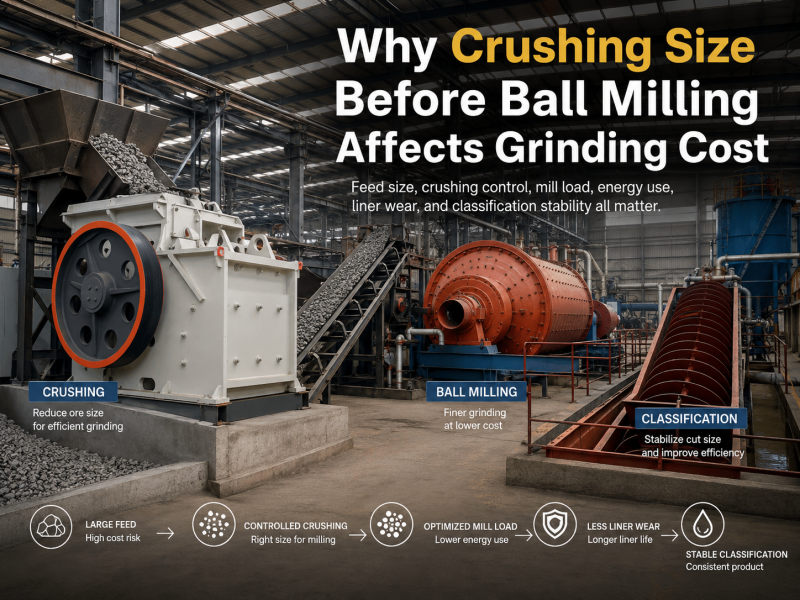
Ball mill grinding cost does not start inside the ball mill only. It often starts from the crushing stage.
If the feed size before ball milling is too large or unstable, the mill may consume more power, wear faster, produce unstable discharge, and reduce the efficiency of classification and beneficiation.
For buyers, the better question is not only "What ball mill model do I need?" A more useful question is "Is my crushing stage preparing the right feed size for the ball mill?"
When crushing and grinding are designed as one connected process, the ore processing plant becomes more stable, more efficient, and easier to operate.
If you are planning an ore processing project, Sentai Machinery can help evaluate the crushing and grinding process according to your raw ore size, ore hardness, required capacity, target fineness, and beneficiation method.
Send us your material photos, feeding size, required output, target grinding fineness, and site condition. Our team can help recommend a suitable jaw crusher, ball mill, spiral classifier, and complete ore processing configuration.
1. What Buyers Often Miss When Matching a Ball Mill and Spiral Classifier
2. What Buyers Should Know Before Choosing Equipment for a Small Gold Ore Processing Plant
3. How Grinding Stability Affects Flotation Performance
4. Ball Mill vs Rod Mill: Which One Should You Choose for Your Plant
5. How Feed Size Affects the Performance of a Jaw Crusher

 WhatsApp
 Email
Email
 +86 15538010601