
STCrushers Is A Professional Minging Equipment Manufacturer since 2004, Providing High Quality Crushers, Sand Making Machines, Drying Equipment and more.
STCrushers Is A Professional Minging Equipment Manufacturer since 2004, Providing High Quality Crushers, Sand Making Machines, Drying Equipment and more.
A vertical compound crusher may discharge a large proportion of material below 5 mm. That can look like finished manufactured sand when the buyer focuses mainly on particle size.
Small discharge size does not confirm grain shape, grading, powder content, cleanliness, or suitability for concrete and dry mortar. The material may still need screening, powder control, washing, or shaping.
The useful question is therefore not whether the machine can produce fine material. It is which reduction duty the machine should perform inside the process.
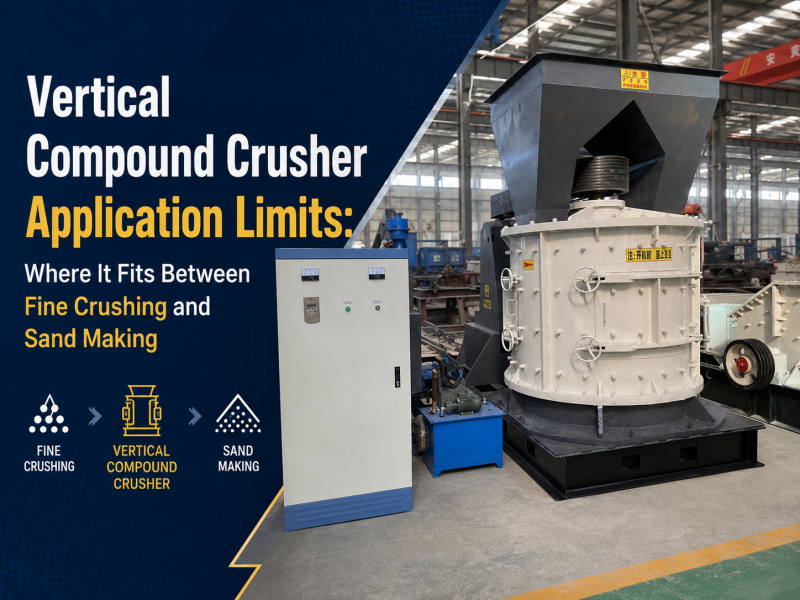
A vertical compound crusher can serve three duties, but not equally well.
For fine crushing, it reduces material after primary or secondary crushing and prepares feed for grinding, screening, or another stage. For coarse sand production, it can generate fine aggregate where shape requirements are moderate. Final shaping requires more careful evaluation because the duty is no longer only size reduction.
Its role is clearer in fine crushing and coarse sand production than where cubic shape and tight grading are the main targets.
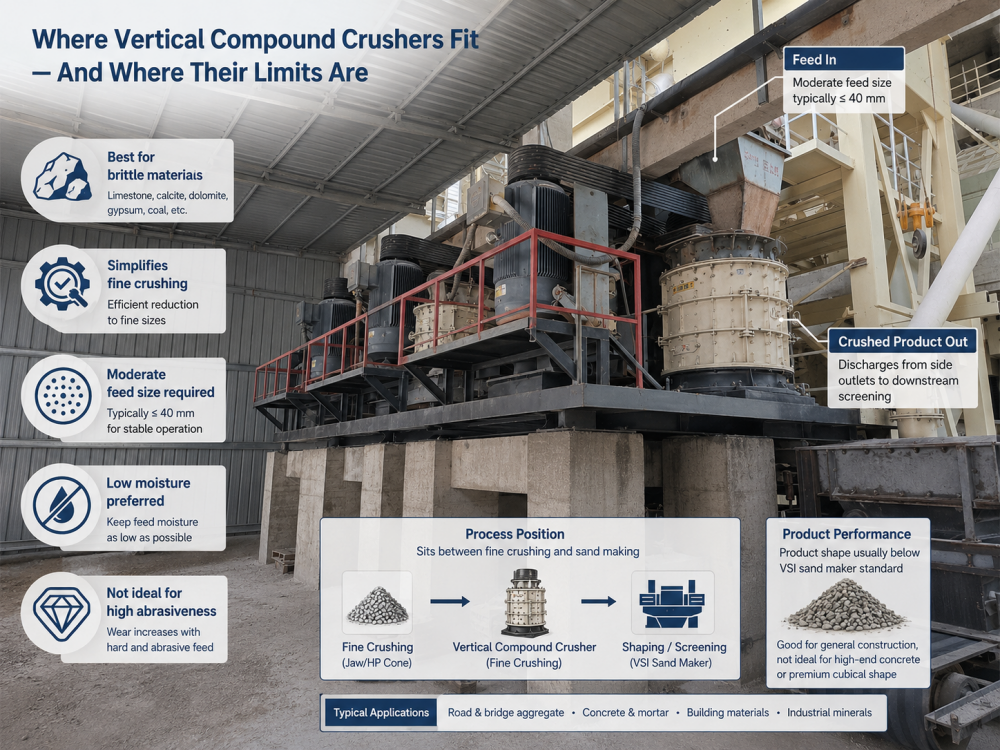
One common position is after a jaw crusher, which handles larger stone before the compound crusher continues fine reduction.
It can also sit after secondary crushing, before a screen separates qualified sizes and returns oversize when required.
It can prepare clinker, coal, limestone, or similar brittle material for grinding or industrial use, where controlled feed size matters more than premium sand shape.
These positions require different screen openings, return plans, and wear expectations. Selecting only from the final millimeter target may assign the wrong duty.
Brittle material fractures readily under repeated impact, collision, and friction, which suits multi-stage reduction.
Limestone, clinker, coal, and similar materials often fit more clearly than dense, abrasive stone. Soft to medium-hard feed usually places a more manageable load on hammers and liners.
Harder stone may still be crushed, but the economic result can change through higher wear, maintenance, or product inconsistency.
The maximum feed opening is not the ideal continuous condition. Oversized pieces force too much primary reduction and can create impact peaks, vibration, and uneven wear.
A wide feed-size distribution creates another problem. Large and fine particles receive different impact histories, leaving some material coarse while already-small particles become powder.
Stable upstream crushing and feeding are essential. Provide maximum size, typical size, and size distribution rather than one number.
A screen can confirm a particle is below 5 mm, but not that it is cubic or suitable for a concrete mix.
Finished sand assessment may also include particle shape, grading curve, powder percentage, clay contamination, water demand, and local standards. A fine-crushing machine can meet size limits while missing these quality requirements.
The compound crusher may simplify reduction for brittle feed, while a VSI is more often considered when shaping is central.
Moisture should be reviewed with clay and stickiness. Wet fines and sticky clay can attach internally, restrict flow, and create uneven discharge.
Buildup can keep material in the chamber longer, creating additional fines and unstable load.
Claims that wet material never blocks should not replace a material test. Drainage, feed preparation, and screening may matter more than the model.
Purchase price is only one part of the decision. Hammers, liners, inspection time, and maintenance downtime all affect the cost of qualified product.
Granite, basalt, quartz-rich stone, river stone, and abrasive ore need careful wear evaluation. High wear can make a lower-cost machine more expensive.
The comparison should use expected wear and qualified product yield, not only motor power or rated capacity.
Crusher discharge contains mixed sizes. A vibrating screen decides what becomes product and what returns.
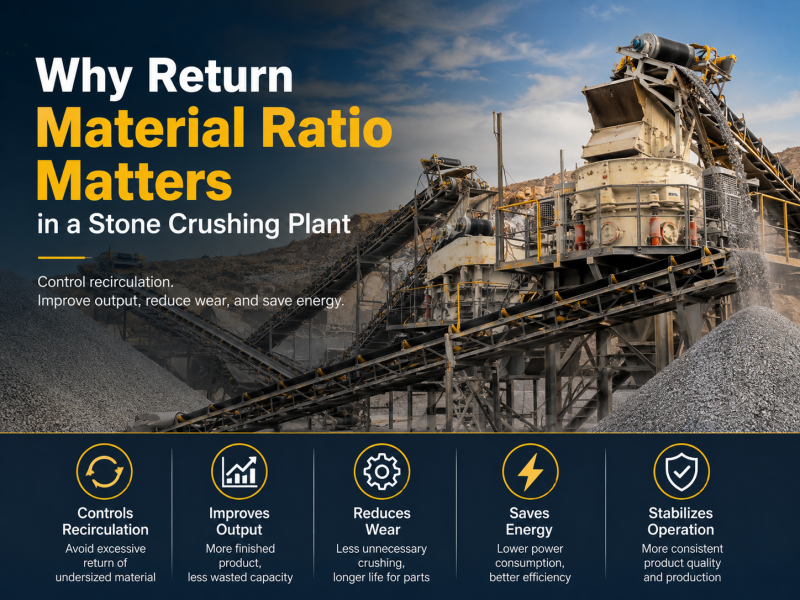
Poor mesh selection, blockage, or uneven distribution can mix products or return qualified material. Excessive return increases crushing, wear, power use, and powder.
The crusher and screen should therefore be planned as one circuit. Open-circuit capacity does not describe a line with return material.
A VSI route deserves stronger consideration for hard or abrasive stone, high-value grain shape, or strict grading and shaping requirements.
River stone, granite, basalt, and dense hard rock often require more shaping and wear control. A VSI still needs stable feed and screening, but its process role is more directly connected with shaping.
The vertical compound crusher remains valuable when fine crushing is the main duty, the feed is relatively brittle, the product standard is less shape-sensitive, and the expected wear cost is acceptable.
Project condition | Likely suitability | Main reason |
Limestone or clinker fine crushing | Generally suitable | Brittle material and clear size-reduction duty |
Ordinary coarse sand production | Can be considered | Product-shape demand is moderate |
High-quality concrete sand | Requires verification | Small size alone does not confirm grain shape |
Wet and sticky feed | Higher operating risk | Material flow and buildup may become unstable |
Granite, basalt, or quartz-rich feed | Careful wear evaluation | Abrasiveness can raise operating cost |
Strict shaping and grading | Compare with VSI | Final product quality is the main target |
High return-material ratio | Process review required | Repeated crushing may increase fines |
1. Raw material name and representative photos or video.
2. Hardness, abrasiveness, and any quartz-rich or dense components.
3. Maximum, typical, and minimum feed size.
4. Required hourly capacity.
5. Required discharge sizes and final product use.
6. Grain-shape and grading requirements.
7. Acceptable powder content.
8. Moisture, clay, and material stickiness.
9. Upstream crusher and feeding method.
10. Downstream screen openings and number of products.
11. Whether oversize will return to the crusher.
12. Expected daily operating hours and maintenance conditions.
A vertical compound crusher can be an effective fine-crushing or coarse-sand machine when the feed is brittle, properly prepared, and matched to a realistic product target.
Its fine discharge should not be treated as automatic proof of high-quality manufactured sand. Hardness, abrasiveness, moisture, particle shape, powder limits, screening efficiency, and return load define the practical boundary.
Sentai Machinery can review the material, feed distribution, capacity, product target, moisture, wear condition, upstream crusher, and screen arrangement. The selected machine should fit the reduction duty and the complete process, not only the discharge size.
1. How to Choose Equipment for a Sand Making Plant
2. Why Finished Sand Quality Depends on More Than the Sand Maker
3. Why Is There Too Much Stone Powder in Manufactured Sand
4. What Changes When River Stone Is Used Instead of Limestone in a Sand Making Plant
5. VSI Sand Making Machine Feed Control: Why Gradation and Moisture Change Sand Shape
 WhatsApp
 Email
Email
 +86 15538010601