
STCrushers Is A Professional Minging Equipment Manufacturer since 2004, Providing High Quality Crushers, Sand Making Machines, Drying Equipment and more.
STCrushers Is A Professional Minging Equipment Manufacturer since 2004, Providing High Quality Crushers, Sand Making Machines, Drying Equipment and more.
An impact crusher may keep running with normal motor current, yet a shutdown inspection shows that one blow bar or one side of the rotor has worn much faster than the rest.
Replacing the most damaged bar may restore the working profile temporarily, but it does not explain the uneven wear. Feed distribution, feed size, installation, material changes, breaker-plate settings, rotor condition, and replacement-bar matching can all influence the pattern.
Relatively uniform wear across a matched set usually develops gradually. The working faces become thinner, product size changes slowly, and operating load remains predictable.
Further inspection is needed when the two sides wear at different rates, one bar loses much more material than the others, wear concentrates at the ends, or cracks and missing sections appear early. Record processed tonnage, feed condition, product grading, vibration, and the position of each bar instead of judging only by operating hours.
Uniform wear generally suggests that the bars are receiving a similar share of the crushing duty. Feed may be spreading across the rotor width, the set may be reasonably matched, and the raw material may not have changed sharply.
The set still requires planned replacement. A uniformly worn profile can gradually reduce impact efficiency and increase coarse product or return load. Any reversal or repositioning must follow the model-specific wear limits and procedure.
A conveyor or chute that drops material mainly onto one side assigns more work to that side of the rotor. The corresponding breaker plates and liners may also wear faster.
Check for an off-center belt discharge, worn guide plate, uneven hopper flow, or large stones repeatedly following one path. Correcting the drop point may prevent the same wear pattern from returning after new bars are fitted.
When only one bar is abnormal, inspect its specific position. Confirm that it matches the others in material, dimensions, orientation, and original weight where records are available.
Check the fastening system, contact surfaces, rotor slot, wedges, and material buildup. A local hard inclusion or metal object can also cause concentrated damage, so review the fracture area and upstream metal-removal conditions before blaming the casting alone.
The crusher inlet dimension is not the ideal continuous feed condition. Repeated oversized lumps make the blow bars perform more primary reduction and create higher impact peaks.
This can concentrate wear, increase edge damage, and leave less controlled secondary impact against the breaker plates. Compare the actual maximum and typical feed sizes with the intended duty, especially when the upstream jaw crusher discharge has changed.
Blow bars on the same rotor should be managed as a matched set according to the manufacturer's instructions. Mixing heavily worn bars with new bars, using unmatched replacements, or installing a bar incorrectly can change mass distribution around the rotor.
Fastening and seating are equally important. After replacement, inspect the rotor before a controlled no-load or low-load trial run. There is no useful universal weight tolerance for every impact crusher; the acceptable matching method depends on the rotor design and model.
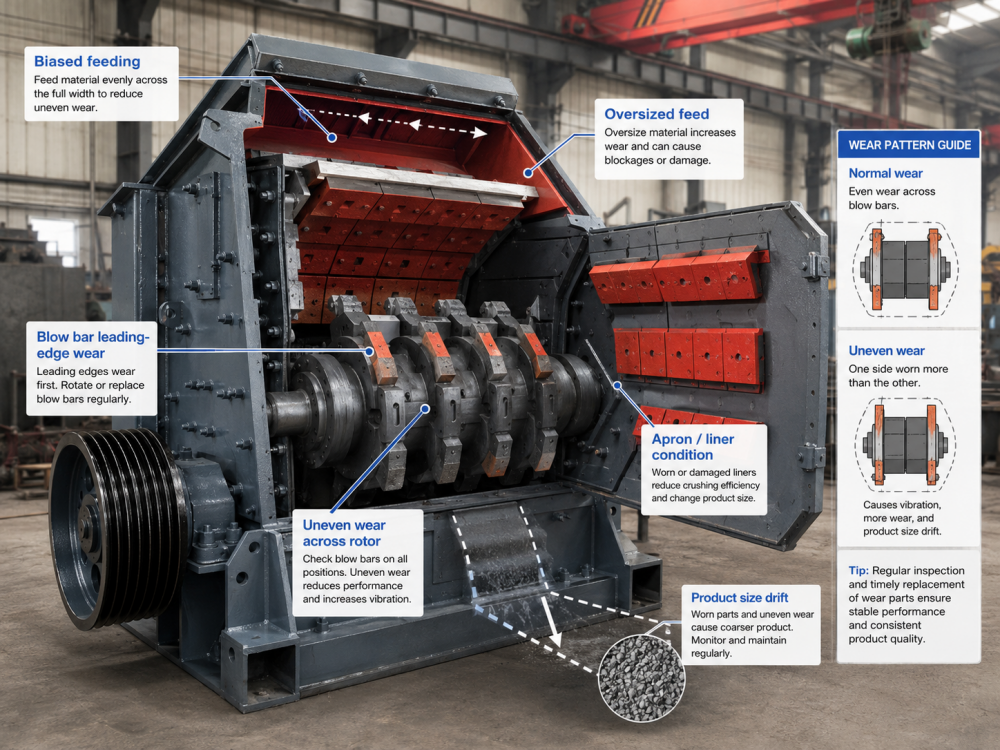
Uneven wear may be the visible symptom of another rotor condition. Inspect the blow bar seats, fastening components, rotor surface, buildup, bearings, drive alignment, and any abnormal noise or vibration.
If vibration remains after replacement, the crusher should stay stopped until the mechanical condition is checked. Repeatedly changing bars cannot correct a damaged seat, looseness, uneven buildup, or bearing problem.
The gap between the blow bars and breaker plates helps determine reduction and product size. As both components wear, the actual gap moves away from the original setting.
A wide gap can allow coarser material to leave the crushing zone. A setting that is too tight can increase repeated impact, fines, internal load, and wear. Gap adjustment cannot fully compensate for a badly worn bar profile or damaged breaker plate.
A quarry face or raw-material source can change without the machine changing. More abrasive minerals, denser bands, larger feed, wet clay, or foreign metal can shorten wear life and alter the wear pattern.
When consumption changes suddenly, compare current feed photos, grading, hardness information, and operating records with the previous wear cycle. A harder alloy is not automatically the answer because wear resistance and impact resistance must remain balanced.
The screening section may show wear effects before total crusher output falls. Oversize can increase, return material can rise, one product fraction can decline, or fines can increase after gap changes.
If the screen mesh and operation remain stable but grading changes gradually, inspect the blow bar profiles and actual breaker-plate gaps. The plant may look busy while producing less qualified aggregate because more material is circulating.
Wear pattern | Possible cause | First inspection |
All bars wear similarly | Normal progressive wear | Remaining profile, weight, grading, and operating history |
One side wears faster | Biased feeding | Conveyor discharge, chute, guide plate, and material trajectory |
One bar wears faster | Installation, matching, or local impact difference | Bar identity, fastening, seat, rotor slot, and local chamber condition |
End sections wear heavily | Feed concentrated near rotor ends | Feed spread across the effective crushing width |
Chipping or cracking | Oversize, hard inclusion, foreign metal, or unsuitable bar selection | Upstream feed, metal removal, fracture location, and bar specification |
Vibration rises after replacement | Matching, seating, fastening, buildup, or rotor issue | Replacement set, mounting condition, rotor, bearings, and drive |
Coarse product increases | Worn bar profile or breaker plates | Working profile, actual gap, and screen return |
Some blow bars are reversible, while other designs use different replacement rules. The machine manual must determine whether rotation or repositioning is permitted.
Consider the remaining working profile, specified wear limit, cracks, fastening area, bar matching, and rotor-seat condition. Bars should be managed as a set; replacing only the worst bar can create a new mismatch when the others have already lost substantial mass.
<!--[if !supportLists]-->1. <!--[endif]-->Impact crusher model and rotor arrangement.
<!--[if !supportLists]-->2. <!--[endif]-->Blow bar dimensions, orientation, and material grade.
<!--[if !supportLists]-->3. <!--[endif]-->Original and current weights, where records are available.
<!--[if !supportLists]-->4. <!--[endif]-->Photos of every bar identified by rotor position.
<!--[if !supportLists]-->5. <!--[endif]-->Raw material, abrasiveness, and recent source changes.
<!--[if !supportLists]-->6. <!--[endif]-->Maximum and typical feed size.
<!--[if !supportLists]-->7. <!--[endif]-->Capacity, working hours, and processed tonnage.
<!--[if !supportLists]-->8. <!--[endif]-->Feed direction and actual drop point.
<!--[if !supportLists]-->9. <!--[endif]-->Product grading and return-load changes.
<!--[if !supportLists]-->10. <!--[endif]-->Vibration, noise, or motor-load changes.
<!--[if !supportLists]-->11. <!--[endif]-->Breaker-plate, rotor seat, fastening, bearing, and liner condition.
<!--[if !supportLists]-->12. <!--[endif]-->Any metal or unusually hard material found in the feed.
Blow bar wear is unavoidable, but abnormal wear should not be treated as routine consumption. Uniform wear and one-sided wear tell different stories.
Feed distribution, feed size, bar matching, installation, rotor condition, material properties, breaker-plate gap, and downstream screening all influence the pattern. Replacing a damaged bar without checking these conditions can allow the same problem to return.
Sentai Machinery can review blow bar photos, rotor positions, feed size, raw material, product grading, return load, and vibration changes before recommending replacement parts or operating checks.
1. What Determines Finished Aggregate Shape in an Impact Crushing Process
2. Impact Crusher vs Heavy Hammer Crusher for Limestone: Which One Makes More Sense
3. A Practical Field Guide to Reducing Downtime in a Stone Crushing Plant
4. Why Return Material Ratio Matters in a Stone Crushing Plant
5. How to Match Jaw Crusher and Vibrating Screen in a Stone Crushing Plant
2. Jaw Crushers

 WhatsApp
 Email
Email
 +86 15538010601