
STCrushers Is A Professional Minging Equipment Manufacturer since 2004, Providing High Quality Crushers, Sand Making Machines, Drying Equipment and more.
STCrushers Is A Professional Minging Equipment Manufacturer since 2004, Providing High Quality Crushers, Sand Making Machines, Drying Equipment and more.
"How many containers does this ball mill need?" is a reasonable question before placing an overseas order. A useful answer requires more than the mill model. The supplier needs to confirm how the machine will travel, which accessories are included, and the packed size and weight of every shipping unit.
A delivery plan should connect the equipment quotation with the site that will receive it. Container choice, packing, inland transport, and unloading all depend on that connection. Agreeing these details before dispatch helps buyers compare freight proposals and prepare for installation.
The diameter and length in a ball mill specification describe the equipment, but they do not establish its shipping envelope. Supports, drive components, protective packaging, and the chosen transport configuration can change the space required. Ask for packed length, width, height, and gross package weight, with units clearly stated.
Confirm whether the mill travels assembled or in manufacturer-defined sections. That decision affects lifting, packing, and the work required after arrival. Any separation of components should follow the manufacturer's transport and reassembly plan. Buyers should also ask which assembly drawings and identification marks will accompany separately packed parts.
Preliminary freight estimates may use estimated dimensions. Before booking, replace those estimates with confirmed shipment data and identify any package that still requires measurement.
A standard enclosed container may be suitable when the complete load fits through its opening, stays within its loading limits, and can be handled properly. Checking the internal dimensions alone is insufficient: the loading path and door opening may impose a separate restriction.
Open-top containers or flat racks may be considered when dimensions or handling arrangements make enclosed loading impractical. Neither option is an automatic answer for every large mill. The forwarder and carrier need the packed dimensions, weights, support arrangement, and loading method to confirm suitability and acceptance.
Total payload is only part of the decision. A heavy package supported over a small area can create a concentrated load that needs a different support arrangement or transport option. Container specifications also vary. Obtain confirmation for the equipment being booked, including weight distribution and securing arrangements, rather than relying on a generic container-size chart.
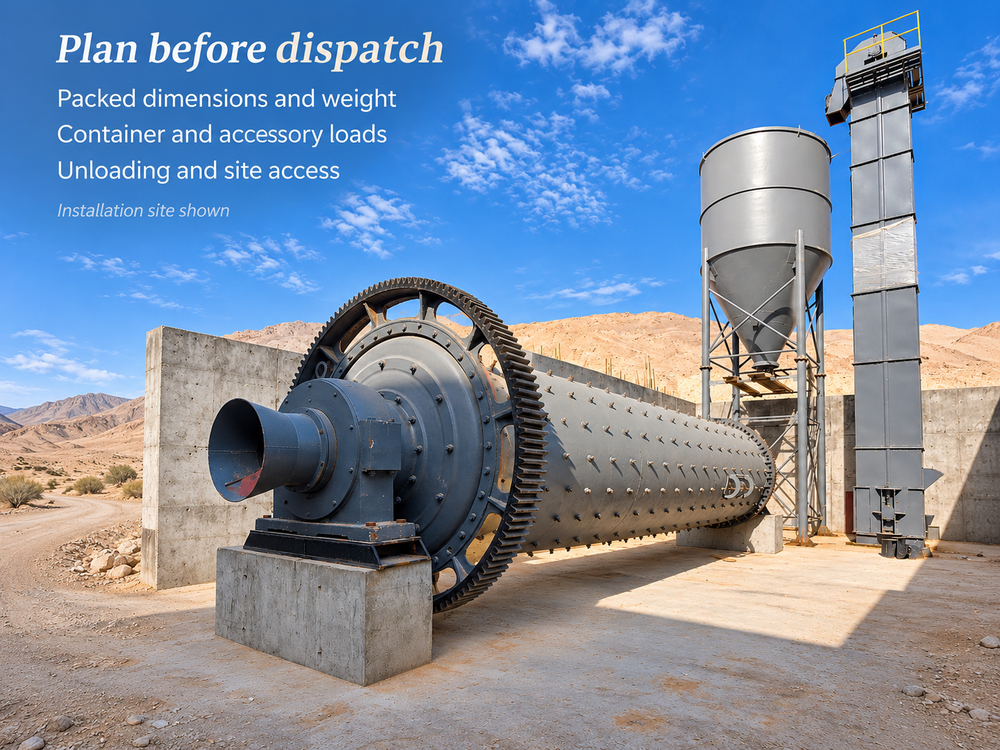
The shipping scope should match the purchase scope. Depending on the agreed configuration, the consignment may include the main mill, motor, reducer, control cabinet, liners, grinding media, installation hardware, and spare parts. Record which items are fitted and which travel separately. Our guide to comparing ball mill quotations explains why these boundaries need checking before an order is compared with another offer.
Grinding media deserves a separate weight entry. A load plan that works for the mill alone may change when the initial media charge is added. Confirm its packaging and location in the shipment; do not assume loose media can simply travel inside the mill shell.
If media will be purchased locally, agree the required specification with the equipment supplier and check availability before removing it from the overseas order. The same principle applies to any locally sourced component needed before commissioning.
A packing list should help the receiving team identify equipment and find the parts needed for assembly. Give each package a clear identification number and connect it to its contents, quantities, and relevant assembly references. Labels on the packages and descriptions in the documents should agree.
For example, a crate marked only "accessories" leaves the installation team searching for information. Identifying the enclosed drive parts or installation hardware and recording their quantities makes the shipment easier to receive and organize. Photographs can support that record without replacing an accurate packing list.
Agree protection for exposed machined surfaces, electrical components, and separately packed parts according to the transport and expected storage conditions. Include instructions for receiving inspection and storage, so essential protection is not removed long before installation. The supporting article on shipment photographs and documents covers the wider dispatch record.
Reaching the destination port does not mean the mill has reached its foundation. Confirm who arranges onward transport, who supplies handling equipment, and where responsibility passes between the parties. Freight offers should state the services included so that port handling, storage, inland haulage, or unloading costs are not left as assumptions.
The inland operator needs the actual package data to assess vehicle suitability, route access, and any required arrangements. The receiving site needs enough access and working space for the agreed unloading method. A clear site photograph and access dimensions are more useful than a simple statement that a crane is available.
Arrange unloading with the handling contractor using confirmed package weights, manufacturer-provided lifting information, and the site conditions. Keep receiving records accessible to the team on the day of delivery. Our equipment arrival inspection guide explains how to document condition and reconcile the delivered packages.
Bring the technical, commercial, and logistics information together before release. The following coordination table identifies useful inputs; the purchase and freight agreements should define the actual responsibilities.
Confirmation | Information needed | Coordination lead |
Transport configuration | Packed dimensions, weights, lifting information | Equipment supplier |
Complete supply | Package contents, media, spares, exclusions | Buyer and supplier |
Container acceptance | Fit, payload, support, securing, handling | Forwarder and carrier |
Delivery route | Port services, inland access, unloading plan | Buyer and logistics providers |
Dispatch record | Final packing list, photos, agreed documents | Supplier and forwarder |
Resolve differences between the packing list, freight booking, and purchase scope before dispatch. Confirm the receiving contact and share the documents needed for the agreed delivery process. If the packing arrangement changes after booking, have the revised load checked again rather than treating the original approval as sufficient.
Reliable ball mill shipping starts with a defined load and ends with a receiving site prepared for that load. The container is one part of the plan. Clear package data, agreed supply boundaries, and coordinated handling give buyers a more useful basis for arranging delivery.
Send Sentai Machinery your required mill configuration, accessory scope, destination port, and available site-access information. The team can prepare equipment packing details for coordination with your forwarder and receiving contractor before the shipment is finalized.
Comparing Ball Mill Quotations: What Is Actually Included in the Price?
What Photos and Documents Should Be Prepared Before Overseas Equipment Shipment
What Buyers Should Check When Equipment Arrives at the Project Site



 WhatsApp
 Email
 +86 15538010601