
STCrushers Is A Professional Minging Equipment Manufacturer since 2004, Providing High Quality Crushers, Sand Making Machines, Drying Equipment and more.
STCrushers Is A Professional Minging Equipment Manufacturer since 2004, Providing High Quality Crushers, Sand Making Machines, Drying Equipment and more.
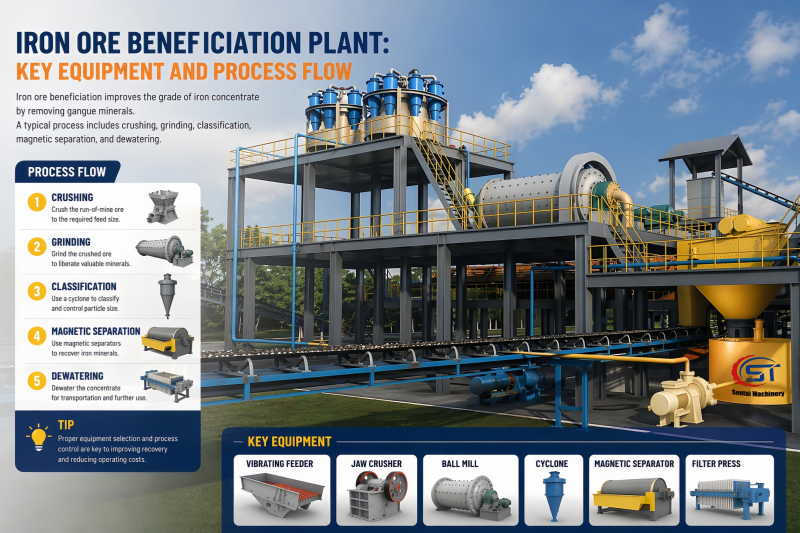
An iron ore beneficiation plant is designed to improve the grade of iron-bearing material through a series of crushing, grinding, classification, separation, and dewatering processes. The exact process depends on ore type, iron content, gangue mineral composition, and final concentrate requirement. However, most iron ore beneficiation plants follow a logical process flow that begins with size reduction and ends with concentrate recovery.
The first stage is crushing. Raw iron ore is usually too large for direct grinding or separation, so it must first be reduced in size. Depending on the feed condition and production capacity, the crushing section may include a vibrating feeder, a jaw crusher for primary crushing, and additional crushing equipment for further size reduction. Proper crushing is important because it prepares the ore for efficient grinding and downstream separation.
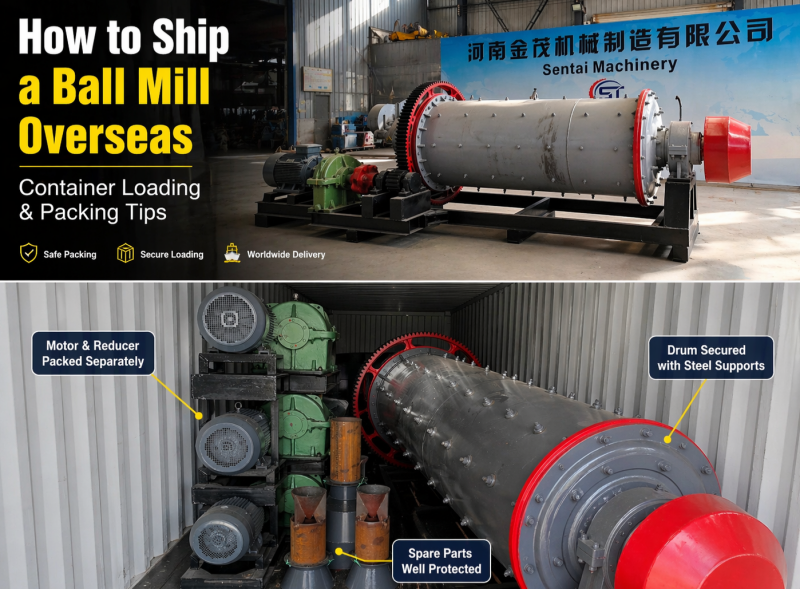
After crushing, the ore enters the grinding stage. The purpose of grinding is to liberate iron-bearing minerals from the surrounding gangue material. In many beneficiation plants, a ball mill is one of the most important machines in this section. Grinding fineness must be carefully controlled, because insufficient liberation can reduce separation efficiency, while excessive grinding may increase energy consumption and complicate later stages.
The next stage is classification. A spiral classifier or another classification device is often used to separate qualified fine particles from coarser material. Proper classification helps the grinding circuit operate more efficiently and ensures the separation stage receives material with the correct size range.
The key separation process in many iron ore plants is magnetic separation. A magnetic separator is used to recover magnetic iron minerals from the ground ore. The exact separation arrangement depends on ore type and magnetic characteristics, but magnetic separation is one of the most common and important stages in iron ore beneficiation.
After separation, the concentrate often goes through thickening and dewatering. These steps reduce moisture content and make the final iron concentrate easier to transport, store, or process further. Depending on the project requirement, the dewatering section may include thickening equipment and additional moisture reduction systems.
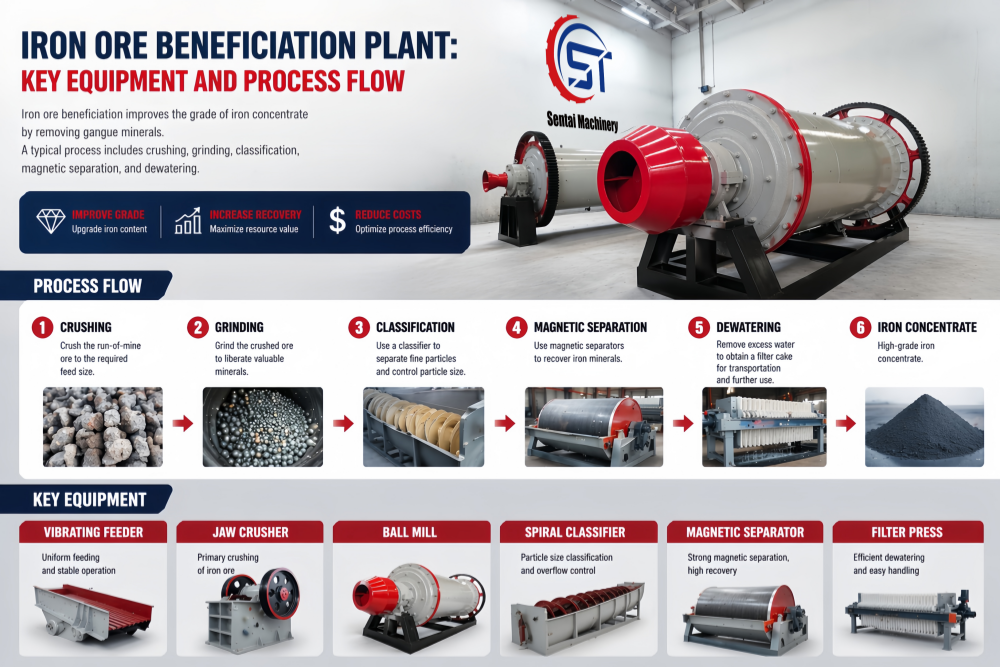
A typical iron ore beneficiation plant may include:
- Vibrating feeder
- Secondary crushing equipment
- Thickening and dewatering equipment
- Conveyors and control system
One of the most important points in plant design is ore characterization. Not all iron ores behave the same way. Different ore bodies may require different grinding fineness, separation intensity, or process configuration. This is why a beneficiation plant should be designed according to actual ore test results whenever possible.
Another key factor is capacity requirement. A small iron ore project and a large commercial beneficiation line require very different machine sizes and process layouts. The crushing, grinding, classification, and separation sections should all be matched to avoid bottlenecks.
Energy consumption is also critical. Grinding is one of the most energy-intensive parts of a beneficiation plant, so proper matching of the ball mill and classification system is essential. At the same time, stable magnetic separation performance depends on consistent feed quality and well-controlled process flow.
When planning an iron ore beneficiation plant, buyers should prepare:
- Ore type and grade
- Feed size
- Capacity target
- Required concentrate quality
- Grinding fineness requirement
- Site conditions
- Power and water supply conditions
In summary, an iron ore beneficiation plant is a complete process system built around crushing, grinding, classification, magnetic separation, and dewatering. The best results come from proper ore understanding, suitable equipment matching, and a process flow designed for actual production goals.
At Sentai machinery, we provide iron ore beneficiation solutions based on ore characteristics, project scale, and process requirements. A well-designed plant helps improve concentrate quality, stabilize recovery, and reduce long-term operating cost.
Need equipment for an iron ore beneficiation plant? Contact Sentai machinery with your ore type, capacity, and concentrate requirement for a suitable process recommendation.
Related Articles
Gold Ore Processing Plant Design: From Crushing to Separation


 WhatsApp
 Email
Email
 +86 15538010601