
STCrushers Is A Professional Minging Equipment Manufacturer since 2004, Providing High Quality Crushers, Sand Making Machines, Drying Equipment and more.
STCrushers Is A Professional Minging Equipment Manufacturer since 2004, Providing High Quality Crushers, Sand Making Machines, Drying Equipment and more.
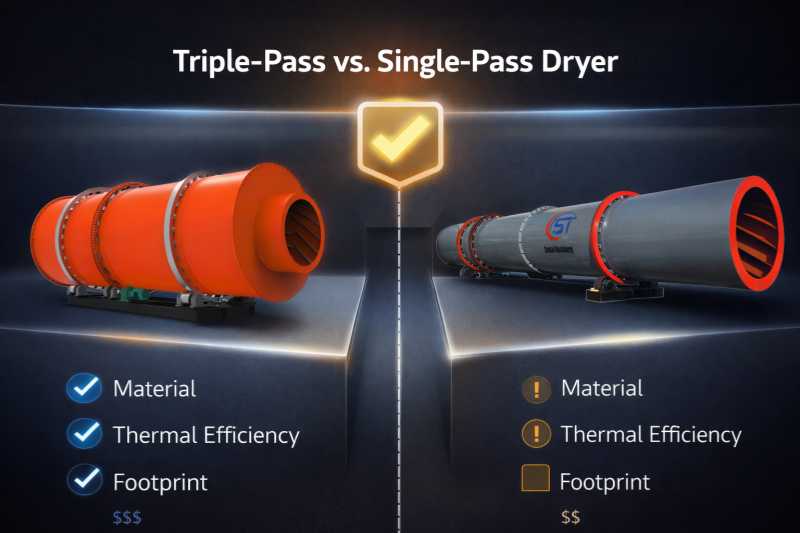
When selecting drying equipment for sand or other granular materials, buyers often compare two common options: the traditional single drum dryer and the three cylinder sand dryer. Both can be used for drying materials, but they differ in structure, thermal efficiency, space requirements, and application suitability.
So which one is better? The answer depends on the material characteristics, production target, available space, and investment priorities.
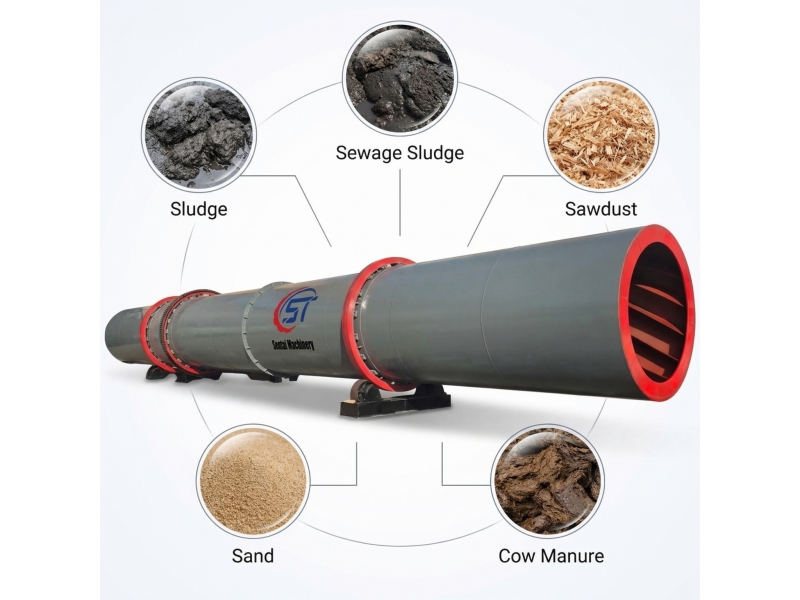
A single drum dryer uses one rotating cylinder to dry material through direct or indirect heat exchange, depending on the system design. It has a relatively straightforward structure and is widely used in many industrial drying applications, including sand, sawdust, sludge, and mineral materials. Because of its broad adaptability, it is often selected when the plant processes different kinds of materials.
A three cylinder sand dryer, also called a three-drum dryer, uses a more compact nested drum structure. This design increases the heat exchange path within a smaller footprint. It is especially popular for sand drying because it can offer high thermal efficiency and save installation space.
One major difference between the two is application range. A single drum dryer is generally more flexible across different materials. It can be designed for various industrial uses, especially when the material properties vary. A three cylinder dryer is more specialized and is particularly suitable for sand and similar free-flowing granular materials.
Another important difference is thermal efficiency. The three cylinder structure often makes better use of heat within a compact space, which can help reduce fuel consumption under suitable conditions. This is one reason why many customers choose it for dedicated sand drying projects. However, actual performance still depends on moisture level, material condition, heat source, and system design.
Footprint and layout are also key considerations. A three cylinder sand dryer usually takes less installation space because of its compact design. This is useful for plants where land area is limited. A single drum dryer may need more space, but it can also be easier to adapt to certain process arrangements depending on the project.
In terms of material adaptability, the single drum dryer often has an advantage. If the material is not only sand, or if it has special characteristics such as stickiness, variable moisture, or lighter bulk density, a single drum dryer may provide more flexibility in internal design and system matching. This makes it a good choice for broader industrial drying tasks.
Maintenance and operation should also be compared. A well-designed three cylinder sand dryer can offer efficient operation for stable sand drying applications, but the buyer should still consider access for inspection, sealing performance, and wear condition. A single drum dryer has a simpler general concept and is familiar to many operators, which can be an advantage in some regions or industries.
From an investment perspective, the better choice depends on the project goal. If the user mainly dries sand and values compact structure and efficient heat use, a three cylinder sand dryer may be the stronger option. If the project handles multiple materials or needs broader application flexibility, a single drum dryer may be more suitable.
Choose a single drum dryer if: - You need a dryer for multiple types of industrial materials - Material conditions may vary - The process needs a more general-purpose drying solution - You want flexibility in system configuration
Choose a three cylinder sand dryer if: - Your main material is sand - You want a compact structure - You aim for efficient sand drying in limited space - The project focuses on a dedicated sand drying application
In practical engineering, the best choice should be based on actual material test data and production requirements. Drying equipment should not be selected only by appearance or general popularity. Material moisture, feed condition, target output, and site layout all need to be evaluated.
At Sentai machinery, we help customers compare single drum dryers and three cylinder sand dryers based on real working conditions. The goal is not simply to sell a machine, but to provide a drying solution that fits the project and performs reliably in daily operation.
Not sure whether you need a single drum dryer or a three cylinder sand dryer? Contact Sentai machinery with your material, moisture, and capacity details for the right recommendation.
Related Articles:
How to Choose a Rotary Drum Dryer for Industrial Materials
Biogas-Powered Sludge Dryers: Turn Farm Waste Into Energy And Fertilizer
 WhatsApp
 Email
Email
 +86 15538010601