
STCrushers Is A Professional Minging Equipment Manufacturer since 2004, Providing High Quality Crushers, Sand Making Machines, Drying Equipment and more.
STCrushers Is A Professional Minging Equipment Manufacturer since 2004, Providing High Quality Crushers, Sand Making Machines, Drying Equipment and more.
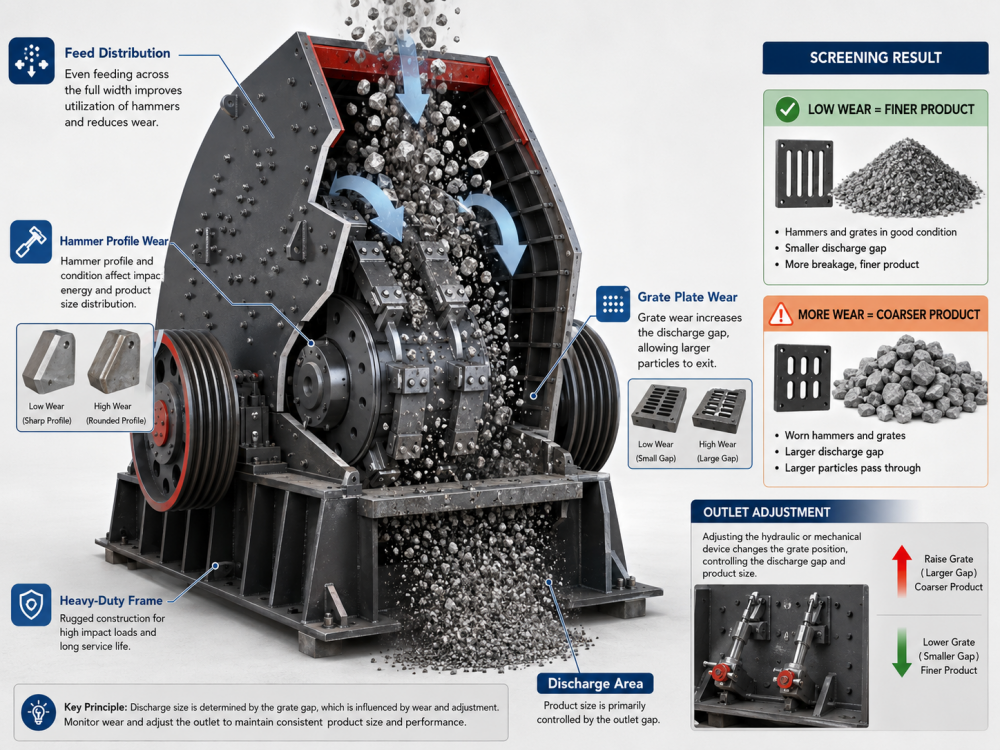
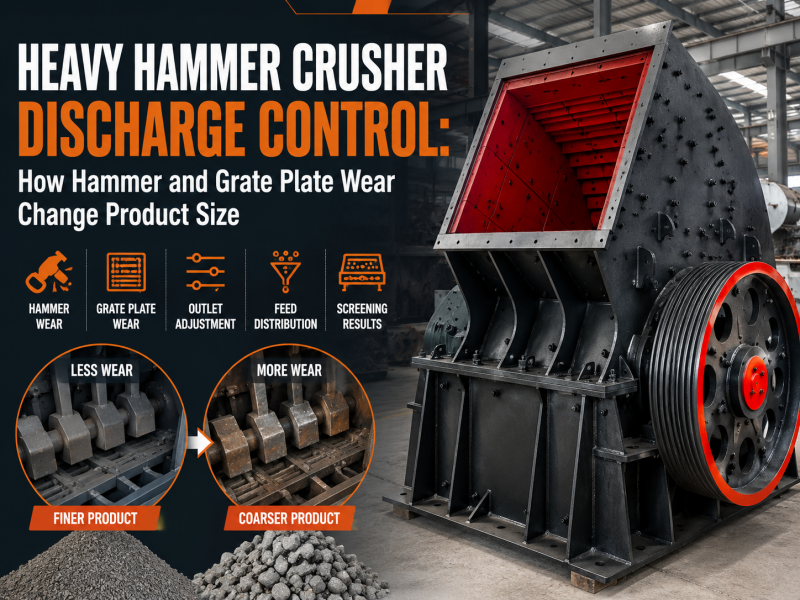
A heavy hammer crusher may continue to run with normal motor current and steady feeding while the finished material gradually becomes coarser. Total discharge may look acceptable, but the screen returns more oversize and the proportion of saleable product falls.
This change is easy to miss because wear develops gradually. Hammer faces lose their original profile, lower plate openings change, and feed may no longer cover the rotor evenly. The crusher keeps producing, but not the same size distribution.
Discharge control therefore requires more than adjusting one outlet gap. Hammer condition, lower plate condition, feed behavior, and screening results should be reviewed as one system.
The hammer head supplies the impact force that breaks the stone. Its working edge gradually becomes rounded, thinner, or unevenly worn. Before the final replacement limit, this profile change can already alter where and how the stone is hit.
As the effective hammer profile changes, some particles may receive weaker or less direct impact and leave at a coarser size. This becomes more visible with large feed or a high one-stage reduction duty.
Wear should not be judged only by operating days. Material abrasiveness, feed size, metal contamination, working hours, and feed distribution change the wear rate. Record hammer profile, remaining dimensions, fastening, and wear differences between positions.
If material enters mainly on one side, the hammers in that area do more work. Local wear develops faster, while other positions remain less worn. The crusher may then have different effective crushing conditions across the rotor width.
This can produce inconsistent discharge and complicate balancing after hammers are rotated or replaced. Follow the machine requirements for hammer position and weight matching, and check the complete set rather than one worn hammer.
Biased wear often begins outside the crushing chamber. A feeder discharging toward one side, a poorly aligned chute, or batch feeding by loader can concentrate the material. Correcting the feed path may extend the interval before the same pattern returns.
In a heavy hammer crusher, material smaller than the lower plate openings can discharge, while larger particles remain in the chamber for further impact. This means the sieve or grate plate is not a minor protective part. It is part of the product-size control system.
Several plate conditions create different symptoms:
1. Opening enlargement from wear can allow coarser particles to leave earlier.
2. Cracks or local damage can create sudden coarse pieces in the discharge.
3. Blocked openings reduce the effective discharge area.
4. Bent or loose sections can produce uneven flow and abnormal contact.
5. Different wear levels across the plate can create unstable product grading.
Blocked openings can cause the opposite problem from enlarged openings. Material remains in the chamber longer, which may increase repeated crushing and fine material while reducing real throughput. The machine may draw power and appear busy, but less qualified product reaches the stockpile.
Discharge adjustment is effective only while the working parts remain usable. A smaller gap cannot recreate a badly worn hammer profile or correct damaged and enlarged lower plate openings.
A smaller setting can reduce capacity or increase residence time. Before a large adjustment, confirm whether the change comes from wear, feed size, hardness, moisture, or screen performance.
Not every coarse discharge requires new hammers. Harder material, larger feed, uneven feeding, sticky material, or more fines can create a similar result.
The inspection should compare current material with the condition used when the machine produced stable results. Useful checks include maximum feed size, actual size distribution, moisture, clay, feed rate, and whether the feeding layer covers the rotor width evenly.
The downstream screen provides evidence about crusher condition. Gradually rising oversize may indicate hammer wear, plate-opening changes, or a feed shift. A sudden change may point to broken mesh, local plate damage, or an abrupt process change.
Screen results should be recorded by product fraction rather than described only as good or bad. If the same screen mesh and operating conditions remain in use, changes in each product percentage can help the team identify when the crusher discharge begins to drift.
Inspect the screen before blaming the crusher. Worn or blocked mesh can create an apparent crusher problem, so both machines should be checked together.
Product or process symptom | Possible cause | First inspection |
Oversize gradually increases | Hammer profile is worn or feed becomes coarser | Hammer working faces and feed-size record |
Sudden coarse pieces appear | Local grate plate damage or screen failure | Lower plate openings and screen mesh |
Fine material increases while capacity falls | Plate blockage or excessive repeated crushing | Effective discharge area and sticky material |
Wear is heavier on one side | Biased feeding or chute misalignment | Feeder discharge position and material layer |
Return material rises steadily | Crusher discharge and screen are no longer balanced | Product grading, plate condition, and screen performance |
Vibration changes after part replacement | Hammer weight or position is not balanced | Complete hammer set and fastening condition |
When product size changes, the site team can review the line in a consistent order:
1. Confirm the current raw material and maximum feed size.
2. Check whether feeding is continuous and centered across the inlet.
3. Record capacity, motor load, sound, and vibration trends.
4. Measure the current product grading and oversize return.
5. Inspect the downstream screen for blockage, wear, or broken mesh.
6. After safe shutdown, inspect hammer profiles and wear differences.
7. Inspect sieve or grate plate openings, fastening, cracks, and blockage.
8. Compare the findings with previous maintenance records before adjustment.
This order helps distinguish progressive wear from a sudden material or screening change.
A fixed replacement interval is not reliable for every site. Follow the equipment design, permitted wear, balance requirements, and actual product change.
Adjustment may be suitable when wear is limited and the working parts remain structurally sound. Some hammer designs may allow rotation or position changes, but this should follow the machine instructions and weight-matching requirements. A damaged, cracked, excessively worn, or badly unbalanced component should not remain in service only because the crusher can still turn.
Repair or replace the lower plate when enlarged openings, deformation, cracks, or loose fastening prevent stable discharge. Prepare critical hammers, plates, fasteners, and screen mesh before shutdown.
1. Heavy hammer crusher model and current operating configuration.
2. Raw material name, photos, and approximate hardness or abrasiveness.
3. Maximum and typical feed size.
4. Daily working hours and recent maintenance history.
5. Required discharge sizes and current product grading.
6. Photos of all hammer working faces, not only one hammer.
7. Photos of the complete sieve or grate plate area.
8. Capacity, motor-load, vibration, and sound changes.
9. Vibrating screen mesh sizes and current oversize return.
10. Whether feed enters evenly across the crusher width.
The hammer provides impact, the lower plate controls discharge, the feeder affects wear distribution, and the screen shows whether the product still meets the target.
A heavy hammer crusher can continue operating after its product distribution has started to change. For this reason, maintenance should not wait for a complete failure. Product grading, return material, hammer profile, lower plate condition, and feed distribution should be tracked together.
Sentai Machinery can review these conditions according to the crusher model, raw material, feed size, required product, operating hours, hammer photos, plate condition, and screening results. This provides a more useful basis for adjustment and wear-part planning than judging the crusher by motor operation alone.
1. Impact Crusher vs Heavy Hammer Crusher for Limestone: Which One Makes More Sense?
2. Limestone, Granite, or River Stone: How Raw Material Changes Crushing Process Design
3. A Practical Field Guide to Reducing Downtime in a Stone Crushing Plant
4. How to Match Jaw Crusher and Vibrating Screen in a Stone Crushing Plant
5. What Determines Finished Aggregate Shape in an Impact Crushing Process




 WhatsApp
 Email
Email
 +86 15538010601